
AI-Generated Content vs Human Content: Which Performs Better?
Every team that creates content has had some version of this discussion in the two years: should we let AI write this or does it need a human? This is not a question anymore. AI tools can create a blog post in a few minutes but search engines, readers and even AI helpers are becoming better at seeing the difference between content that is truly helpful and content that is just empty words.
So here is the real question this article answers: does content created by AI actually work well as content written by people?
The quick answer is: it depends less on who or what wrote it and more on whether the content’s correct, helpful, new and honest. AI-written content can do well when it is researched checked for facts and edited carefully. Content written by people can do badly when it is done fast vague or not optimized well. Success depends on the quality and purpose. Not who wrote it.
Let’s look at what that means for your plan, for creating content.
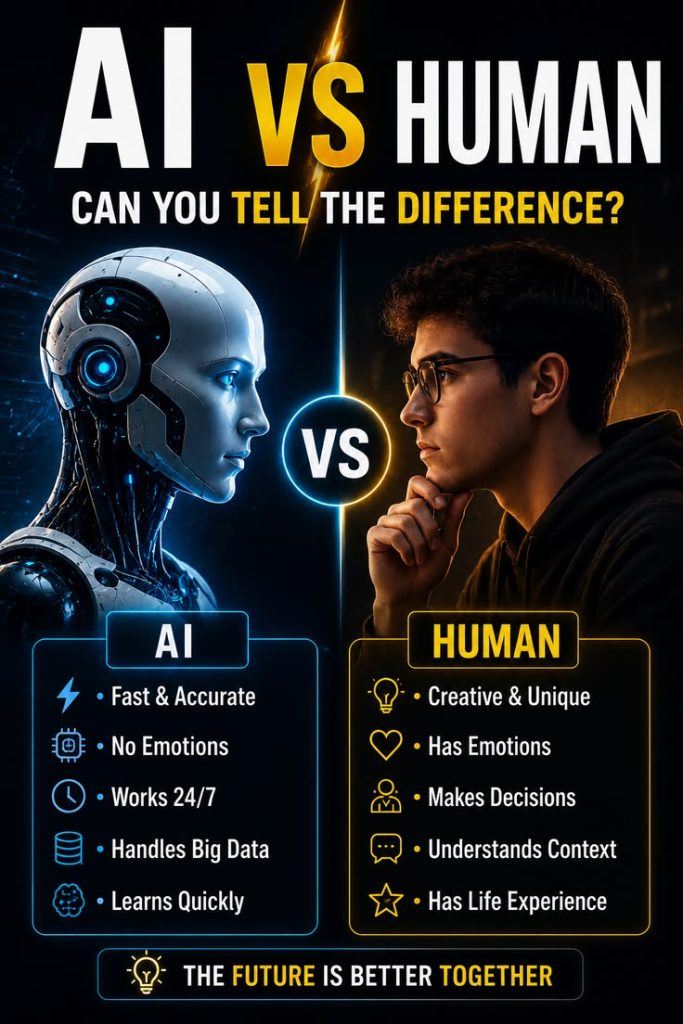
What Is AI-Generated Content?
AI-generated content is content that is made using intelligence tools. These tools use language models to create text based on a prompt, an outline or information that is already available. Examples include blog posts, product descriptions, social media captions, email messages and even full articles.
Most companies today do not publish content that is created by AI without any changes. Instead AI helps in some part of the process. It can be used to:
- Write a draft of an article
- Create outlines or content briefs
- Summarize research or long documentsMake different versions of ad copy or meta descriptions
- Turn one piece of content into several different formats
The quality of the content that is made by AI depends a lot on the prompt that is given. It also depends on the data the AI was trained on and how much a person checks and edits the output. Content that is published without any editing often sounds generic. That is because the AI is not experiencing life. It is just predicting what words are likely to come based on patterns, in the data.
Can AI-Generated Content Rank on Google?
Yes. Content that is created with the help of intelligence or is entirely created by artificial intelligence can show up in search results when it offers real value and follows the standards that search engines look for. Googles own instructions have focused on giving credit to content that’s useful and made with people in mind and they have said it does not matter how the content is made. What matters is if it is useful and trustworthy. For the up-to-date and accurate information on this topic go directly to Google Search Central as the advice can change over time.
That being said, being ranked is one part of the situation. Ranking puts content in front of people. Whether people stay, trust it and become customers depends on the quality of the content they see. Which brings us back to the standards, for editing, not who wrote it.
Why Human Content Can Still Have an Advantage
With strong AI tools there are areas where human involvement tends to matter most. Keep in mind: these advantages depend on the writer and the editorial process not on being human.
- First-Hand Experience. Someone who has actually used a product run an event. Lived through a situation can describe details AI simply doesn’t have. A real experience brings texture, small truths and authentic details that no dataset can replicate.
- Original Insights. A new angle or opinion not a synthesis of existing content. It’s about seeing something others miss offering a perspective that wasn’t just pulled from the web.
Expert Judgment. Knowing which advice actually applies to a situation. This isn’t about information but about knowing when to apply it and when to hold back.
- Emotional Intelligence. Reading what an audience needs emotionally not informationally. A human writer can sense the mood in the room the unspoken concerns and respond accordingly.
- Storytelling. Structuring a narrative that builds and pays off. It’s about pacing, tension, surprise and meaning. Things that make readers feel something.
- Brand Personality. Writing that sounds like this company, not a voice. A human writer absorbs the tone, the values, the rhythm of the brand over time.
- Nuance. Understanding when a rule has exceptions. It’s about knowing that not every situation fits the template and knowing why.
- Fact-Checking. Catching errors AI tools can introduce with confidence. A human can spot the inconsistencies that make the difference between right and wrong.
- Audience Understanding. Knowing what this specific reader already knows and needs next. It’s about listening, not just speaking. It’s about meeting people where they’re
- Strategic Decision-Making. Deciding what content should even exist and why. Not every topic deserves a post. Not every idea should be written. This is, about purpose not output.
Where AI-Generated Content Has an Advantage
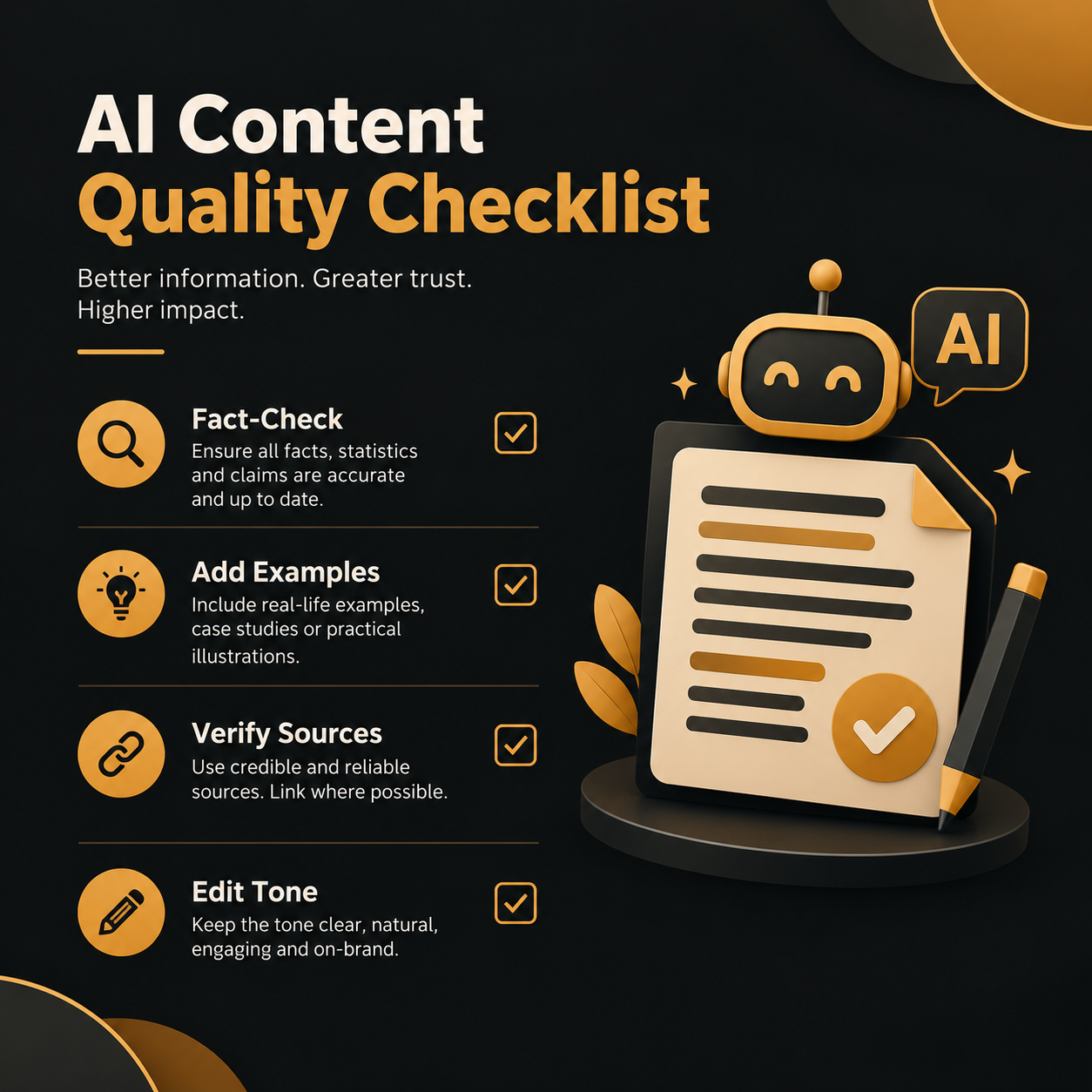
AI tools truly work well in parts of the content process.
- Speed. They can produce drafts faster than someone writing by hand.
- Ideation. They help come up with angles, headlines and topic ideas quickly.
- Outlining. They assist in organizing an article before the writing starts.
- Research assistance. They can summarize documents or large data sets efficiently.
- Content repurposing. They turn one piece of content into media posts, emails or scripts.
- Drafting. They create a version that a human writer can improve.
- Scaling workflows. They support managing content calendars easily.
- Summarization. They shorten articles into shorter versions.
- Brainstorming. They offer options for a writer to consider.
- SEO briefs. They build outlines based on target keywords.
- Meta descriptions and variations. They generate copy variations, for testing.
When used this way AI acts as a productivity layer. It doesn’t take the place of judgment.
Where AI-Generated Content Can Struggle
Left unsupervised AI content tends to run into problems:
- Generic forgettable writing
- Repetitive phrasing and sentence patterns
- No first-hand experience to draw on
- Contextual or nuanced errors
- Hallucinated facts, stats or quotes
- Outdated information if the model wasn’t updated recently
- Weak or absent original opinions
- Predictable, formulaic structure
- Little authentic brand personality
- Poor differentiation from competitor content
- Insufficient fact-checking if published as-is
Most of these are fixable with a solid editorial process. Research, verification and a real edit pass, before publishing.
Where Human-Written Content Can Struggle
Human-written content comes with its set of real limitations.
- It takes longer to produce each piece.
- The cost, per item is higher compared to automated solutions.
- Quality can vary a lot depending on the writer.
- When trying to stay objective personal bias often shows up in the writing.
- There are research limits when deadlines are tight and time is short.
- Writers can get tired when they have to write the type of content over and over—like product descriptions or listings.
- Scaling to hundreds of pages becomes a challenge.
- Without SEO knowledge important opportunities can be missed.
- Publishing schedules become unpredictable if you depend on a few writers.
- That’s why more teams are choosing an approach. They don’t go in on one method. Instead they mix input with automated tools to get the best results.
AI vs Human Performance by Content Type
There’s no one-size-fits-all answer. The best method depends on the type of content you’re creating.
For Blog Articles a hybrid approach works best. AI can handle the draft and outline but a human writer brings in real expertise, practical examples and a personal voice that readers connect with.
When it comes to Product Descriptions AI is great for handling volumes quickly. It can churn out copy across thousands of items.. A human must set the tone and check for accuracy to make sure everything stays on brand.
For Social Media Posts AI helps by generating variations and testing different styles.. A human must review the output to keep the brand voice clear, consistent and on point.
In Email Marketing, a hybrid method makes sense. AI can draft lines and organize the flow of the message.. The human writer owns the persuasive angle, personalization and emotional pull that turns clicks into conversions.
Technical Content needs a hand from start to finish. Accuracy and precision are non-negotiable. AI might help with formatting or organizing. The core content must come from someone with real subject-matter knowledge.
Thought Leadership content should be entirely human-created. This is where original ideas, opinions and credibility make the difference. AI can’t replicate the depth of experience or the confidence that comes from insight.
Case Studies are another area where humans lead. These rely on results, interviews, customer stories and detailed facts. AI doesn’t have access to those experiences so the human writer is essential to bring the story to life.
For Industry Research the human takes the lead in interpretation and analysis. AI can assist by pulling together data summarizing trends and formatting reports. The big-picture understanding and critical thinking must come from a person.
When covering News or Current Events human oversight is vital. The speed of breaking stories can’t come at the cost of accuracy. A human should verify facts assess implications and manage any legal or reputational risks.
Brand Storytelling is a only domain. This is about personality, emotion and building trust. AI can help with structure. Even draft phrases, but the soul of the story. The voice, the heartbeat. Must come from a real person.
For SEO Landing Pages a hybrid model works well. AI can help structure content, around search intent and keywords.. A human must refine the copy to ensure it converts speaks to the audience and reflects the brand’s promise.
In Ad Copy a hybrid approach delivers the results. AI can generate versions quickly allowing for testing.. The human writer selects the best options and refines them to truly persuade, resonate and drive action.
Why the Future of Content May Be Human + AI
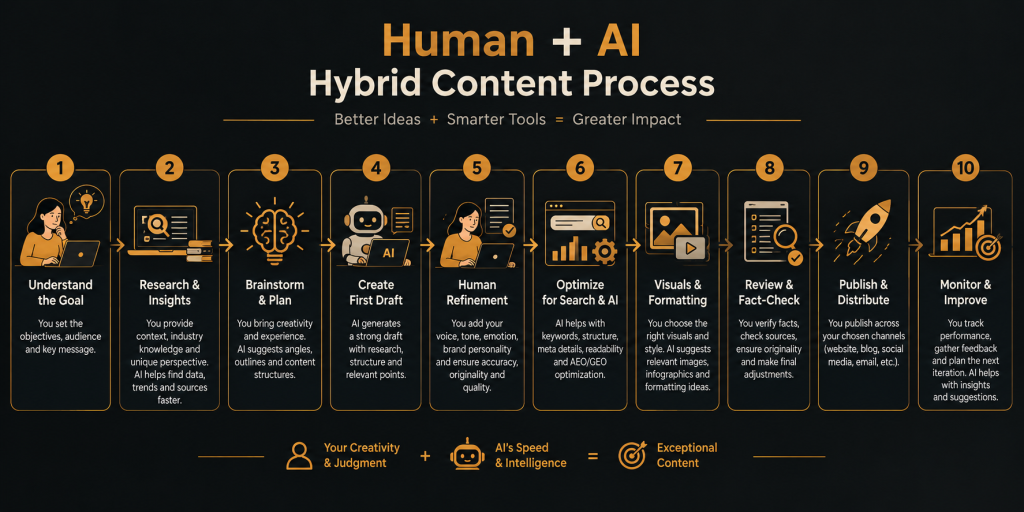
Of thinking of AI as a competitor most top content teams are using it as a tool, within a process led by humans. A real-world workflow might go like this:
- A sets the strategy. Deciding on the topic, purpose, target audience and what people are searching for.
- AI helps with research and idea generation. Pulling together angles and organizing information.
- A human checks the facts. Making sure everything is correct and relevant.
- AI steps in to help write or reorganize. Creating a draft that’s ready to build on.
- A human adds their knowledge, real-life examples, personal insights and unique tone. Things that only a person can create.
- An expert reviews the content for accuracy. Verifying all claims, numbers and sources.
- SEO optimization happens. Matching keywords and search intent to improve visibility.
- AEO optimization takes place. Shaping content so it answers questions clearly for answer engines.
- GEO optimization occurs. Formatting content in a way that AI systems can understand and reference easily.
- Finally a human does an editorial review. Making sure everything is polished and ready to publish.
It can be, as long as it’s accurate, useful, and reviewed by someone with real expertise. Raw, unedited AI output tends to underperform because it lacks depth and originality, not because search engines specifically penalize AI.
AI can be a strong starting point for drafts, outlines, and research. Businesses should pair it with human review, fact-checking, and original insight before publishing.
Common issues include generic phrasing, factual errors, outdated information, weak original opinions, and a lack of first-hand experience — all of which a solid editing process can reduce.
Yes. A hybrid workflow — AI for drafting, research, and structure; humans for judgment, experience, and final review — is becoming the standard approach for high-performing content teams.
Add real examples, first-hand details, a clear point of view, and varied sentence structure. Editing for specificity and cutting generic phrasing both help significantly.
Technical content, case studies, news, thought leadership, and anything involving factual claims, data, or expert advice should always go through human review before publishing.
Conclusion
Generated content and human content aren’t in a race with one side always coming out on top. What matters most is how well the content performs based on needs. That includes usefulness matching what people are searching for being original showing expertise drawing from experience, building trust fitting the audience and having good editorial quality. It doesn’t come down to who wrote it. Whether it was an AI or a person.
AI helps fast. It scales easily. Supports research.. Humans bring judgment lived experience, true originality and trustworthiness. The best content strategies, in 2026 will not see AI as a replacement or a rival. Instead they’ll use AI as a tool that backs up knowledge and skill. It’s not about which’s better. It’s about using both in the way.