
Why Your Content Gets Traffic but No Leads—and How to Fix It
Traffic is an attention metric. Leads are a business outcome. Here is how to bridge the gap.
Introduction
You publish blog posts consistently. Google Search Console shows impressions and clicks climbing. Analytics reports thousands of visitors each month. But the contact form stays quiet. No inquiries. No demo requests. No consultation bookings.
This is one of the most common frustrations in content marketing, and it is rarely a traffic problem. It is a conversion problem. The average B2B website turns just 1.5% of visitors into leads, while top performers reach 8% to 15%. That gap is not about getting more people to your site. It is about what happens after they arrive.
In 2026, the stakes are higher. Roughly two-thirds of Google searches now end without a click, and on searches where AI Overviews appear, organic click-through rates have dropped by approximately 61% (Seer Interactive, 2026). The visitors who do reach your site are fewer, and they are far more serious. Every friction point on your page now costs you more than it did a year ago.
This article will walk you through exactly why content gets traffic but no leads, and what you can change to turn that traffic into qualified business opportunities. You will learn how to diagnose the problem, fix the conversion path, and build a content system that supports the entire customer journey.
Why Does My Content Get Traffic but No Leads?
Traffic often fails to generate leads because of a mismatch between what visitors need and what your content offers. Common causes include targeting informational search intent instead of commercial intent, attracting visitors who are not your ideal customers, missing or weak calls to action, poor content-to-offer alignment, weak landing pages, lack of trust signals, and not measuring the right metrics. The fix is not more traffic. It is building a clear conversion path that guides the right visitors toward a meaningful next step.
Traffic vs. Leads: What's the Difference?
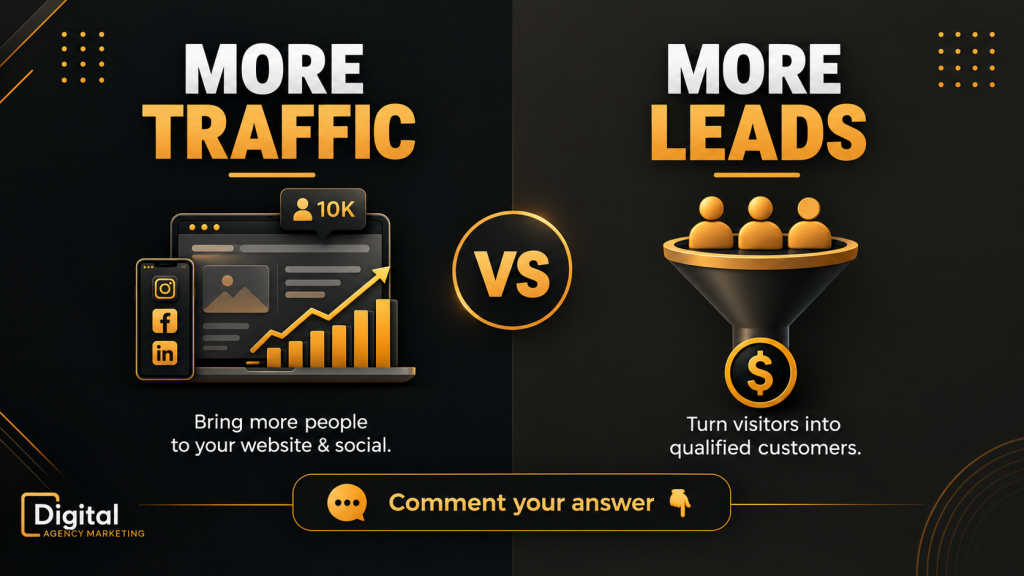
Traffic is the number of people who visit your website. It tells you how many people found you, but it does not tell you whether they care about what you offer.
Engagement is what people do on your site: how long they stay, which pages they read, how far they scroll. Engagement is a sign of interest, but it is still not a business outcome.
Leads are people who take a meaningful action that allows your business to continue the conversation. A lead is a form submission, a consultation request, a demo booking, a phone call, a newsletter signup, a download, a quote request, or a trial registration.
High traffic does not automatically mean high commercial value. A blog post about “what is digital marketing” might attract thousands of readers who are simply curious. A comparison page about “best CRM for small business” might attract far fewer visitors, but those visitors are actively evaluating solutions and are much closer to making a purchase decision.
The goal is not to maximize traffic. The goal is to attract the right traffic and guide it toward a conversion.
Why Content Gets Traffic but No Leads: 12 Root Causes
1. You're Targeting the Wrong Search Intent
Search intent falls into four categories: informational, navigational, commercial investigation, and transactional. Someone searching “what is SEO” has informational intent. They want to learn. Someone searching “SEO agency for small business” has commercial investigation intent. They are comparing providers and are much closer to making a decision.
Many businesses prioritize high-volume informational keywords because they generate more traffic. But informational traffic rarely converts into leads. In one analysis of top-performing content, over 70% of the pages had informational intent, and less than 8% had commercial or transactional intent. Those pages had visibility, but they were not built to generate business opportunities.
The fix is not to abandon informational content. It is to create content for every stage of the buyer journey, and to ensure that informational content includes a clear path toward commercial pages.
2. You're Attracting Visitors Who Are Not Your Ideal Customers
There is a difference between traffic volume, relevant traffic, and qualified traffic. Volume is how many people visit. Relevant traffic is people who are interested in your topic. Qualified traffic is people who match your ideal customer profile and have the potential to become paying customers.
Viral or broad content can generate large amounts of traffic without generating any business opportunities. A blog post that appeals to students, hobbyists, or people outside your target market will never convert into leads, no matter how well it ranks.
Before optimizing for traffic, define your ideal customer profile. What problems do they have? What questions are they asking? What solutions are they actively evaluating? Create content that speaks directly to those people, not to the widest possible audience.
3. Your Content Answers the Question but Gives No Next Step
A reader finishes your article and thinks, “That was helpful. Now what?” If the answer is not obvious, they leave. They do not search your site for a service page. They do not hunt for a contact form. They move on.
Every piece of content should have a clear next step. That might be a relevant CTA, an internal link to a deeper guide, a related resource, a lead magnet, a service page, or a consultation offer. The reader should never have to guess what to do next.
Content journeys work best when they feel natural. A post about “how to improve Instagram engagement” can lead to a free content planning template. A template download can lead to a guide on social media strategy. A strategy guide can lead to a consultation offer.
4. Your CTA Is Weak or Missing
Generic CTAs like “Contact Us” or “Learn More” do not give readers a reason to click. They do not communicate value. They do not create urgency. They do not tell the reader what they will get.
Contextual CTAs perform better. Instead of “Contact Us,” try “Get a Free SEO Audit.” Instead of “Learn More,” try “Download the Content Planning Template.” Instead of “Submit,” try “Send Me the Checklist.”
The best CTA depends on the content type. A how-to blog post might offer a downloadable checklist. A case study might offer a consultation. A comparison guide might offer a demo. Match the CTA to the reader’s stage in the journey.
5. Your Offer Does Not Match the Content
Content-offer alignment is one of the most overlooked conversion factors. If someone reads a blog post about “how to improve Instagram engagement,” a relevant offer is a downloadable Instagram content planning template. A less relevant offer is a full digital transformation consultation. The second offer might be valuable, but it does not match the reader’s immediate need.
When the offer matches the content, conversion rates improve because the reader sees a logical next step. When the offer is disconnected, the reader feels like they are being pushed toward a sales pitch instead of being helped.
6. You're Creating Content for the Awareness Stage Only
The marketing funnel has three main stages: awareness, consideration, and decision. Awareness content helps people discover a problem. Consideration content helps them evaluate solutions. Decision content helps them choose a provider.
Most blogs are filled with awareness content. They explain concepts, answer basic questions, and teach fundamentals. That content is valuable, but it rarely generates leads on its own because the reader is not yet ready to buy.
Consideration content might include comparison guides, case studies, and “best tools” lists. Decision content might include pricing pages, demo requests, and consultation offers. A healthy content strategy includes all three stages. The consideration stage is often where the biggest gaps exist.
7. Your Landing Page Is Losing the Lead
Even if your content does its job, the landing page can lose the lead. Common problems include slow loading times, weak headlines, too much information, confusing navigation, weak social proof, poor mobile experience, long forms, no clear value proposition, and CTA mismatch.
Google data shows that 53% of mobile users abandon a page that takes over three seconds to load. A one-second delay in page load time can reduce conversions by up to 7%. Those numbers matter because every second of friction is a lost opportunity.
Content and landing pages must work together. The landing page should deliver exactly what the content promised. If the content offered a free template, the landing page should show the template and a simple form to get it. No detours. No distractions.
8. Your Content Doesn't Build Enough Trust
Trust is the currency of conversion. Visitors will not share their contact information or request a consultation if they do not believe you are credible. Trust signals include author expertise, original insights, case studies, examples, reviews, testimonials, data, credentials, transparent explanations, and first-hand experience.
Google’s people-first content principles emphasize experience, expertise, authoritativeness, and trustworthiness. Content that demonstrates first-hand experience and provides genuine value performs better in search and converts better on the page.
9. Your Internal Linking Strategy Is Weak
Internal links move readers from informational content toward commercially relevant pages. They also help search engines understand the relationship between your pages. A blog post that ranks for “how to improve SEO” should link to a guide on “SEO strategy for small business,” which should link to an “SEO services” page, which should link to a consultation booking page.
Without internal links, readers are stranded. They finish one article and have nowhere to go. With internal links, they move naturally through a content journey that ends with a conversion opportunity.
10. You're Not Measuring the Right Metrics
Pageviews alone are insufficient. They tell you how many people visited, but they do not tell you whether those visits led to anything useful. The metrics that matter depend on your business model, but they often include engaged sessions, engagement rate, conversion rate, form submissions, CTA clicks, lead quality, assisted conversions, landing-page conversion rate, organic conversions, and revenue influenced by content.
Tracking the wrong metrics leads to wrong decisions. If you only track traffic, you will keep investing in content that attracts visitors but does not generate leads. If you track conversion rate by content type, you will see which pages are actually driving business results.
11. Your Content Has Traffic but Poor UX
User experience affects conversion. Mobile experience, page speed, readability, intrusive pop-ups, confusing navigation, poor visual hierarchy, and misplaced CTAs all create friction. Visitors decide within seconds whether to stay or leave. A visitor judges your site in about 50 milliseconds.
A clean, fast, mobile-friendly page with clear structure and a single primary CTA will always outperform a cluttered, slow page with competing calls to action.
12. You Are Not Updating Content Based on User Behavior
Content is not a publish-and-forget activity. Analytics and search data can reveal pages with high traffic but low conversion, queries that generate traffic, CTA click behavior, exit patterns, content gaps, and high-performing sections. That data tells you where to focus your improvement efforts.
Regularly review high-traffic pages. Ask: Is this page attracting the right audience? Does it have a clear next step? Is the CTA relevant? Does the landing page deliver on the promise? Update, optimize, and test.
The Traffic-to-Lead Diagnostic Framework
Use this framework to audit your own website. Work through each row, identify the warning signs, and apply the fix.
| Problem | What to Check | Warning Sign | What to Fix |
|---|---|---|---|
| Wrong search intent | Compare target keyword to page content | High impressions, low clicks, low conversions | Create content for each funnel stage |
| Unqualified audience | Review visitor demographics and search queries | Traffic from unrelated industries or regions | Refine keywords and audience targeting |
| No clear next step | Check for CTAs and internal links in content | High bounce rate, low pages per session | Add contextual CTAs and internal links |
| Weak CTA | Review CTA copy and placement | Low CTA click-through rate | Use benefit-driven, specific CTA text |
| Offer-content mismatch | Compare content topic to offer | Low lead magnet opt-in rate | Create a content upgrade that matches the topic |
| Awareness-only content | Audit content by funnel stage | No comparison pages or case studies | Add consideration and decision content |
| Poor landing page | Test page speed, mobile experience, form length | High exit rate on landing page | Simplify form, improve headline, add social proof |
| Missing trust signals | Check for testimonials, case studies, author bios | Low conversion on high-intent pages | Add proof, credentials, and original insights |
| Weak internal linking | Map links from blog to service pages | Blog pages have no links to commercial pages | Add contextual internal links |
| Wrong metrics | Review analytics goals and conversion tracking | Only tracking pageviews | Track conversions, CTA clicks, lead quality |
Match Your Content to Search Intent
Use this table to align content type and CTA with the searcher’s intent.
| Search Intent | Example Query | Best Content Type | Appropriate CTA |
|---|---|---|---|
| Informational | What is SEO? | Explainer blog post | Download SEO checklist |
| Commercial Investigation | Best SEO agency for small business | Comparison guide | Get a free audit |
| Transactional | SEO services pricing | Pricing page | Book a consultation |
| Navigational | HubSpot login | Homepage or login page | No CTA needed |
How to Turn an Existing High-Traffic Blog Into a Lead Generator
You do not need to start over. You can transform existing content into a lead generation asset. Follow these steps.
Step 1: Identify high-traffic pages. Open Google Analytics or your analytics platform. Sort pages by sessions and find the pages that receive the most organic traffic.
Step 2: Analyze the queries bringing visitors. Use Google Search Console to see which queries drive traffic to each page. Understand what visitors are looking for.
Step 3: Check whether the audience matches your ICP. Compare the search queries and visitor behavior to your ideal customer profile. If the audience is not a fit, consider creating a new page for the right audience.
Step 4: Identify the user’s next logical problem. After reading the article, what will the reader want to know next? That is your opportunity for a relevant CTA or internal link.
Step 5: Add a relevant content upgrade. Create a downloadable checklist, template, calculator, or guide that directly extends the article. Offer it in exchange for an email address.
Step 6: Improve CTA placement. Place CTAs at natural stopping points: after a key insight, at the end of a section, and at the conclusion. Test different placements.
Step 7: Add contextual internal links. Link from the blog post to related guides, service pages, and conversion pages. Use descriptive anchor text.
Step 8: Strengthen trust signals. Add author bios, credentials, case studies, and testimonials to the page. Show readers that you are credible.
Step 9: Improve the destination landing page. Ensure the landing page delivers exactly what the CTA promised. Simplify the form. Improve the headline. Add social proof.
Step 10: Track conversions and iterate. Set up conversion tracking for the CTA and the landing page. Measure results. Test changes. Improve continuously.
Content-to-Conversion Example
Consider a digital marketing agency that receives 10,000 monthly visits from SEO content but only a few inquiries. This is a hypothetical example, but the pattern is common.
Before: Traffic arrives on blog posts about general marketing topics. Readers read, then leave. There is no clear next step, no relevant offer, and no internal link to service pages. The journey ends at the blog.
After: The agency adds a relevant lead magnet to each high-traffic post. A post about “local SEO” offers a “Local SEO Checklist.” A post about “content marketing” offers a “Content Calendar Template.” Each post includes internal links to the agency’s SEO services page. The services page links to a consultation booking page. The journey becomes: Traffic → Helpful Article → Relevant Resource → Service Page → Lead Form.
The transformation is not about more traffic. It is about creating a clear path from attention to action.
CTA Examples That Fit Different Content Types
Use these examples as starting points. Adapt them to your audience and offer.
SEO blogs: “Download the 27-Point On-Page SEO Checklist”
Social media blogs: “Get the Instagram Content Planning Template”
Google Ads blogs: “Request a Free Google Ads Audit”
Email marketing blogs: “Grab the 12 Email Subject Line Swipe File”
Content marketing blogs: “Download the Content Strategy Workbook”
E-commerce blogs: “Get the Product Page Optimization Guide”
B2B blogs: “Book a 15-Minute Strategy Call”
Local business blogs: “Schedule Your Free Consultation”
Lead Magnets That Can Turn Content Traffic Into Leads
A lead magnet should solve a specific problem for your reader. Here are ten ideas and the article types they work best with.
1. Checklists — Work best with how-to and process articles. Quick to consume, easy to act on.
2. Templates — Work best with planning and strategy articles. Readers want something they can use immediately.
3. Calculators — Work best with pricing, ROI, and budgeting articles. Interactive tools engage readers.
4. Audit sheets — Work best with optimization and troubleshooting articles. Readers want to assess their own situation.
5. Guides — Work best with in-depth educational articles. Position them as the next step after a blog post.
6. Swipe files — Work best with copywriting and creative articles. Give readers examples they can model.
7. Content calendars — Work best with social media and content strategy articles. Help readers plan their own content.
8. Case studies — Work best with problem-solution articles. Show how others solved the same problem.
9. Toolkits — Work best with comprehensive topic hubs. Bundle multiple resources into one download.
10. Free assessments — Work best with diagnostic and audit articles. Give readers a personalized score or recommendation.
The Content Conversion Funnel
Search Query → Search Result → Blog Article → Engagement → Relevant CTA → Lead Magnet / Service Page → Lead Form → Qualified Lead → Sales Conversation
Each stage has a job. The search query tells you what the visitor wants. The blog article answers their question. The CTA gives them a next step. The lead magnet or service page provides value. The form captures their information. The sales conversation turns a lead into a customer.
If any stage is missing or weak, the funnel breaks. Most websites have strong search queries and blog articles, but weak CTAs, irrelevant offers, or broken landing pages.
SEO + Conversion Should Work Together
SEO should not be treated only as a traffic-generation activity. Rankings and organic sessions matter, but they are means, not ends. The goal is to attract the right people and help them take the right next step.
When SEO and conversion work together, content serves the business. It ranks, it engages, and it converts. When they work separately, you get traffic without leads.
This does not mean every page needs a hard sell. It means every page should have a purpose. Awareness pages can offer lead magnets. Consideration pages can offer comparison guides. Decision pages can offer demos and consultations.
Conclusion
More traffic is not automatically the goal. The goal is attracting the right people and helping them take the right next step.
Content should be evaluated based on its ability to support the customer journey and contribute to meaningful business outcomes. Pageviews are a diagnostic metric, not a business metric. Leads, pipeline, and revenue are what matter.
If your content gets traffic but no leads, the problem is almost always fixable. Audit your highest-traffic pages. Check search intent. Add relevant offers. Improve CTAs. Strengthen trust signals. Track conversions. Small changes can produce meaningful results.
If you would like help turning your content into a lead generation engine, our team can help. We build content strategies that attract qualified traffic and convert it into business opportunities.
No. Traffic can still create brand awareness, returning visitors, and future customers. However, if traffic consistently produces no meaningful actions, you should evaluate the quality, intent, and conversion path of that traffic.
Look at metrics such as search queries, traffic sources, engagement, landing pages, location, and conversion behavior. If visitors are searching for information unrelated to your products or services, your content may be ranking for the wrong intent.
Your content may answer their question without giving them a compelling reason to take the next step. Add relevant CTAs, demonstrate your expertise, address objections, provide proof, and make contacting you easy.
Not necessarily the same CTA. Match the CTA to the reader’s stage in the buying journey. Educational content may work better with a guide or newsletter, while solution-focused content may be better suited to a consultation or product demo.
People are more likely to submit their information or contact a business when they trust it. Case studies, testimonials, reviews, credentials, transparent information, original insights, and evidence can strengthen credibility.
You need both, but qualified traffic and meaningful conversions are more valuable than traffic volume alone. A smaller audience with strong purchase intent can generate more revenue than thousands of visitors with little commercial interest.