
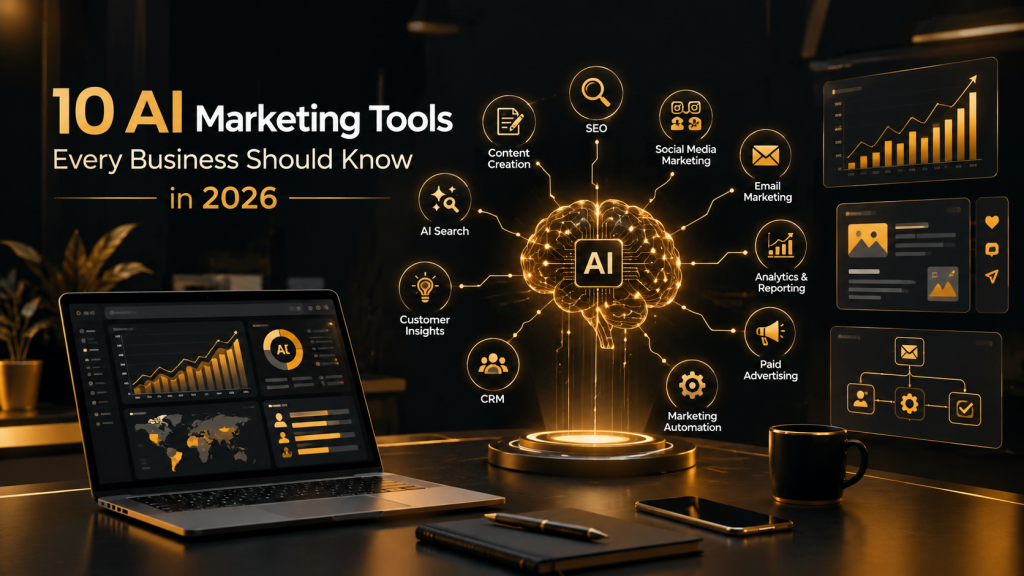
10 AI Marketing Tools Every Business Should Know in 2026
10 AI Marketing Tools Every Business Should Know in 2026 Month a client asked me why her three‑person team was suddenly producing more than agencies five times larger. The honest answer was not talent or budget. She stopped seeing AI as a novelty. Began using AI as infrastructure just like she uses her CRM or her accounting software. This shift is happening in businesses, startups and marketing departments all over right now. It is why the discussion about AI marketing tools has changed from “should we try this?” to “which AI marketing toolsre actually worth our time?” In 2026 there are hundreds of AI marketing tools. Most of them promise to save time grow traffic or “transform” your strategy. Few of them explain what they are not good, at who should not buy them or how they fit with the tools you already use. This guide does that. We have narrowed the field to 10 AI marketing tools that cover practical needs—content, SEO, design, social, email, video, advertising and customer engagement—so you can build a stack that fits your business instead of chasing every new release. In 2026 the best AI marketing tools are not all-in-one solutions. They each focus on one challenge. Jasper is great for creating amounts of content fast. Surfer SEO and Semrushs AI features help with on-page SEO and getting search visibility. HubSpot’s Breeze AI takes care of marketing automation and CRM tasks. Canva’s Magic Studio makes design work easy by generating graphics. Sprout Social manages social media publishing. Tracks what people say online. Klaviyo uses AI to improve email and SMS messages, for ecommerce brands. Descript helps with editing videos using tools. Google Ads’ AI Max and Performance Max make paid ad campaigns run automatically. Fin, which used to be called Intercom handles customer conversations with AI. Most companies don’t need all these tools. Three or four of them are usually enough to make a change. What Are AI Marketing Tools? AI marketing tools are software platforms that use intelligence – that includes machine learning, generative AI, natural language processing and predictive analytics – to help businesses plan, create, share and measure marketing activity while reducing manual effort. In practice that breaks down into a core capabilities: AI marketing tools use generative AI to draft text, images and video from a prompt giving marketers a clear starting point instead of a blank page. AI marketing tools use machine learning to find patterns in customer or campaign data that would take a human analyst far longer to spot. AI marketing tools use natural language processing (NLP) to let tools understand and respond to written or spoken language, which powers AI chatbots and content assistants. AI marketing tools use predictive analytics to forecast outcomes – for example which subject line will get opened, which ad creative will fatigue first and which customer is about to churn. AI marketing tools automate repetitive rules‑based parts of a workflow such as sending a follow‑up email tagging a lead or scheduling a post removing those tasks from a person’s plate. None of this replaces marketing judgment. AI marketing tools remove friction from the parts of the job that do not need insight so the humans, on your team can spend more time on strategy, positioning and the creative decisions that actually move a brand forward. Why Are AI Marketing Tools Important for Businesses in 2026? A years ago AI in marketing mainly helped people write faster. That is still true. Ai in marketing is no longer just about speed. This is what has really changed for businesses: Time savings on work. Drafting captions, summarizing performance reports or tagging inbound leads used to take hours every week. AI in marketing compresses that into minutes. Faster content production. Teams can move from idea to published asset in a day of a week. AI in marketing matters when businesses compete for attention on channels that reward frequency. Better personalization at scale. Email and ad platforms can now tailor messaging to behavior instead of broad segments and no data science team is required to build it. Sharper campaign optimization. Predictive bidding and creative testing tools adjust budgets. Messaging in near real time. No human could track dozens of ad sets manually. Accessible data analysis. Marketers can ask a plain‑language question about performance data. Receive an answer instead of waiting for a BI team or building a dashboard from scratch. AI search visibility. As more consumers research through AI Overviews, Chat GPT and Perplexity of traditional search results businesses need tools that help their content get cited and recommended by these systems. Not just ranked on a results page. The limitations matter as much. AI-generated content still needs review for accuracy brand voice and nuance. Predictive models are only as good as the data feeding them so a business with CRM data or thin traffic history will receive less reliable output.. Over‑automating customer‑facing communication without oversight can damage trust faster than it builds efficiency. The businesses that get the most out of AI in 2026 treat AI as a boost for their team, not a replacement, for one. 10 AI Marketing Tools Every Business Should Know in 2026 1. Jasper Jasper is an AI writing tool that is made for marketing teams not for general writing.Jasper can learn from a companys existing voice, tone and previous articles so that the output does not feel generic like a Chat GPT prompt. Marketing teams use Jasper to write drafts of blog posts ad copy, product descriptions email campaigns and social captions. After that they edit the text for correctness and brand fit. Jasper does not replace a copywriter. Its real value lies in solving the blank-page problem and helping a small content team match a publishing schedule. features – Training for brand voice using existing content – Templates for common marketing formats such as ads, emails and landing pages – Team collaboration and approval steps – Links with SEO and campaign tools – Creating content in multiple