Uncategorized

Uncategorized

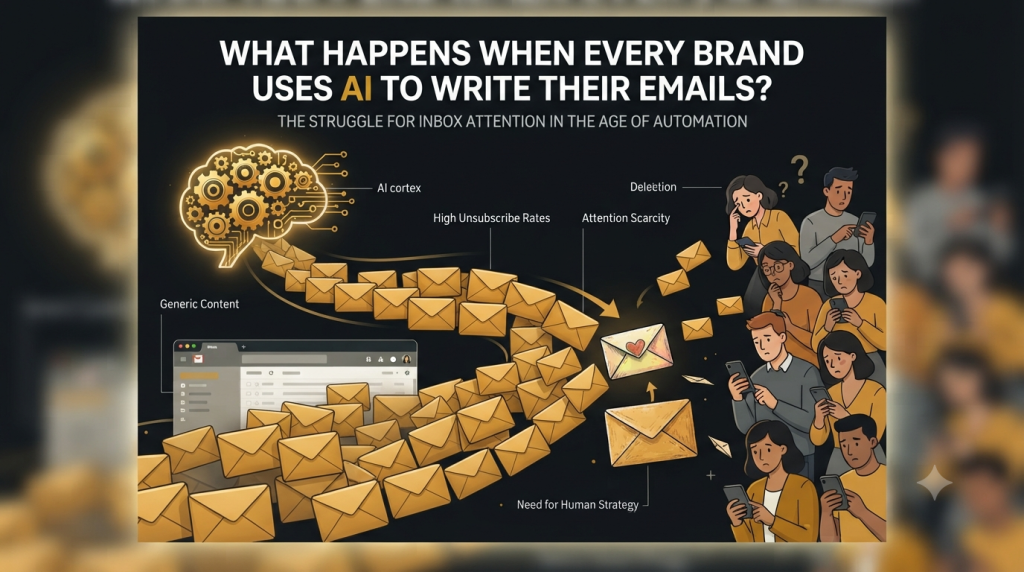
“What Happens When Every Brand Uses AI to Write Their Emails?”

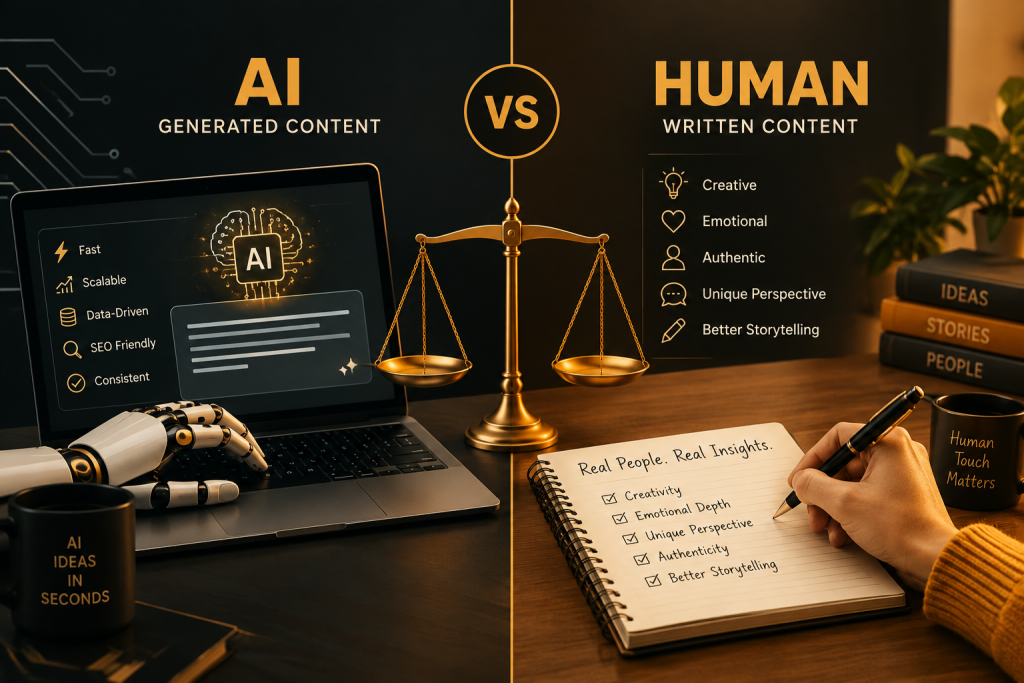
What Happens When Every Brand Uses AI to Write Their Emails? The email marketing advantage is no longer AI. It is what you do with it. Imagine opening your inbox on a Tuesday morning. Five promotional emails sit unread. One from a clothing brand. One from a SaaS company. One from a coffee subscription. One from an airline. One from a fitness app. They are all perfectly written. Personalized. Grammatically flawless. Optimized for conversion. Each one greets you by name. Each one references something you actually looked at. Each one has a subject line engineered to make you click. And yet something feels wrong. They all sound strangely similar. The rhythm is the same. The hooks are the same. The emotional temperature is the same. It is as if five different brands hired the same copywriter, who happens to be a large language model. This is the question that matters in 2026: What happens when AI-generated email becomes so common that it stops being a competitive advantage? The short answer: AI has made email production easier, faster, and cheaper. But it has also made differentiation harder. When every brand can generate a polished, personalized email in seconds, polish and personalization stop being differentiators. The brands that win will be the ones that use AI intelligently, creatively, and authentically, without losing the human judgment that makes a message worth reading. This article explores what widespread AI email adoption actually means for marketers, where AI genuinely helps, where it quietly hurts, and how to build an email strategy that is AI-assisted but unmistakably human-led. AI Has Made Email Writing Easier—But That Changes the Competitive Landscape A decade ago, producing a single email campaign required a writer, a designer, an approval chain, and days of coordination. Enterprise teams typically invested eight to fourteen working days to build one campaign, with complex multilingual versions taking up to three weeks. Today, that timeline has collapsed. AI-powered platforms help teams produce emails in minutes rather than weeks. A recent industry benchmark showed that enterprises using AI-powered production platforms achieve 70% faster timelines than traditional methods, with some teams cutting build time by over 90%. This is genuinely useful. Marketers can generate draft subject lines in seconds. They can produce five variations of the same offer for different segments before lunch. They can translate a campaign into six languages without hiring six translators. But here is the uncomfortable implication: speed and efficiency are not durable competitive advantages when everyone has access to the same tools. When a capability becomes commoditized, the advantage shifts. It moves from access to application. From can you do it? to can you do it in a way that actually matters to your customer? The data supports this. While 87% of businesses using AI apply it to email marketing workflows, only 6% qualify as AI high performers. Adoption is nearly universal. Mastery is rare. What Happens When Every Brand Uses AI to Write Emails? The consequences of widespread AI email adoption are already visible. Some are positive. Some are concerning. Most are a mix of both. Email Quality May Improve AI raises the floor. A brand that previously sent poorly written, error-ridden emails can now produce clean, structured, grammatically correct messages. That is a net positive for the inbox. AI is also excellent at brainstorming. It can generate twenty subject line variations in seconds. It can suggest angles a human might not have considered. It can analyze which phrasing tends to perform better in similar campaigns. For resource-constrained teams—small businesses, solo founders, lean startups—AI has been a genuine equalizer. A solo marketer can now produce a volume and quality of email content that previously required a team. But Emails May Start Sounding the Same This is where the story gets more complicated. AI models are trained on vast corpora of human writing. They are optimized to produce text that is clear, coherent, and conventional. In email marketing, this means they default to familiar patterns: the friendly opener, the benefit-driven body, the urgency-driven CTA, the polite sign-off. Research comparing AI-generated and human-written emails found that AI-generated emails tend to be more formal, more verbose, and more complex, while human-written emails are often more concise and personalized. In other words, AI writes like a polite professional who has read a lot of marketing textbooks. That is fine for a first draft. It is less fine when every brand in the inbox sounds like the same polite professional. The result is a phenomenon marketers are already noticing: inbox sameness. Different brands, different products, different audiences—but the same rhythm, the same hooks, the same emotional register. Personalization May Become Less Differentiating For years, personalization was the holy grail of email marketing. Insert the customer’s name. Reference their past purchase. Recommend a product based on browsing history. The assumption was that this level of tailoring would create a sense of one-to-one communication. But when every brand can do this—and do it at scale—personalization becomes table stakes. It stops being a differentiator. There is a deeper problem, too. AI personalization is often surface-level. It can insert a name and a product reference. It struggles with genuine relevance. It cannot infer what a customer is actually struggling with, what they are hesitant about, or what question they have not yet articulated. A recent analysis of AI personalization failures in cold email found that AI frequently hallucinated details, referenced outdated job titles, and confused people with similar names. In one test batch, only one out of ten AI-personalized emails contained accurate information. Even when the data is accurate, inserting a name is not the same as understanding a person. Customers May Become Better at Detecting Generic AI Content Consumers are not passive recipients. They develop pattern recognition. And the patterns of AI-generated email are becoming recognizable. According to a HubSpot and SurveyMonkey study of 15,000 consumers worldwide, 70% say they have noticed AI being used in marketing emails. Only 23% say they like or love AI when applied to marketing
Uncategorized

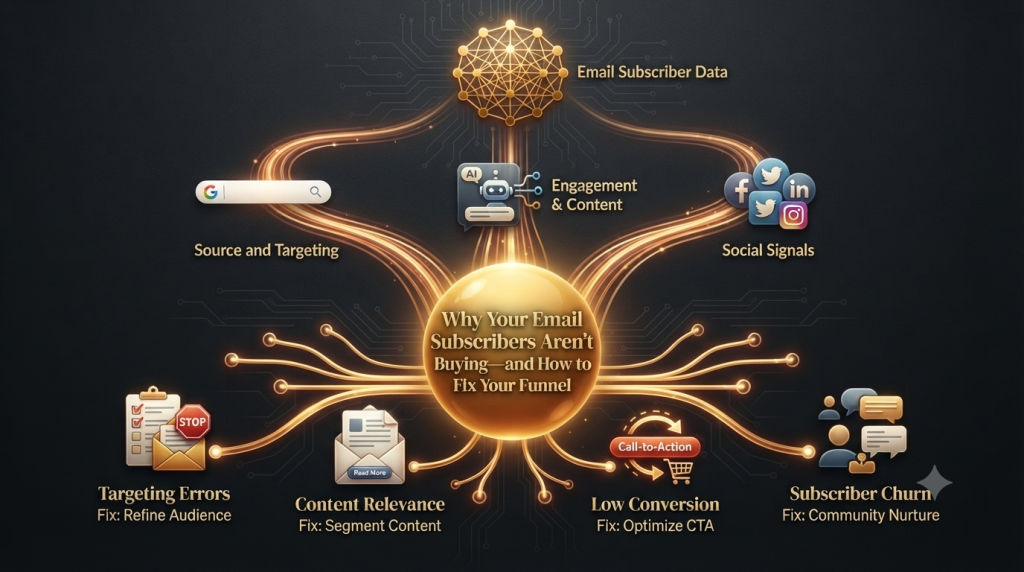
“Why Your Email Subscribers Aren’t Buying—and How to Fix Your Funnel”

Why Your Email Subscribers Aren’t Buying—and How to Fix Your Funnel Email Marketing · Funnel Optimization · 2026 A subscriber is an audience asset. A customer is a business outcome. The funnel in between decides which one you get. You did the hard part. You built the list. Maybe 5,000 subscribers. Maybe 50,000. You send campaigns, watch the opens come in, see the clicks register — and then almost nothing. A handful of sales. A conversion rate that makes you quietly wonder whether email marketing is worth the effort at all. Here’s the uncomfortable truth most agencies won’t say out loud: an email list is an audience asset, not a guaranteed sales channel. Those are two completely different things. A subscriber gave you permission to talk to them. They did not promise to buy. Between “I subscribed” and “I purchased” sits a funnel — and if that funnel is broken, growing your list only multiplies the problem. Most businesses with underperforming email revenue don’t have a subscriber problem. They have a journey problem. The wrong people, the wrong message, the wrong moment, the wrong offer, or too much friction at the wrong stage. This article breaks down exactly why email subscribers aren’t buying, where email funnels leak, and how to fix each stage — from segmentation and nurturing to landing pages, checkout, and measurement. By the end, you’ll have a diagnostic framework, a 12-step fix plan, an audit checklist, and the metrics that actually matter. Why Aren’t My Email Subscribers Buying? Email subscribers often don’t buy because the funnel between attention and purchase is misaligned. The most common causes are weak purchase intent in the lead source, generic messaging, poor segmentation, selling too early, an offer that doesn’t match the audience, a landing page that breaks the email’s promise, checkout friction, and measurement focused on opens instead of revenue. Fixing this means auditing each stage of the email conversion funnel — not just writing better emails. Having Subscribers Is Not the Same as Having Buyers List size is the most flattering metric in email marketing and one of the least useful. A subscriber is simply someone who raised their hand for something. That something might be a discount, a PDF, a webinar, a quiz result, or a genuine interest in buying. The funnel treats all of them identically until you decide otherwise. It helps to separate four distinct groups: Subscriber — opted in, no demonstrated intent beyond the opt-in itself. Lead — shared enough information or behavior to indicate a possible fit. Marketing-qualified lead (MQL) — engaged repeatedly, matches your ideal customer profile. Customer — has paid, and ideally will pay again. A list of 40,000 where 3,000 are MQLs will almost always out-earn a list of 100,000 where nobody remembers signing up. Engagement and purchase intent matter far more than raw list size. If your email reporting celebrates subscriber growth while revenue stays flat, you’re optimizing the wrong number. The Email Funnel: Where Subscribers Become Customers Every email-driven sale travels through the same sequence. When revenue is weak, one of these stages is underperforming. Traffic → Lead Magnet → Subscriber → Welcome Sequence → Nurturing → Offer → Email Click → Landing Page → Checkout → Purchase → Retention Each stage has one job. Traffic attracts attention. The lead magnet converts attention into permission. The welcome sequence builds trust and sets expectations. Nurturing moves someone from curious to convinced. The offer gives them something worth paying for. The click is a micro-commitment. The landing page confirms the promise. Checkout removes the last obstacle. Purchase is the outcome. Retention turns one sale into recurring revenue. Break any single link and the whole chain underperforms — which is why “write better emails” is rarely the complete answer. Funnel Stage What Should Happen Common Problem What to Improve Traffic Attract the right audience Broad, untargeted traffic Channel-to-audience fit, ad targeting Lead Magnet Convert attention into permission Attracts freebie seekers High-intent offer, qualification question Welcome Sequence Build trust, set expectations Single generic welcome email 5–7 email sequence with proof Nurturing Move curious → convinced No education, only promotion Value-first content, objection handling Offer Present something worth buying Weak value, no risk reversal Offer-market fit, guarantees, urgency Email Click Generate a micro-commitment Vague CTA, multiple competing links One specific CTA per email Landing Page Confirm the email’s promise Message mismatch, distractions Message match, single goal, trust signals Checkout Remove the last obstacle Hidden costs, forced account creation Guest checkout, wallets, transparent pricing Purchase Complete the transaction Technical errors, payment failures Payment options, page speed, QA Retention Turn one sale into repeat revenue No onboarding or follow-up Post-purchase sequence, loyalty, win-back 10 Reasons Your Email Subscribers Aren’t Buying These are the ten leaks I see most often when auditing email funnels. For each one, I’ve broken down the problem, why it happens, what it looks like in your data, how to fix it, and a realistic example. 1. Your Subscribers Never Had Strong Purchase Intent The problem: You’re emailing an audience that never intended to buy. They wanted the free thing, not the paid thing. Why it happens: Lead magnets attract the people they’re designed for. A “10 Social Media Myths” PDF attracts hobbyists and students. A “Free Shipping + Fit Guide” attracts shoppers. Same channel, completely different intent. What it looks like: Strong lead magnet download rates, healthy open rates, but offer emails barely click. Unsubscribe spikes the first time you promote something. How to fix it: Redesign the lead magnet around a buying-adjacent problem, add a one-question qualification survey at opt-in, use a quiz funnel to route people by intent, and tag every subscriber with their original lead source so you can segment from day one. Example: A skincare brand offering “10 Skincare Myths Debunked” attracts browsers. Switching to “Find your skin type in 60 seconds” attracts people actively shopping for products — and the same email sequence converts noticeably better. 2. Your Emails Are Too Generic The problem: One newsletter goes

Uncategorized

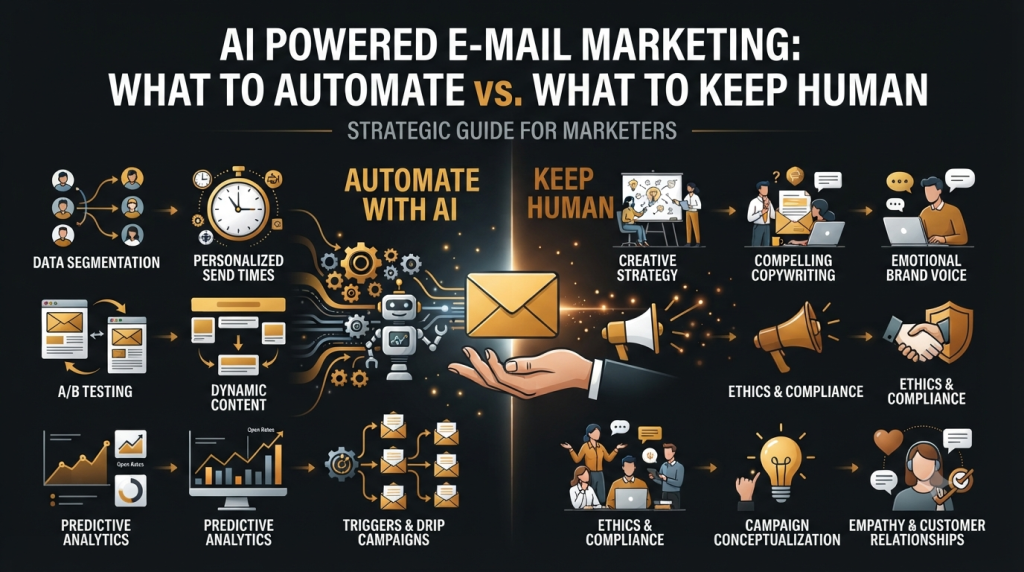
“AI-Powered Email Marketing: What Should Marketers Automate—and What Should Stay Human?”

AI-Powered Email Marketing: What Should Marketers Automate — and What Should Stay Human? Every marketer knows the feeling. You open your email platform, stare at a blank campaign, and realize you need to segment 15,000 subscribers, write three subject line variants, schedule sends across four time zones, and somehow personalize it all — before lunch. The pressure to send more, personalize deeper, and optimize faster keeps growing. AI-powered email marketing promises relief. And in 2026, that promise is largely real: 87% of businesses using AI now apply it to email marketing workflows, and advanced adopters deploy campaigns 28% faster than early-stage teams. But here’s the tension. Forty percent of U.S. consumers say they would trust a retailer’s emails less if they knew AI had written them. Automating everything doesn’t just risk generic messaging — it risks eroding the very trust that makes email the highest-ROI channel most businesses have. The real question isn’t whether to use AI. It’s knowing exactly which tasks to hand over, which to keep human, and how to build a workflow where both sides make each other better. AI is reshaping how marketers build, send, and measure email campaigns. What Is AI-Powered Email Marketing? AI-powered email marketing means using artificial intelligence — from rule-based automation to machine learning and generative models — to plan, create, send, and analyze email campaigns. It’s not one thing. It’s a spectrum. Traditional email automation follows fixed rules: if a subscriber abandons a cart, wait two hours, then send a reminder. Predictive AI goes further by studying historical data to estimate who is likely to engage, churn, or purchase. Generative AI drafts subject lines, body copy, and even images from a prompt. AI-assisted optimization analyzes performance patterns and recommends adjustments — send times, audience segments, content variations. Consider a simple example. A clothing brand wants to recover abandoned carts. Traditional automation sends the same reminder email to everyone after 24 hours. An AI-assisted workflow, by contrast, analyzes each shopper’s browsing history, purchase frequency, and engagement patterns to decide whether to send a reminder, a product recommendation, or a small incentive — and at what time that specific person is most likely to open it. Klaviyo’s personalized send time feature works this way: AI delivers each message when the individual is most likely to open, click, and buy. The business benefit is measurable relevance. But AI outputs still depend on data quality, appropriate permissions, and human oversight. No platform’s AI can compensate for inaccurate CRM data, missing consent records, or a team that never reviews what goes out. Why AI Is Changing Email Marketing in 2026 The shift isn’t theoretical. Adoption is already mainstream. According to Litmus’s State of Email 2026 report, 28% of marketers have AI deeply integrated into their email workflows and another 34% use it regularly — only 5% aren’t using it at all. Meanwhile, 40% of marketers named expanded AI use among their top three email priorities for 2026. More relevant segmentation. AI now identifies customer groups using behavioral, transactional, and engagement data — not just demographics. You can spot high-intent prospects, at-risk subscribers, and loyal advocates without manually building dozens of filters. Behavioral personalization. Instead of inserting a first name and calling it personalization, AI can recommend products, content, and offers based on real behavior. Klaviyo’s next best product recommendations dynamically show unique products based on each customer’s recent purchase history. Automated customer journeys. AI-assisted workflows adapt on the fly. HubSpot’s Nurture Agent uses CRM data and live web research to rewrite subject lines, preview text, body copy, and CTAs for individual recipients at send time. Faster experimentation. Teams that once needed two weeks to produce a single email now ship campaigns in minutes using AI-powered platforms. Enterprises using AI-powered email tools achieve 70% faster timelines than traditional methods. Integration with CRM and e-commerce data. The real advantage comes when AI connects to your CRM, e-commerce platform, and behavioral tracking. ActiveCampaign’s Active Intelligence 3.0 now monitors your website for content changes and automatically drafts campaigns with that new content. The privacy imperative. With India’s DPDP Act, GDPR, and Google/Yahoo bulk sender requirements tightening, consent and data handling are no longer optional. AI can help you manage this — but only if humans set the rules. What Should Marketers Automate Using AI? A. Audience Segmentation AI can analyze behavioral, transactional, and engagement data to identify customer groups automatically — new subscribers, repeat buyers, inactive subscribers, high-intent prospects. What a human should review: Check for inaccurate assumptions, unfair profiling, and inappropriate use of sensitive data. Common mistake: Assuming AI segments are always accurate without validating against actual business outcomes. B. Routine Email Personalization AI can handle product recommendations, relevant content suggestions, lifecycle messages, and contextual offers at scale. What a human should review: The line between useful and intrusive personalization. A recommendation based on browsing history feels helpful; one that references a sensitive purchase feels invasive. Common mistake: Overpersonalizing using data customers didn’t expect you to use. C. Welcome Emails and Onboarding Sequences AI can automate welcome messages, introductory sequences, product education, and onboarding reminders. What a human should review: The initial brand messaging and strategic framing. The first email sets the relationship tone. Common mistake: Letting AI write the entire welcome sequence without human review — resulting in generic openings that fail to establish brand personality. D. Abandoned Cart and Behavioral Emails AI can trigger cart reminders, browse-related follow-ups, and post-purchase communications at optimal times. What a human should review: Consent, frequency limits, and relevance. Common mistake: Sending too many reminders without testing whether they actually recover carts — or annoy customers. E. Lead Nurturing and Lifecycle Workflows AI can support lead scoring, follow-up timing, educational sequences, and lifecycle communications. What a human should review: Predictive scores are estimates, not guarantees. A high score doesn’t mean someone will buy. Common mistake: Treating AI lead scores as definitive and deprioritizing prospects the model undervalues. F. Subject Line and Email Copy Variations Generative AI can produce initial drafts, alternative

Uncategorized

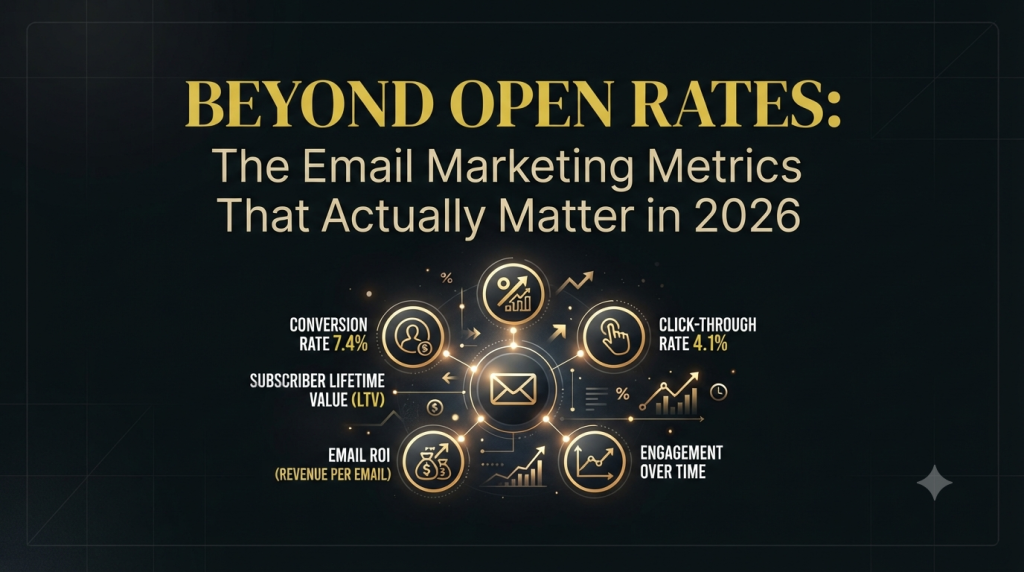
“Beyond Open Rates: The Email Marketing Metrics That Actually Matter in 2026”

Beyond Open Rates: The Email Marketing Metrics That Actually Matter in 2026 An email being opened does not necessarily mean that it influenced a customer, generated a lead, produced a sale, or created business value. Modern email measurement should move from “Did someone open the email?” to “What happened because we sent the email?” Are Open Rates Still Relevant in 2026? Open rate measures the percentage of delivered emails that were opened. Historically, marketers relied on it because it was the first meaningful signal available in most email platforms, and it offered a quick read on subject lines and sender recognition. It can still be useful as a directional diagnostic metric—especially when you compare your own campaigns over time. But Apple Mail Privacy Protection has structurally inflated open rates since 2021. Apple Mail pre-fetches tracking pixels the moment an email lands, before a human has seen the subject line. Apple Mail accounts for roughly 47% of all email opens as of January 2026, based on 1.1 billion tracked opens. A campaign reporting a 50% open rate post-MPP might genuinely have a 25–30% human open rate. The distinction that matters: Open rate is a useful diagnostic metric for subject-line testing and send-time optimization. It is not a business outcome metric. It does not tell you whether anyone engaged with your content, clicked through, or converted. The Problem With Measuring Email Success by Opens Alone A high open rate does not automatically mean high engagement, more clicks, more leads, more sales, higher revenue, or better customer retention. It means a tracking pixel loaded. That is it. Consider two hypothetical campaigns: Campaign A: 50% open rate, 2% click rate, 0.3% conversion rate Campaign B: 35% open rate, 8% click rate, 4% conversion rate Campaign B may be significantly more valuable despite having a lower open rate. The people who did open were far more likely to engage, click, and convert. If those conversions are purchases, Campaign B could generate several times the revenue of Campaign A from the same list size. This is why the question needs to shift from “How many people opened?” to “What did they do next?” The Email Marketing Metrics That Actually Matter in 2026 1. Click-Through Rate (CTR) Formula: CTR = (Total Clicks ÷ Delivered Emails) × 100 CTR tells you what percentage of people who received the email actually clicked a link inside it. Unlike open rate, a click requires a deliberate human action. Someone had to read enough of the email to decide a link was worth their time. That decision carries far more weight than a tracking pixel loading automatically. In 2026, Klaviyo’s benchmark data shows a good email click rate is 1.69% for campaigns and 5.58% for flows. The gap between campaigns and flows is significant—it reflects the difference between sending to a broad list and sending to people based on a specific action or trigger they just took. Limitations: CTR can be inflated by bot clicks in some environments, and it does not tell you whether the click led to a meaningful action. Pair it with conversion data. 2. Click-to-Open Rate (CTOR) Formula: CTOR = (Unique Clicks ÷ Unique Opens) × 100 CTOR measures how effective your email content is at getting people who opened to click. It isolates the quality of your body copy, call-to-action, and offer from the subject line’s performance. MailerLite data suggests a good email click-to-open rate is 6.81%, meaning just under 7 in every 100 people who open go on to click a link inside. The GDMA Email Benchmark 2026 puts CTOR at 7.7%. Important caveat: Because CTOR uses opens in the denominator, it inherits the reliability problems of open tracking. If Apple MPP is inflating your open count, your CTOR will look artificially low. Use it as a relative comparison between your own campaigns, not as an absolute benchmark. 3. Conversion Rate Formula: Conversion Rate = (Conversions ÷ Delivered Emails or Clicks) × 100 A conversion is whatever action you defined as valuable: a purchase, a form submission, a demo booking, a registration, a download. The denominator matters—conversions per delivered email tells a different story than conversions per click. In 2026, email marketing conversion rates typically range from 1–5% across most industries, with rates above 3% considered good performance. Automated flows convert at 2.11% versus 0.16% for campaigns—a 13x advantage. Conversion rate is often more meaningful than open rate because it connects email activity to a tangible outcome. But it still does not tell you the value of that outcome. A 4% conversion rate on a $10 product is a very different business result than a 4% conversion rate on a $2,000 service. 4. Revenue Per Email Revenue per email divides the total revenue attributed to a campaign by the number of emails delivered. It gives you a direct monetary read on campaign efficiency. Example: A promotional campaign delivers 10,000 emails and generates $2,500 in revenue. Revenue per email = $0.25. If a product launch campaign delivers the same 10,000 emails and generates $8,000, revenue per email = $0.80. The second campaign is more than three times as efficient per send. Klaviyo’s 2026 benchmarks show top 10% email flows achieve revenue per recipient as high as $7.79, while average campaigns generate far less. This metric is especially useful for comparing campaigns of different sizes and identifying which offers, audiences, and send times produce the most value per contact. 5. Email Marketing ROI Formula: ROI = ((Revenue − Marketing Cost) ÷ Marketing Cost) × 100 Revenue is not the same as profit. Profit is not the same as ROI. ROI accounts for the cost of generating that revenue—platform fees, design costs, copywriting, list acquisition, and the labor involved in running the program. Sinch Mailgun’s 2026 Email Impact Report found that fewer than half of senders actively measure the ROI of their email programs. Among those who do measure promotional email ROI, 60% report returns greater than $10 for every $1 spent, and 13% report returns above $40:1.

Uncategorized

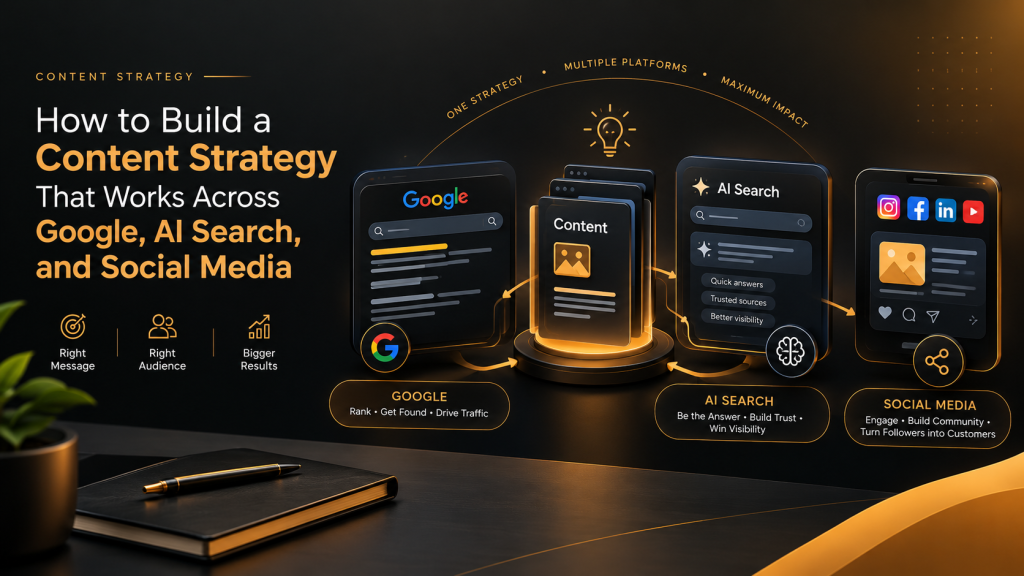
How to Build a Content Strategy That Works Across Google, AI Search, and Social Media

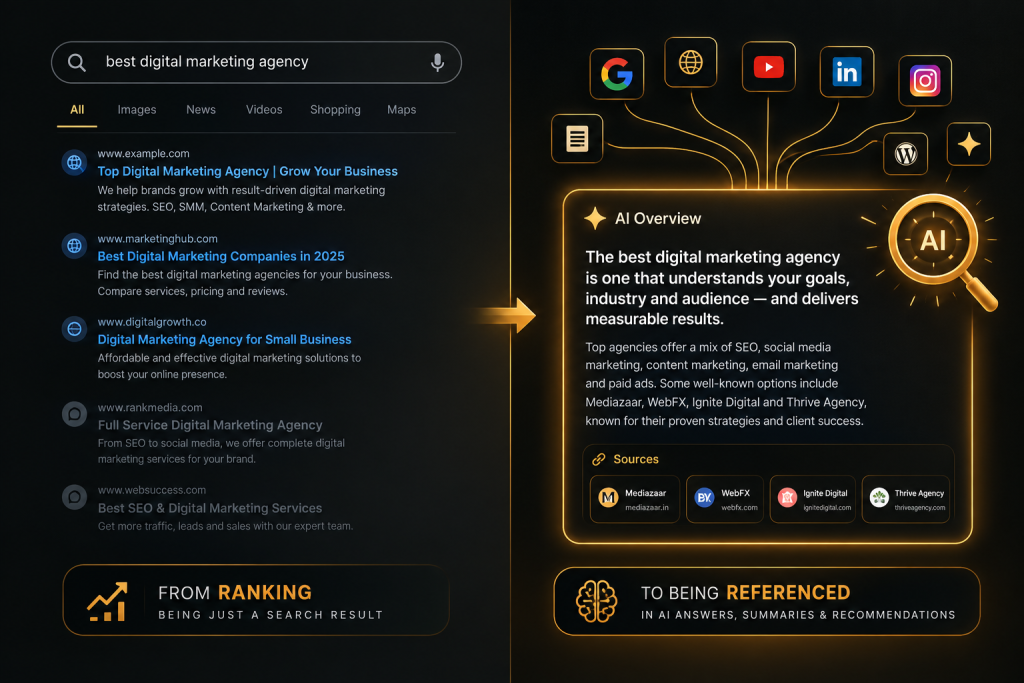
How to Build a Content Strategy That Works Across Google, AI Search, and Social Media One content ecosystem. Three discovery channels. Zero wasted effort. Here’s the playbook for 2026. Picture this: You publish a well-researched blog post. You wait for Google to send traffic. A week passes. Nothing. Meanwhile, a competitor’s messy TikTok about the same topic gets 40,000 views, and ChatGPT recommends their brand when someone asks about your category. That’s not bad luck. That’s a strategy that only works for one channel in a world where people discover information across many. In 2026, discovery is fragmented. Someone might first see your brand on LinkedIn, then ask ChatGPT for recommendations, then Google your name to verify you’re real. If you’re only optimized for one of those moments, you’re invisible for the rest. This guide is about fixing that. Not by creating three separate strategies, but by building one content system that gets discovered, understood, and shared everywhere your audience looks. What Is a Modern Content Strategy? A content strategy is the plan that decides what content you make, who it’s for, where it lives, and what it’s supposed to achieve. It’s the difference between publishing because you feel like you should and publishing because you know exactly what result you’re chasing. People often mix up content creation, content marketing, content strategy, and content distribution. They’re related, but they’re not the same thing: Content creation — making the thing (writing the post, recording the video). Content marketing — using content to attract and convert an audience. Content strategy — deciding what to create, for whom, and why, before you start. Content distribution — getting that content in front of the right people on the right platforms. Most businesses skip strategy and jump straight to creation. That’s why they burn out. Without a strategy, every piece of content is a guess. Why One Content Strategy Must Work Across Multiple Channels Your audience doesn’t live on one platform. Someone might find you through Google, verify you through ChatGPT, and follow you on Instagram. That journey is normal now. The businesses that win aren’t running three separate content operations. They’re building one core body of work and adapting it for each discovery surface. Stop treating each platform like its own separate content universe. A strong pillar article can feed a LinkedIn post, a short video script, an email newsletter, and an AI-search-friendly FAQ section — all from the same research and expertise. How Google Search Is Changing Content Strategy Google still matters. It just doesn’t work the way it did five years ago. Three shifts are reshaping what gets visibility: Experience is now part of the quality equation. Google’s Quality Rater Guidelines added a second ‘E’ — Experience — to the old E-A-T framework. First-hand knowledge and original perspective carry weight that generic summaries don’t. Topical authority beats isolated posts. The algorithm evaluates content clusters, not just individual pages. Depth around a subject is the signal. AI Overviews are in the results. Google’s AI-generated summaries appeared on roughly 25–50% of queries by late 2025, up from around 6.5% in January 2025. When they show, users click less. The practical takeaway: stop writing for a single keyword. Write to become the most useful, specific, and trustworthy source on a topic. That’s what both traditional rankings and AI systems reward. How AI Search Is Changing Content Discovery AI search tools — ChatGPT, Perplexity, Gemini, Google’s AI Mode — don’t show a list of links. They read, synthesize, and answer. If your content isn’t structured for that process, you don’t get mentioned. These systems look for content that is: Clear and direct in its answers Well structured with descriptive headings Factually accurate and sourced where needed Context-rich with specific examples Consistent in how it names entities (brands, people, places) Supported by evidence and first-hand experience One thing the data makes clear: YouTube mentions show the strongest correlation with AI visibility across platforms — stronger than traditional authority metrics like domain rating. When brands appear in video titles, transcripts, and descriptions, AI systems pick them up. That doesn’t mean every brand needs a YouTube channel tomorrow. It means video content and transcript-rich pages are becoming part of the discoverability layer, not just a nice-to-have. What Is AEO and Why Does It Matter? Answer Engine Optimization (AEO) is the practice of structuring your content so AI tools can find it, understand it, and use it as a direct answer. Think of it as SEO’s cousin. SEO tries to get you ranked in a list. AEO tries to get you quoted in the answer. The core moves are simple: Answer the question in the first two sentences. Don’t make the AI dig for it. Use question-based headings. Mirror how people actually ask things. Add FAQ sections where they’re genuinely useful. Not as an SEO trick — as a service to the reader. Define key concepts clearly. Ambiguity kills citability. Keep punctuation and formatting clean. Lists and tables work better than walls of text for machine parsing. AEO doesn’t replace SEO. It extends it. The same content can rank in traditional results and get cited in AI answers if it’s structured for both. What Is GEO (Generative Engine Optimization)? GEO is the broader practice of making your content more useful for generative AI systems — the models behind ChatGPT, Gemini, Claude, and AI Overviews. Where AEO focuses on answer structure, GEO focuses on the qualities that make a source worth citing: Information clarity — no jargon soup, no vague claims. Authority signals — credentials, experience, and evidence where relevant. Context — the surrounding information that helps a machine understand what you’re actually saying. Original insight — something the model can’t get from 50 other pages. Factual accuracy — because generative systems pull from sources that don’t contradict themselves. Entity clarity — naming your brand, products, and key people consistently. Citability — writing in a way that’s easy to quote and reference. No one can promise you a guaranteed spot

Uncategorized

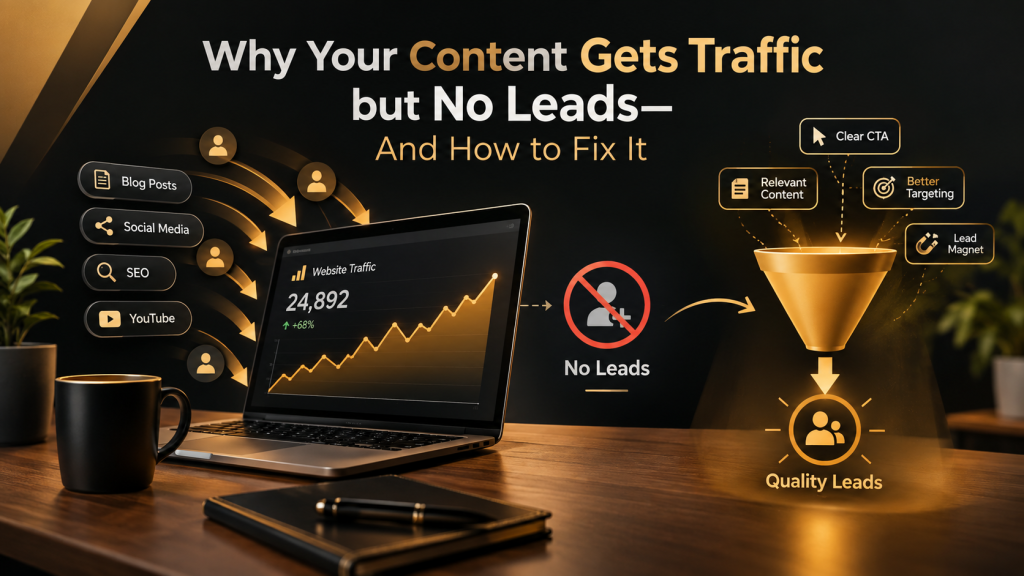
Why Your Content Gets Traffic but No Leads—and How to Fix It

Why Your Content Gets Traffic but No Leads—and How to Fix It Traffic is an attention metric. Leads are a business outcome. Here is how to bridge the gap. Introduction You publish blog posts consistently. Google Search Console shows impressions and clicks climbing. Analytics reports thousands of visitors each month. But the contact form stays quiet. No inquiries. No demo requests. No consultation bookings. This is one of the most common frustrations in content marketing, and it is rarely a traffic problem. It is a conversion problem. The average B2B website turns just 1.5% of visitors into leads, while top performers reach 8% to 15%. That gap is not about getting more people to your site. It is about what happens after they arrive. In 2026, the stakes are higher. Roughly two-thirds of Google searches now end without a click, and on searches where AI Overviews appear, organic click-through rates have dropped by approximately 61% (Seer Interactive, 2026). The visitors who do reach your site are fewer, and they are far more serious. Every friction point on your page now costs you more than it did a year ago. This article will walk you through exactly why content gets traffic but no leads, and what you can change to turn that traffic into qualified business opportunities. You will learn how to diagnose the problem, fix the conversion path, and build a content system that supports the entire customer journey. Why Does My Content Get Traffic but No Leads? Traffic often fails to generate leads because of a mismatch between what visitors need and what your content offers. Common causes include targeting informational search intent instead of commercial intent, attracting visitors who are not your ideal customers, missing or weak calls to action, poor content-to-offer alignment, weak landing pages, lack of trust signals, and not measuring the right metrics. The fix is not more traffic. It is building a clear conversion path that guides the right visitors toward a meaningful next step. Traffic vs. Leads: What’s the Difference? Traffic is the number of people who visit your website. It tells you how many people found you, but it does not tell you whether they care about what you offer. Engagement is what people do on your site: how long they stay, which pages they read, how far they scroll. Engagement is a sign of interest, but it is still not a business outcome. Leads are people who take a meaningful action that allows your business to continue the conversation. A lead is a form submission, a consultation request, a demo booking, a phone call, a newsletter signup, a download, a quote request, or a trial registration. High traffic does not automatically mean high commercial value. A blog post about “what is digital marketing” might attract thousands of readers who are simply curious. A comparison page about “best CRM for small business” might attract far fewer visitors, but those visitors are actively evaluating solutions and are much closer to making a purchase decision. The goal is not to maximize traffic. The goal is to attract the right traffic and guide it toward a conversion. Why Content Gets Traffic but No Leads: 12 Root Causes 1. You’re Targeting the Wrong Search Intent Search intent falls into four categories: informational, navigational, commercial investigation, and transactional. Someone searching “what is SEO” has informational intent. They want to learn. Someone searching “SEO agency for small business” has commercial investigation intent. They are comparing providers and are much closer to making a decision. Many businesses prioritize high-volume informational keywords because they generate more traffic. But informational traffic rarely converts into leads. In one analysis of top-performing content, over 70% of the pages had informational intent, and less than 8% had commercial or transactional intent. Those pages had visibility, but they were not built to generate business opportunities. The fix is not to abandon informational content. It is to create content for every stage of the buyer journey, and to ensure that informational content includes a clear path toward commercial pages. 2. You’re Attracting Visitors Who Are Not Your Ideal Customers There is a difference between traffic volume, relevant traffic, and qualified traffic. Volume is how many people visit. Relevant traffic is people who are interested in your topic. Qualified traffic is people who match your ideal customer profile and have the potential to become paying customers. Viral or broad content can generate large amounts of traffic without generating any business opportunities. A blog post that appeals to students, hobbyists, or people outside your target market will never convert into leads, no matter how well it ranks. Before optimizing for traffic, define your ideal customer profile. What problems do they have? What questions are they asking? What solutions are they actively evaluating? Create content that speaks directly to those people, not to the widest possible audience. 3. Your Content Answers the Question but Gives No Next Step A reader finishes your article and thinks, “That was helpful. Now what?” If the answer is not obvious, they leave. They do not search your site for a service page. They do not hunt for a contact form. They move on. Every piece of content should have a clear next step. That might be a relevant CTA, an internal link to a deeper guide, a related resource, a lead magnet, a service page, or a consultation offer. The reader should never have to guess what to do next. Content journeys work best when they feel natural. A post about “how to improve Instagram engagement” can lead to a free content planning template. A template download can lead to a guide on social media strategy. A strategy guide can lead to a consultation offer. 4. Your CTA Is Weak or Missing Generic CTAs like “Contact Us” or “Learn More” do not give readers a reason to click. They do not communicate value. They do not create urgency. They do not tell the reader what they will get. Contextual CTAs perform better.

Uncategorized

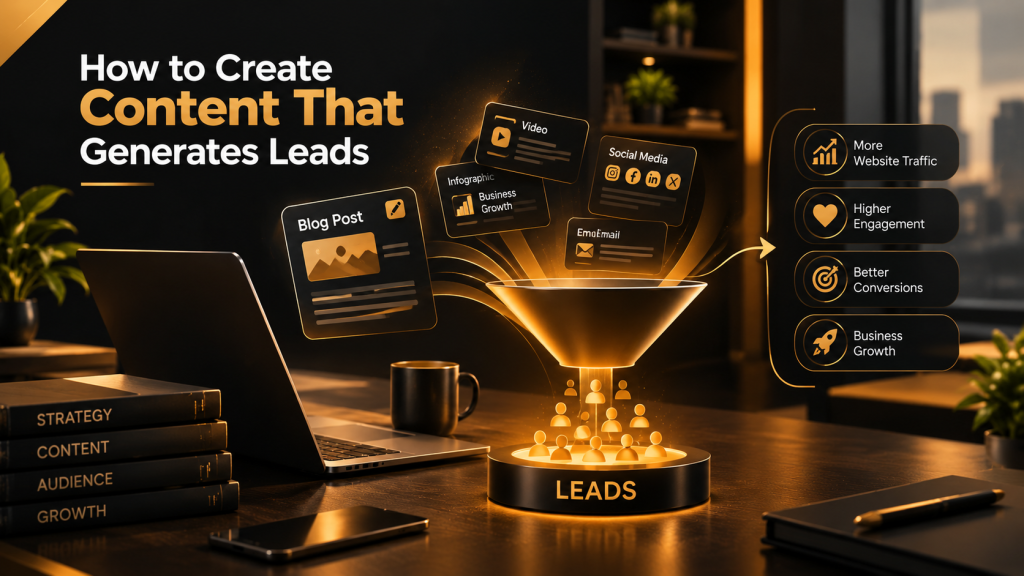
How to Create Content That Generates Leads

How to Create Content That Generates Leads: A 2026 Practical Guide You publish blog posts, guides, and videos. You get traffic. But the leads aren’t coming. This is the most common frustration in content marketing, and it’s almost never a traffic problem. It’s a connection problem. This guide shows you exactly how to create content that attracts the right audience, builds trust, and turns readers into qualified leads. No fluff. No vanity metrics. Just a practical framework you can implement this week. Content attracts. Trust builds. A clear conversion path turns readers into leads. What Is Lead-Generating Content? Lead-generating content is content created with a specific business outcome in mind: capturing a qualified prospect’s information or initiating a conversation. It is not the same as content that gets traffic or engagement. The distinction matters because most businesses invest heavily in traffic-focused content and wonder why their pipeline is empty. Here’s the difference: Factor Traffic-Focused Content Lead-Generating Content Primary goal Maximize pageviews and sessions Capture qualified leads and drive pipeline Audience Broad, anyone interested in the topic Specific ideal customer profile with buying intent Topic choice High-volume keywords Commercially relevant problems with clear solutions Success metric Organic sessions, rankings MQLs, form submissions, revenue influenced CTA Generic or absent Contextually relevant to the reader’s stage Trust building Surface-level explanation Original insight, data, and proven experience A practical example: A digital marketing agency could publish a blog post titled “What Is SEO? A Beginner’s Guide.” This might attract traffic from students and curious beginners. Alternatively, they could publish “How Much Should Your Business Spend on SEO? A Framework for Budget Allocation.” This attracts business owners and marketing managers who are actively evaluating SEO services. Both are useful. Only one generates leads. Why Does Some Content Get Traffic but No Leads? If your content is getting traffic but not leads, the problem usually lies in one of these areas: Wrong audience — You’re attracting people who will never buy from you. Students, competitors, or hobbyists instead of decision-makers. Wrong search intent — You ranked for an informational query but offer no natural next step for someone with commercial intent. No clear CTA — The article ends with a summary and nothing else. The reader has no idea what to do next. Weak value proposition — The content is generic and could have been written by anyone. It doesn’t demonstrate why you are the right solution. Content-to-offer misalignment — The blog post is about email marketing, but the CTA offers a social media audit. The reader is confused. Lack of trust signals — No author bio, no case studies, no original data. The reader has no reason to believe you. No conversion path — There is no landing page, no form, no lead magnet. The reader would have to figure out how to contact you on their own. Poor user experience —Slow page speed, intrusive pop-ups, bro ken mobile layout. The reader leaves before they can convert. The fix is not to abandon content marketing. It’s to connect your content to a clear conversion path and ensure it speaks to the right people at the right moment. The 7-Step Framework for Creating Lead-Generating Content This is the exact process we use at Mediazaar to help clients turn content into a systematic lead-generation asset. Step 1: Define Your Ideal Customer You cannot create content for everyone and expect it to convert anyone. Start with a clear Ideal Customer Profile (ICP) that includes: pain points, goals, objections, buying triggers, industry context, and decision-making process. The more specific your ICP, the more relevant your content becomes. Example: A B2B SaaS company selling project management software might define their ICP as: Operations managers at agencies with 20-50 employees who struggle with resource allocation across multiple client projects and are evaluating tools to improve utilization rates. Step 2: Find Problems Worth Creating Content About Great lead-generating topics come from real customer problems. Mine these sources: sales call recordings, support tickets, customer reviews, Reddit and industry forums, Google’s People Also Ask, competitor content gaps, and keyword research tools. Look for problems that are frequent, painful, and expensive to solve. Example: If a sales team hears “How do I know if my content is actually working?” on 60% of discovery calls, that’s a topic worth creating content around. Step 3: Understand Search Intent Search intent determines the type of content you should create. Informational queries need educational content. Commercial investigation queries need comparisons, reviews, and case studies. Transactional queries need product pages and pricing. Navigational queries need branded pages. Match your content format to the intent. Example: “What is content marketing?” is informational → create a guide. “Best content marketing agencies” is commercial investigation → create a comparison or showcase page. Step 4: Choose Topics With Lead Potential Not every topic deserves equal investment. Evaluate each topic against this checklist: Audience relevance (does it matter to your ICP?), Business relevance (does solving this problem lead to a sale?), Search demand (are people actively searching for this?), Problem severity (is it urgent and painful?), and Conversion potential (is there a natural next step?). Example: A topic that scores high on all five criteria is: “How to Reduce Customer Acquisition Costs in B2B SaaS” — it’s highly relevant, directly tied to business outcomes, has search volume, addresses a painful problem, and naturally leads to a consultation offer. Step 5: Create Content That Solves a Real Problem Useful content earns trust. Include clear explanations, actionable steps, real examples, frameworks, checklists, and practical recommendations. The goal is not to demonstrate how much you know. The goal is to help the reader make progress on a problem that matters to them. Example: Instead of explaining “what is a lead magnet,” show readers how to create one in 30 minutes with a specific template and worked example. The latter is more useful and more likely to be shared and cited. Step 6: Build Trust Before Asking for the Lead Trust is the currency of lead generation. Demonstrate E-E-A-T

Uncategorized

Is Blogging Still Effective in the Age of AI?

Is Blogging Still Effective in the Age of AI? Something unusual is happening in search analytics dashboards. Rankings hold steady. Impressions climb. But clicks fall. The pattern appeared gradually in 2024, accelerated through 2025, and by 2026 it has become the defining characteristic of organic search for most content-driven websites. The cause is structural, not algorithmic. AI-powered search experiences now answer questions directly on the results page. Google’s AI Overviews appear in roughly 43% of searches, up from 15% a year earlier. A randomized field experiment published in early 2026 found that when an AI Overview appears, outbound organic clicks drop by 38%, with zero-click searches rising from 54% to 72%. Separately, SparkToro’s clickstream data shows that 68% of US Google searches now end without a click to the open web. The direct answer: Yes, blogging can still be effective in 2026. But the strategy that worked in 2020 will actively hurt you today. The era of publishing generic, keyword-focused articles at scale is ending. What replaces it looks less like blogging and more like publishing original, experience-driven information that earns trust — and, sometimes, gets cited. This is not a story about blogging dying. It is a story about what blogging has to become. The businesses seeing results from content in 2026 are not publishing more. They are publishing differently — with original data, first-hand experience, expert analysis, and a clear understanding that visibility no longer guarantees traffic. Is Blogging Dead in 2026? The “blogging is dead” argument rests on real evidence. And it deserves to be taken seriously before it is dismissed. Generative AI can produce a competent 1,500-word article in under 60 seconds. AI Overviews and AI Mode answer questions directly, keeping users inside Google’s ecosystem. Zero-click searches now account for 68% of US Google queries. Generic informational articles — definitions, how-to guides, comparison listicles — are the most heavily affected content type. Social platforms and short-form video have absorbed discovery attention for younger audiences. Google’s own AI Mode has surpassed 1 billion monthly active users. When you put those factors together, the case for abandoning blogging looks strong. But that conclusion is an oversimplification, and treating it as settled strategy leads businesses to make worse decisions — not better ones. Here is why the obituary is premature. First, search is not disappearing. It is layering. Similarweb data from 2026 shows that search still draws 3.3 billion average monthly unique visitors worldwide, roughly five times the entire AI chatbot category combined. Second, AI Overviews do not affect all content equally. Transactional and navigational queries, local service pages, and content requiring proprietary data or human judgment see far less disruption. Third, and most importantly, the content that AI systems struggle to replace — original research, first-hand experience, expert interpretation — is also the content that builds the strongest brand authority and conversion paths. The honest assessment is this: blogging as a volume game is dead. Blogging as a credibility and authority-building channel is not. The businesses adapting successfully are not writing more articles. They are writing fewer, better ones — and measuring success differently. What Has AI Changed About Blogging? AI Can Produce Content at Scale Before generative AI, producing 50 blog posts a month required a content team. Today, a single marketer with access to an LLM can generate that volume in an afternoon. Nearly 94% of marketers now use AI for content creation, and the percentage of marketers who do not use AI for blog creation has dropped from 65% to just 5% in two years. This sounds like an advantage. In practice, it has become a liability. When everyone can produce content at scale, volume stops being a competitive differentiator. Ahrefs analyzed 331,000 pages and found that low and moderate AI-content pages received 2–3x the organic impressions of high or very-high AI-content pages — the starkest performance gap in the study. Pages where AI contributed less than 50% of the content accounted for 82.2% of top-3 rankings. Searchers Can Get Answers Without Visiting Websites This is the change with the most immediate impact on blog traffic. AI Overviews and AI Mode synthesize answers from multiple sources and present them directly in the search experience. The user gets what they need without clicking through to any website. Drop in organic clicks when AI Overviews appear 0 % US Google searches ending without a click 0 % Click rate with AI summary vs. 15% without 0 % Google searches showing AI Overviews 0 % The implication is not that all organic traffic is gone. It is that the commercial value of an impression has changed. Impressions have held or grown even as clicks fell — visibility has not disappeared, its commercial value has changed. The realistic planning assumption is a permanently lower click yield per impression, not the end of organic search. Generic Content Is Easier to Replicate An article explaining “What is content marketing?” or “10 benefits of email automation” contains no proprietary information. An LLM trained on the same publicly available sources can produce a functionally equivalent article in seconds. The differentiation that once came from simply publishing a competent overview has evaporated. Google’s May 2026 core update reinforced this shift. The update emphasized surfacing “relevant, satisfying content for searchers from all types of sites,” and the volatility that followed disproportionately affected sites publishing commodity content. Sites with original research, unique frameworks, and demonstrable expertise saw less disruption. Original Expertise Has Become More Valuable Here is the counterintuitive effect of AI saturation: it has made genuinely original content more valuable, not less. When the web is flooded with competent summaries, the scarce resource becomes first-hand experience, proprietary data, and expert interpretation. Google’s E-E-A-T framework — Experience, Expertise, Authoritativeness, Trustworthiness — has evolved to reflect this. In late 2025, Google expanded E-E-A-T evaluation to all competitive queries, not just YMYL topics. Google’s quality rater guidelines now explicitly warn against fabricated author profiles, AI-generated headshots, and false credentials, treating them as deception and “a signal of

Uncategorized

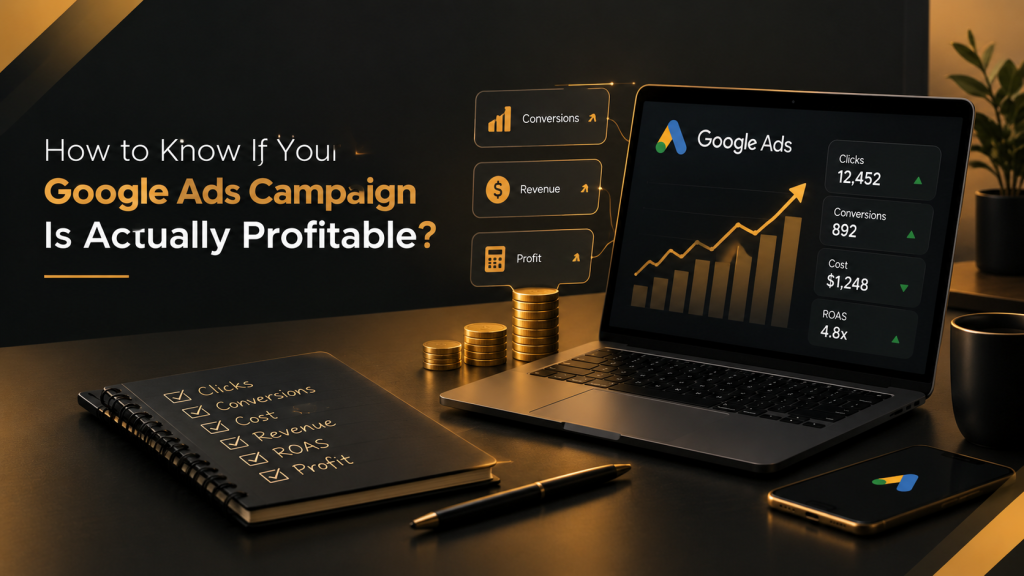
How to Know If Your Google Ads Campaign Is Actually Profitable

How to Know If Your Google Ads Campaign Is Actually Profitable Revenue and ROAS alone don’t prove profitability. Here’s how to calculate what your Google Ads campaigns are actually earning after every cost. A business owner logs into Google Ads, sees ₹300,000 in tracked revenue against ₹100,000 in ad spend, and concludes the campaign is a winner. Three months later, the accountant asks why cash flow is tight. This scenario plays out constantly. Revenue is visible. Profit is buried under product costs, shipping, refunds, payment processing, and the uncomfortable reality that not every customer who clicks actually converts into a paying one. Google Ads can generate impressive top-line numbers while quietly eroding your margins. The platform’s reporting tools are built to show you what happened — not necessarily what it cost you to make it happen. That distinction is the entire ballgame when you’re trying to decide whether to scale, optimize, or pull the plug. This guide walks through the exact calculations, metrics, and frameworks you need to answer one question honestly: Is my Google Ads campaign actually making money? What Does It Actually Mean for a Google Ads Campaign to Be Profitable? A Google Ads campaign is profitable when the contribution margin generated by the customers it acquires exceeds the total cost of acquiring them. That’s the plain-English definition. Everything else is detail. The problem is that most advertisers stop at revenue. Revenue is the number at the top of the funnel. Profit is what survives after everyone else gets paid. Here’s how the layers break down: Layer What It Includes Why It Matters Revenue Total sales value attributed to ads Shows demand, not viability Gross Profit Revenue minus cost of goods sold (COGS) Reveals whether the product itself makes money before ad costs Contribution Profit Gross profit minus ad spend, shipping, fees, refunds The number that tells you if the campaign is sustainable Net Profit Contribution profit minus operating overhead The bottom line the business actually keeps Consider a simple example. An online store sells a product for ₹2,000. The cost to produce and ship it is ₹1,200. That’s a ₹800 gross profit per unit — a 40% gross margin. If the store spends ₹1,000 in Google Ads to acquire a customer who buys one unit, the campaign lost ₹200 on that first transaction. The revenue was ₹2,000. The profit was negative. That’s the gap this article exists to close. Profitability is not a dashboard metric. It’s a business calculation. And it starts with understanding why ROAS — the metric most advertisers live by — doesn’t tell you what you think it tells you. The Numbers You Need Before Judging Profitability Not every business needs every metric. An e-commerce store selling ₹500 products has a different calculation than a B2B software company selling ₹500,000 annual contracts. But before you can calculate profitability, you need to know these numbers: Metric Formula / Meaning Why It Matters Total Ad Spend Sum of all Google Ads costs The starting point for every calculation Conversion Value Total revenue attributed to ads Tells you what the campaign generated, not what it kept Number of Conversions Total actions counted as conversions Needed to calculate CPA and understand volume Average Order Value (AOV) Revenue ÷ Number of Orders Shows the average transaction size Gross Margin (Revenue − COGS) ÷ Revenue The single most important number for profitability CPA Ad Spend ÷ Conversions What you paid per acquired action CAC Total Acquisition Cost ÷ New Customers What you paid per actual customer (not just lead) Conversion Rate Conversions ÷ Clicks Efficiency of turning traffic into action Customer Lifetime Value (LTV) Average Revenue per Customer × Retention Period Long-term economic value of a customer Refund / Cancellation Rate Refunded Orders ÷ Total Orders Reduces effective revenue and margin Repeat Purchase Rate Returning Customers ÷ Total Customers Impacts whether first-purchase CAC is recoverable The mistake most businesses make is trying to optimize everything at once. Start with gross margin and ad spend. Those two numbers alone will tell you whether you’re in the ballpark of profitability. Add CAC and refund rates next. LTV and repeat purchase rates matter for businesses with longer sales cycles or subscription models — they’re not urgent for a one-time purchase e-commerce store. How to Calculate Google Ads Profitability The core formula is straightforward: Ad-Attributed Profit = Revenue − Product/Service Costs − Ad Spend But this simple version misses refunds, fees, and other variable costs. A more complete calculation uses contribution margin: Contribution Profit = (Revenue × Gross Margin) − Ad Spend − Other Variable Costs Worked example: A business spends ₹100,000 on Google Ads. The campaign generates ₹300,000 in tracked revenue across 150 orders. The average order value is ₹2,000. The gross margin is 35%. Refunds account for 5% of orders. Shipping and payment processing cost ₹80 per order. Gross profit before ads: ₹300,000 × 35% = ₹105,000 Refund impact (5% of ₹300,000): −₹15,000 Fulfillment and fees (150 orders × ₹80): −₹12,000 Ad spend: −₹100,000 Contribution profit: ₹105,000 − ₹15,000 − ₹12,000 − ₹100,000 = −₹22,000 The campaign generated ₹300,000 in revenue — a 3× ROAS — and still lost ₹22,000. That’s the reality ROAS hides. How to Calculate Break-Even ROAS Break-even ROAS is the minimum return required to cover all relevant variable costs and advertising spend — the point at which the campaign neither makes nor loses money. Break-Even ROAS = 1 ÷ Gross Profit Margin This formula is simple, but its implications are not. With a 25% gross margin, the break-even ROAS is 4.0. With a 40% margin, it drops to 2.5. With a 20% margin, it climbs to 5.0. That means a campaign with a 3× ROAS is profitable for a business with a 40% margin but deeply unprofitable for one with a 25% margin. Gross Margin Break-Even ROAS 3× ROAS Verdict 20% 5.0 Losing money 25% 4.0 Losing money 30% 3.33 Losing money 40% 2.5 Profitable 50% 2.0 Profitable Note that this formula ignores repeat purchases. Brands with

Uncategorized

From Keywords to Intent: How Google Ads Is Changing the Way We Target Customers

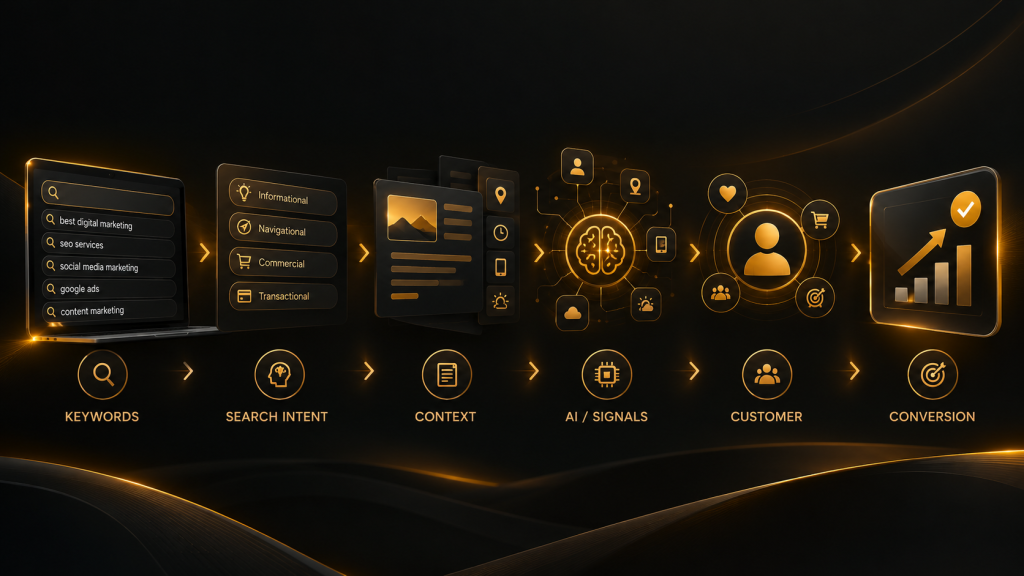
From Keywords to Intent: How Google Ads Is Changing the Way We Target Customers For twenty years, Google Ads targeting followed a predictable model: Keyword → Ad → Landing Page. You chose keywords, wrote ads around them, sent clicks to a page, and measured the result. It was linear. It was controllable. And it worked. That model is no longer the whole picture. In 2026, the modern reality looks more like this: Query + Intent + Context + Signals + Audience + Creative + Landing Page + Conversion Data. Google’s AI evaluates billions of signal combinations at auction time to decide not only which ad to show, but which queries are worth entering at all. This shift matters because it changes what advertisers control, what they can measure, and where strategic advantage now lives. It also creates confusion. Is keyword targeting dead? Does broad match simply show your ads for anything? Can AI really understand what a searcher wants? This guide answers those questions with a clear, balanced view of how Google Ads search intent works in 2026—where it helps, where it falls short, and how to build a strategy that uses automation without surrendering judgement. The Traditional Keyword-First Model Traditional Google Search advertising was built on keyword control. Advertisers selected keywords based on relevance and estimated search volume, grouped them into tightly themed ad groups, wrote ads that included those keywords, and managed bids manually or through basic rules. Match types gave advertisers layers of precision. Exact match limited delivery to close variants of a specific query. Phrase match allowed broader but still constrained matching. Broad match reached the widest audience but was often used cautiously, because it could trigger ads for loosely related searches. Negative keywords acted as guardrails, excluding irrelevant queries. Search query reports revealed what people actually typed, and advertisers used that data to refine keyword lists. Bids were adjusted by device, location, and time of day. Landing pages were chosen to match keyword themes. Keywords were central because they were the primary signal Google used to connect an advertiser’s offer with a user’s search. The system matched words. Advertisers who built better word lists, tighter ad groups, and stronger negative keyword coverage generally won. The limitation was rigidity. Keywords could not capture tone, urgency, context, or the unspoken problem behind a search. A query like “best CRM for small team” and “CRM too expensive” may share vocabulary but represent very different needs. A keyword-first model sees overlap; it does not always see meaning. What Is Search Intent? Search intent is the underlying purpose a user has when typing a query into Google. It is what they are trying to accomplish, not simply the words they used. Intent is usually grouped into four broad categories. These categories are not perfect, and the same query can shift category depending on context, but they provide a useful starting framework. Informational intent: The user wants to learn something. Example: “what is SEO?” Navigational intent: The user wants to reach a specific site or page. Example: “Google Ads login.” Commercial investigation: The user is researching options before a purchase. Example: “best CRM software for small business.” Transactional intent: The user is ready to act. Example: “buy CRM software.” The same keyword can carry different intent depending on who is searching and why. A search for “digital marketing” might be a student researching a topic, a business owner exploring services, or a marketing manager comparing agencies. The words are identical. The intent is not. This is why modern Google Ads targeting increasingly evaluates context and signals alongside the query itself. The goal is not to abandon keywords, but to understand what the query means in the moment it is typed. Keywords and Intent Are Not the Same Thing A keyword is what an advertiser targets. Intent is what the user is actually trying to accomplish. When those two align, campaigns perform. When they drift apart, budget burns and leads go cold. Consider the same root phrase across different queries: Search Query Possible Intent Business Opportunity digital marketing Research / informational Educational content digital marketing agency Commercial Agency lead best digital marketing agency Commercial investigation Comparison / shortlist digital marketing agency near me Local / transactional Lead / contact hire digital marketing agency Transactional High-value lead The strategic implication is straightforward: advertisers should understand the meaning behind the query, not only the words inside it. That does not mean discarding keywords. It means treating them as one signal among several, rather than the entire targeting strategy. How Google Ads Has Evolved Beyond Exact Keyword Control Google Ads search targeting has changed gradually, then all at once. The evolution can be traced through several overlapping developments. Match-type evolution. Close variants expanded what exact and phrase match could reach. Broad match modifier was deprecated. Broad match itself was rebuilt around machine learning and signal evaluation. Semantic understanding. Google’s systems now interpret meaning and intent, not just literal strings. A query does not need to contain a keyword for the ad to be relevant. Smart Bidding. Conversion-based automated bidding shifted optimisation from clicks to outcomes. Bids are set at auction time based on predicted conversion likelihood. Audience and contextual signals. Audience segments, remarketing lists, location, device, browser, language, and time of day now influence delivery alongside keywords. AI-powered search advertising. AI Max for Search campaigns, which moved out of beta in April 2026, uses keywordless matching, real-time text customisation, and final URL expansion to identify relevant queries beyond a keyword list. Keywords have not become irrelevant. They still provide control, thematic structure, reporting insight, and negative keyword guardrails. But they are no longer the sole mechanism by which Google decides what a user is looking for. How Broad Match Uses Intent and Context Broad match is the only match type that uses all available signals to understand both the user’s search intent and the advertiser’s keyword intent. That sentence is worth reading twice, because it explains why modern broad match is not the same

Uncategorized

ROAS Is Not Enough: What Should Businesses Measure in Google Ads?

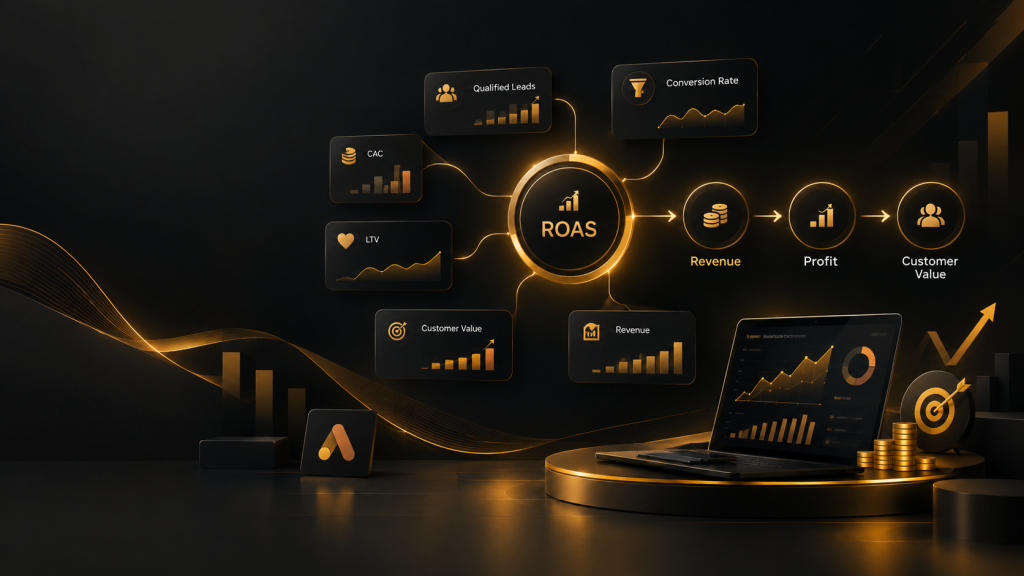
ROAS Is Not Enough: What Should Businesses Measure in Google Ads? Every Google Ads dashboard has a favourite number. For most businesses, it’s ROAS — Return on Ad Spend. It’s clean, it’s easy to calculate, and it makes reporting simple. Spend ₹50,000, generate ₹2,00,000 in attributed revenue, and you have a 4x ROAS. The slide looks great in the boardroom. But here’s the uncomfortable truth that experienced marketers learn the hard way: a 4x ROAS can lose money. A 2x ROAS can be the most profitable campaign in the account. The difference is everything ROAS leaves out — margins, repeat purchases, lead quality, customer lifetime value, and the difference between revenue and actual profit. This guide is for every business that runs Google Ads — e-commerce stores, lead-generation services, SaaS companies, local businesses, startups, and the marketing managers and PPC specialists who run their campaigns. You’ll learn why ROAS is a useful diagnostic metric but a dangerous sole benchmark, which metrics to track instead, and how to build a measurement framework that connects clicks to profit. What Is ROAS in Google Ads? ROAS (Return on Ad Spend) measures the revenue generated for every unit of currency spent on advertising. The formula is simple: ROAS = Attributed Revenue ÷ Advertising Spend If you spend ₹50,000 and generate ₹2,00,000 in attributed revenue, your ROAS is 4 (often written as 4x or 400%). This means the campaign generated ₹4 in attributed revenue for every ₹1 spent. Google Ads reports ROAS in the Campaigns tab when you have conversion values set up. It’s used both as a reporting metric and as a bid strategy target (Target ROAS) in automated bidding. Why ROAS Became a Popular Google Ads Metric ROAS gained popularity because it answers a question that every business asks: “Is our advertising working?” It’s platform-native, meaning Google Ads calculates it automatically. It works seamlessly with automated bidding. It’s easy to compare across campaigns, channels, and time periods. And critically, it gives a single, comprehensible number that non-marketing stakeholders can understand. There’s nothing wrong with using ROAS. The problem is when it becomes the only metric that matters. Why ROAS Alone Does Not Tell the Full Story ROAS answers one question: How much revenue did we generate relative to advertising spend? That’s valuable. But businesses need answers to harder questions: Are we acquiring profitable customers? Are leads actually qualified? How much does each customer truly cost to acquire? What is the customer’s lifetime value? Are conversions turning into real sales? Are campaigns creating incremental business? Is growth sustainable? Are we measuring the right conversion actions? Is the attribution model giving a realistic picture? ROAS cannot answer any of these. Worse, optimizing exclusively for ROAS can actively harm the business by favouring cheap retargeting clicks over expensive new-customer acquisition, or by rewarding low-margin products because the algorithm only sees revenue, not margin. ROAS vs ROI: What’s the Difference? ROAS and ROI are often used interchangeably. They are not the same thing. ROAS measures attributed revenue ÷ ad spend. It’s a top-line efficiency metric.ROI measures (profit − cost) ÷ cost. It accounts for all costs — COGS, fulfillment, overhead, salaries, agency fees — and expresses the net return. A campaign can have a 5x ROAS and a negative ROI. That happens when the revenue generated doesn’t cover the full cost of delivering the product or service. ROAS is a useful advertising metric. ROI is a business metric. Both matter, but ROI is the one that determines whether the business actually makes money. 12 Metrics Businesses Should Measure Alongside ROAS These metrics — grouped by financial, performance, lead generation, and e-commerce categories — give a fuller picture of Google Ads performance. 1. Customer Acquisition Cost (CAC) CAC measures the total cost to acquire one paying customer: total ad spend ÷ number of new customers acquired. Unlike cost per conversion (which may count form fills or add-to-carts), CAC counts actual customers. Google Ads supports a New Customer Acquisition goal at the campaign level, which lets you set a dedicated budget for acquiring first-time customers and reports new customer acquisition cost alongside standard metrics. 2. Customer Lifetime Value (LTV / CLV) LTV estimates the total revenue (or profit) a customer generates over their entire relationship with the business. Google Ads’ API includes a new_customer_lifetime_value metric that estimates the long-term value of customers making their first purchase through ads. The ratio LTV:CAC is one of the most important health indicators in any business. A general guideline is 3:1 — meaning a customer should generate three times their acquisition cost over their lifetime. 3. Conversion Rate Conversion rate is the percentage of users who complete a desired action (purchase, form fill, call, sign-up) after clicking an ad. It shows how effectively you turn clicks into actions. A high conversion rate with low-value conversions, however, can be misleading — which is why conversion quality matters as much as conversion volume. 4. Cost Per Conversion Cost per conversion (also called cost per action or CPA) is ad spend ÷ conversions. It tells you how much each conversion costs. The limitation: not all conversions are equal. A ₹200 cost per email sign-up is very different from a ₹200 cost per completed purchase. Always pair cost per conversion with the value of that conversion. 5. Cost Per Qualified Lead Cost per qualified lead is ad spend ÷ number of leads that meet your qualification criteria. This is a far more meaningful metric than cost per lead because it filters out leads that will never convert. To measure it, you need CRM integration — connecting Google Ads to your CRM so the platform knows which leads became qualified, which became customers, and which went nowhere. 6. Lead-to-Customer Rate The percentage of leads that become paying customers. If a campaign generates 100 leads but only 5 become customers, the lead-to-customer rate is 5%. This metric, combined with cost per lead, gives you true customer acquisition cost: cost per lead ÷ lead-to-customer rate = CAC. 7. Average

Uncategorized

AI Max vs Traditional Google Ads: What Has Really Changed in 2026?

AI Max vs Traditional Google Ads: What Has Really Changed in 2026? Google Search advertising in 2026 is undergoing its most significant structural shift in over a decade. For years, the workflow was predictable: you researched keywords, wrote ads, chose landing pages, set bids, and then optimized manually. The marketer decided what to target. Google executed. That model is changing. With AI Max, Google’s AI increasingly helps determine which searches may be relevant, which message to show, which landing page fits best, and how campaign signals should be interpreted. The marketer’s role is shifting from manual execution toward strategic direction, input quality, and oversight. This article examines what AI Max actually is, how it differs from traditional Google Search Ads, and what has genuinely changed in 2026 — without hype, without exaggeration, and with the practical clarity that experienced marketers need. AI Max vs Traditional Google Ads — the 2026 shift in Search campaign management What Is AI Max for Google Search Ads? Quick answer: AI Max is not a completely separate Search campaign type. It is an AI-powered optimization layer within existing Search campaigns that expands targeting through broad match and keywordless technology, automates parts of creative generation, and dynamically selects landing pages — all while retaining many of the controls and reporting that Search advertisers expect. Google introduced AI Max in 2025 as an open beta and moved it out of beta in April 2026. It was designed to help advertisers capture search demand that traditional keyword-based campaigns miss — particularly long-tail, conversational, and unpredictable queries that are growing as search behavior evolves. AI Max sits inside a standard Search campaign. You turn it on with a single click at the campaign level. It combines three core feature areas: Search term matching — expands your reach beyond existing keywords using broad match and keywordless technology Text customization — formerly known as automatically created assets, this generates and adapts headlines and descriptions based on your landing pages, ads, and keywords Final URL expansion — sends users to the most relevant page on your website based on their query intent Google’s own data indicates that advertisers using the full AI Max feature suite see an average of 7% more conversions or conversion value at a similar CPA/ROAS compared to using search term matching alone. For campaigns still relying heavily on exact and phrase keywords, Google reported typical uplift of up to 27% in earlier testing. Key takeaway: AI Max is an optimization layer, not a replacement campaign type. It operates within Search campaigns and is designed to work alongside existing keywords, not eliminate them. What Were Traditional Google Search Ads Like? Traditional Google Search campaigns followed a structured, manual workflow that gave advertisers granular control: Keyword research — identifying search terms your audience uses Match types — exact, phrase, and broad match to control how closely queries must match your keywords Ad groups — organizing keywords into tightly themed groups Responsive Search Ads (RSAs) — providing multiple headlines and descriptions for Google to test and combine Negative keywords — excluding irrelevant queries Landing-page selection — manually choosing which page each ad points to Bid strategy — setting manual or automated bids Search-term analysis — reviewing actual queries and adding negatives or new keywords This model offered clarity. You could see exactly which keywords triggered which ads and sent traffic to which pages. It also required significant manual effort, constant monitoring, and a willingness to iterate weekly. The limitation was coverage. Even with broad match, your campaigns could only target what you thought to include. Unpredictable, conversational, or emerging queries often fell through the gaps. AI Max vs Traditional Google Ads: Key Differences Area Traditional Search Ads AI Max Targeting Manually selected keywords and match types Keywords + broad match expansion + keywordless technology Keywords Central to targeting; you decide what to bid on Still matter, but AI expands beyond them using intent signals Search-term discovery You add new keywords manually after reviewing reports AI identifies and targets relevant queries automatically Ad creation You write all headlines and descriptions AI generates and adapts assets based on landing pages and context Landing pages Manually assigned per ad or keyword Final URL expansion can dynamically select the most relevant page Creative optimization Manual A/B testing of RSA assets AI-driven real-time adaptation Automation Limited to Smart Bidding and RSA rotation Targeting, creative, and landing page automation combined Brand controls Manual brand keyword management Brand exclusions, text guidelines, URL rules Location controls Campaign and ad group level Ad group level location controls available Reporting Search terms, keywords, assets, conversions Same reports plus AI Max-specific dimensions Advertiser control High — every query, ad, and page is chosen manually Strategy-level — you set signals, goals, and guardrails Manual workload High — constant keyword and ad management Lower — focus shifts to monitoring and strategic inputs Optimization approach Reactive — review data, then make changes Predictive — AI anticipates and adapts in real time Traditional Google Ads workflow vs AI Max automated workflow 1. Search Term Matching Has Changed In traditional Search campaigns, your targeting was defined almost entirely by the keywords you added. Broad match already expanded reach beyond exact keywords, but it still operated within the framework of keywords you provided. AI Max introduces keywordless technology — a capability similar to what Dynamic Search Ads (DSA) used. Instead of relying solely on your keyword list, AI Max can use your landing page content, ad creative, and real-time signals to identify relevant queries you may not have anticipated. This does not mean keywords have disappeared. They still serve as valuable signals. But they are no longer the only input into which queries your ads can match. Keywords tell Google what you think matters. AI Max also learns from what your website and ads actually communicate. Key takeaway: Keywords have not disappeared. Their role has shifted from being the sole targeting mechanism to being one of several signals that guide Google’s AI toward relevant queries. 2. Google

Uncategorized

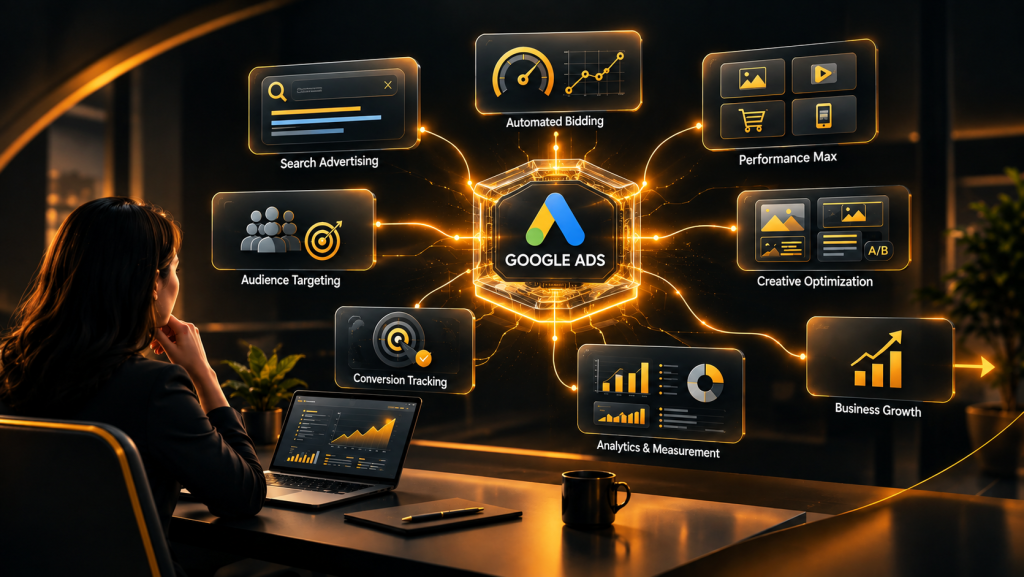
Google Ads in 2026: What Has Changed and What Businesses Need to Know

Google Ads in 2026: What Has Changed and What Businesses Need to Know Google Ads in 2026 looks fundamentally different from the platform most businesses learned to manage. The days of manual bid adjustments, keyword-by-keyword control, and campaign structures built around exact-match lists are fading. Google’s AI systems now handle bidding, budgeting, query matching, and even creative generation at a scale no human team can match. This isn’t a gradual evolution. In 2026 alone, Google rolled out AI Max for Search, renamed its entire Smart Bidding framework, added first-party audience exclusions to Performance Max, and introduced Journey-Aware Bidding for lead generation. Businesses that haven’t adapted their PPC strategy are already seeing the impact: higher costs, wasted spend, and campaigns that underperform despite looking healthy in the dashboard. This guide breaks down exactly what has changed, what those changes mean for your campaigns, and what you need to do differently to get results. Quick Answer: What Has Changed in Google Ads in 2026? In 2026, Google Ads shifted decisively toward AI-driven automation. The biggest changes include AI Max for Search replacing legacy broad match and dynamic search ads, a unified Smart Bidding naming framework, new Performance Max controls for audience exclusions and reporting, and a stronger emphasis on first-party data and conversion quality. Businesses must now focus on data quality, creative inputs, and measurement accuracy rather than manual bid management. What Is Google Ads and How Does It Work? Google Ads is Google’s paid advertising platform. Businesses bid to show ads on Google Search, YouTube, Google Maps, and across millions of websites and apps. The core system is a real-time auction: when someone searches, Google runs an auction in milliseconds to decide which ads appear, in what order, and at what cost. Your bid is the maximum you’re willing to pay for a click. But bid amount alone doesn’t determine who wins. Google also evaluates the quality of your ad and landing page for that specific query, your ad relevance, expected click-through rate, and the search context including location, device, and time of day. This is why a well-built ad with a strong landing page can win a higher position at a lower cost than a competitor bidding more. At its core, Google Ads connects three things: keywords (what people search), search intent (what they actually want), and conversions (the actions that matter to your business). In 2026, Google’s AI systems handle far more of the matching and bidding work—but the fundamental logic of connecting intent to value remains the advertiser’s job. What Has Changed in Google Ads in 2026? 2026 brought several verified, structural changes to Google Ads. Here’s what actually changed, why it matters, and what businesses should do. What Changed Why It Matters What Businesses Should Do AI Max for Search replaces legacy broad match and Dynamic Search Ads settings Campaigns using automatically created assets or campaign-level broad match will be upgraded to AI Max for Search starting September 2026. AI Max enables automated search term matching, text customization, and final URL expansion. Review campaigns with broad match or automated assets enabled. Decide whether to opt into AI Max voluntarily or disable legacy features to avoid automatic upgrade. Smart Bidding strategy labels unified in June 2026 Target CPA and Target ROAS are now standalone options again, separated from Maximize Conversions and Maximize Conversion Value. The underlying behavior is unchanged, but the naming clarity helps advertisers choose the right strategy. Re-evaluate your bid strategies. If you were using Maximize Conversions with a target, switch to the standalone Target CPA label for clearer intent. Budget-limited campaigns now adhere more closely to bid targets Starting August 17, 2026, campaigns with Target CPA or Target ROAS that are limited by budget will perform more consistently with the target you set, even during budget adjustments. Check your target settings. If your actual CPA has been lower than your target, update the target to reflect realistic performance before the change takes effect. Performance Max adds first-party audience exclusions and expanded reporting Advertisers can now exclude existing customer lists from Performance Max campaigns and access budget reports, audience demographic breakdowns, and placement reports segmented by network. If running acquisition-focused Performance Max campaigns, exclude existing customer lists to reduce wasted spend. Use the new reporting to understand where budget is actually going. Google Ads Terms of Service updated effective July 1, 2026 The new terms address how advertiser inputs are used across AI features, URL crawling permissions, and the obligation to review automatically generated assets. Review the updated terms. Ensure your team understands how AI-generated assets and automated settings interact with your brand and compliance requirements. Sources: Smart Bidding Strategy Naming Update (Google Ads Developer Blog, June 2026) Changes to Target-Based Bidding Strategies (Google Ads Help) AI Max Auto-Upgrade for Broad Match Campaigns (PPC Land, August 2026) Performance Max 2026 Updates (Search Engine Journal) Google Ads Terms of Service Update (Google Ads Help, April 2026) How AI Is Changing Google Ads in 2026 AI is no longer a feature inside Google Ads. It is the operating layer. In 2026, Google’s Gemini models power campaign creation, bidding, budget allocation, creative generation, and performance reporting. The question is no longer whether to use AI—it’s how to direct it. Where AI Now Operates in Google Ads Campaign creation: AI Max and Smart campaigns generate campaign structures from a business goal and a website URL. AI suggests keywords, audiences, and ad variations. Query matching: AI Max expands search term matching beyond exact and phrase match, using intent signals to find queries your manually built keyword list would miss. Bidding: Smart Bidding adjusts bids in every single auction using real-time signals including device, location, time, browser, and historical conversion patterns. Budget allocation: Demand-led budget pacing shifts spend toward periods of predicted higher demand while staying within monthly limits. Creative generation: Asset Studio uses Gemini to generate headlines, descriptions, and even short-form video from uploaded images. Veo, Google’s generative video model, can create 10-second video ads from three static images. Optimization

Uncategorized

How Social Media Is Becoming the New Search Engine

SOCIAL SEARCH How Social Media Is Becoming the New Search Engine For more than two decades, searching for information meant opening Google, typing a few words into a box, and scanning a list of blue links. That habit is now changing. People still open search engines, but millions of them also turn to TikTok to find a pasta recipe, Instagram to research a skincare product, YouTube to learn a new skill, Reddit to compare headphones, and Pinterest to plan a home renovation. Search has become distributed. It happens across search engines, social platforms, video apps, communities, and AI-powered tools. This shift is often described as the rise of the social media search engine — the idea that social platforms increasingly function as places where people search, discover, compare, and decide. This article explains what social search is, why people are using it, how it differs from traditional search, and what businesses can do to stay visible. Whether you run a local shop, manage a startup, or build a personal brand, understanding social search is no longer optional. What Is Social Search? Social search is the act of using social media platforms to find information, products, services, recommendations, and answers. Instead of starting on a traditional search engine, a user might open TikTok and type “best budget skincare for oily skin” or search Instagram for “vegan restaurants near me.” The platform returns videos, posts, creator recommendations, and community discussions rather than a list of web links. Social search works differently from traditional search. Platforms interpret queries using keywords, captions, hashtags, on-screen text, spoken words, and engagement signals. Recommendations and personalization play a larger role. Two people can search the same phrase and see different results because their feeds are shaped by their behavior, interests, and social connections. This does not mean traditional search engines have stopped mattering. It means search is becoming multi-platform, and social platforms are now part of the discovery journey. Why Are People Using Social Media to Search? Several forces are driving this behavior shift. 1. Visual Discovery People want to see a product in use, a destination in motion, or a recipe being made. Visual platforms make this natural. 2. Short-Form Video TikTok, Reels, and YouTube Shorts deliver fast, digestible answers. A 15-second video can explain more than a paragraph of text. 3. Real User Experiences People often trust ordinary users more than brand messaging. Social search surfaces real experiences from real people. 4. Reviews and Recommendations Comments, reviews, and community discussions act as social proof. Users can see what others think before making a decision. 5. Creator Influence Creators explain, demonstrate, and recommend. Their content often ranks well in social search because it answers specific questions. 6. Community Discussions Platforms like Reddit allow users to ask questions and get honest answers from people who have already solved the problem. 7. Personalized Results Social platforms use behavior, interests, and engagement to tailor results. The experience feels more relevant. 8. Faster Answers A short video or a pinned comment can answer a question faster than scanning multiple web pages. 9. Product Discovery Social commerce is growing. Users can discover and buy products without leaving the app. 10. Local Business Discovery Instagram, TikTok, and Facebook help users find local restaurants, salons, gyms, and services through location tags, reviews, and community recommendations. How Social Search Is Different From Traditional Search Factor Traditional Search Social Search Discovery Query-based, links Feed-based, content Content format Text, images, links Video, audio, carousels, posts Personalization Limited, based on history High, based on behavior and interests Social proof Reviews on third-party sites Likes, comments, shares, saves User intent Often informational Often exploratory and commercial Recommendations Algorithmic, but link-focused Creator and community-driven Reviews Separate review platforms Native comments and community posts Creator influence Limited Central to discovery Community interaction Indirect Direct and conversational Visual discovery Image search Native visual and video search Purchase discovery Research then buy elsewhere Research and buy in-platform The comparison is not about one being better. It is about different strengths. Traditional search is strong for broad information retrieval, structured data, and finding specific websites. Social search is strong for inspiration, validation, and discovery through people and communities. Which Social Media Platforms Are Becoming Search Platforms? Instagram Instagram search has evolved beyond accounts and hashtags. Users can search keywords, audio, places, and Reels. Instagram has also introduced AI-generated search summaries to help users understand results. Captions and on-screen text matter for discoverability. For businesses, this means optimizing profile bios, captions, alt text, and location tags. Local businesses can benefit from place searches and location tags. YouTube YouTube is a major search platform and a leading source in AI-powered search results. YouTube is cited 200 times more than any other video platform in AI search results, and 29.5% of Google AI Overviews cite YouTube. Titles, descriptions, chapters, and spoken keywords all influence discoverability. Tutorials, reviews, and how-to content perform strongly. TikTok TikTok has become a search destination, especially for younger users. A 2025 WARC report found that 86% of Gen Z internet users search on TikTok weekly, nearly matching traditional search engines. TikTok’s search is visual and trend-driven, with users searching for sounds, effects, and topics. Keywords in captions, on-screen text, and spoken audio all contribute to discoverability. Facebook Facebook search is often community-driven. Groups, Marketplace, Events, and local business Pages create spaces where users search for recommendations, services, and products. LinkedIn LinkedIn search serves professional discovery. Users search for experts, companies, industry insights, and jobs. Content that answers professional questions performs well. Pinterest Pinterest is built for visual discovery. Users search for ideas in fashion, home design, recipes, and more. Pinterest has expanded visual search features, including image-based search and an AI-powered assistant for shopping discovery. Reddit Reddit search is growing rapidly. Reddit reported 80 million weekly search users in Q4 2025, up from 60 million the year before. Reddit Answers, its AI-powered feature, reached 15 million weekly users. Reddit content is frequently cited in AI search results because it reflects real

Uncategorized

The Rise of Creator Marketing: Why Small Creators Can Be Powerful for Brands

The Rise of Creator Marketing: Why Small Creators Can Be Powerful for Brands Ask most brand teams what a good influencer campaign looks like and you will usually hear the same answer: big follower counts, big reach, big names. Yet some of the most useful brand partnerships happening right now involve creators with 3,000, 10,000, or 25,000 followers. People who will never trend on a national news cycle, but who happen to have exactly the audience a brand needs. That is the shift behind the rise of creator marketing. For years, influencer marketing meant renting attention from someone famous. Today it increasingly means building something with someone credible. The difference matters, because follower count tells you how many people are watching. It does not tell you how much those people trust the person talking. In this guide we will break down what creator marketing actually is, why small creators can punch well above their weight, how to find and evaluate them, how to run campaigns that produce measurable results, and the mistakes that quietly drain budgets. Whether you run a D2C label, a local clinic, a café, or a B2B startup, the principles are more similar than you would expect. What Is Creator Marketing? Creator marketing is a strategy in which brands collaborate with content creators to reach relevant audiences through creator-produced content, recommendations, demonstrations, or other forms of partnership. The creator builds an audience around a specific interest. Budget cooking. Sensitive-skin skincare. Home workouts for people over 40. Accounting software for freelancers. A brand then works with that creator to produce content that fits naturally into what the audience already came for. How it works in practice Most creator partnerships follow one of a few shapes: Sponsored content — the creator makes a post or video that the brand pays for, with clear disclosure. Product gifting — the brand sends product, and the creator may or may not post about it. No guarantees unless agreed in writing. Affiliate arrangements — the creator earns a commission on sales driven through a unique link or code. Ambassadorships — an ongoing relationship across several months or a year, rather than a single post. Content licensing — the brand pays to reuse creator-made content in its own ads, website, or email. How it differs from traditional advertising Traditional advertising is interruption-based. You buy space, you control the message, and you push it in front of people who may or may not care. Creator marketing works the other way. The creator controls the tone and format, the platform decides who sees it based on interest signals, and the audience chooses to watch because they already follow that person. That means less control for the brand. It also means far more native credibility when it is done well. Creator marketing vs influencer marketing The two terms overlap, and plenty of people use them interchangeably. The practical difference is emphasis. Influencer marketing traditionally revolved around reach. A brand paid a well-known face to endorse a product, and success was measured largely in impressions. Creator marketing is content-first. It includes the person who films a 12-part series about building a home office, the food creator whose recipes consistently get saved, and the B2B writer whose LinkedIn breakdowns get screenshotted. You can think of influencer marketing as one slice of creator marketing. Creator marketing is the wider category, and it keeps widening as more people build audiences around things they genuinely know. Why Is Creator Marketing Growing? Several forces are pushing brand budgets toward creators at the same time. None of them is brand new, but together they have changed what works. Consumers have learned to ignore ads People scroll past sponsored placements without registering them. Ad blockers, premium ad-free tiers, and plain old habit have all reduced the value of the interrupt-and-hope model. A recommendation from a person the audience chose to follow lands differently. It reads as advice, not advertising. The creator economy gave people a reason to build audiences Platform monetisation tools, brand deal marketplaces, and creator funds turned content creation into a viable income stream. Goldman Sachs Research has projected the creator economy could approach roughly half a trillion dollars in market value by 2027, up from around a quarter trillion in 2023. That is a forecast, not a guarantee, but the direction is clear: more people are creating professionally, and more of them are specialists rather than generalists. Social platforms now distribute by interest, not follower count Instagram Reels, TikTok, and YouTube Shorts push content to people who do not follow the account. A creator with 4,000 followers can produce a video that reaches 400,000 people if the algorithm decides it is worth showing. That single change made small creators commercially interesting to brands in a way they were not five years ago. Audiences reward content that does not look like a commercial Polished, scripted brand content still has a place, usually in paid placements. But inside a feed, something filmed on a phone in a real kitchen often outperforms a studio production. The audience is not comparing your creator content with other brands. They are comparing it with the other content in their feed. Communities have fragmented into niches Mass marketing assumes a shared culture. That assumption is weaker than it used to be. Hobbyist communities, professional subcultures, and local interest groups all run on their own references. A niche creator can speak to one of those groups with a precision a broad campaign cannot match. Short-form video lowered the cost of producing content A creator can shoot, edit, and publish a vertical video in an afternoon. Brands benefit from that speed, especially when they need fresh creative every week rather than every quarter. Social commerce and UGC closed the loop Shopping features inside social platforms and the widespread use of creator content in paid ads mean creator output is no longer just top-of-funnel. It can be a performance asset too. Who Are Small Creators? Small creators are content creators with

Uncategorized

How Small Businesses Can Grow on Instagram Without Thousands of Followers

How Small Businesses Can Grow on Instagram Without Thousands of Followers You post every day. You look at your follower count. It doesn’t change much. Then you see someone with 15,000 followers and start to think maybe your account isn’t worth the time. Here is the good news. Small businesses can grow on Instagram without having thousands of followers because followers are not the same as customers. A business with 800 followers who live close by trust the brand and message often can do better than an account full of people who don’t buy anything. This guide shows what really helps small business Instagram growth: being building trust getting engagement being easy to find and having a clear way for people to buy from the profile. You will get a content plan 25 content ideas, a profile checklist, a table with numbers, a way to turn views, into sales and a 30-day plan. Nothing here promises growth. It is a way to make a small account work better. Can a Small Business Grow on Instagram Without Thousands of Followers? Yes. A small business can grow on Instagram by reaching the people not the most people. Content that is relevant conversations that’re real proof that is social and a clear path from profile, to inquiry can create leads and customers. Follower count is one signal. Engagement, trust and conversions show whether Instagram is actually helping the business. Why Follower Count Is Not the Same as Business Growth A follower is a person who clicked Follow. A customer is a person who gave money. Those are different actions. Follower count measures how many people chose to see posts. Follower count does not measure whether those people: Need what you sell Live in your service area Trust your brand Read, save, share or reply to your content Contact you or buy These are often called vanity metrics because they look impressive but say little about business results. Follower count is not useless. Follower count can signal proof and some partnerships or brand collaborations set minimum thresholds.. Follower count should never be the only number that the business watches. Here is a simple way to think about follower count: A small Instagram audience can still be valuable when the people following the account are the customers. Instagram growth works as a chain: content → reach → engagement → trust → profile visits → leads → customers. Followers sit somewhere in the middle. A weak link anywhere in the chain, such as a bio or slow replies to DMs wastes attention that the business already earned. Consider a neighborhood salon with 700 followers. Its posts get replies, appointment DMs, story shares and referrals from local clients. A larger account with 20,000 followers scattered across countries might send far fewer bookings. The first account is smaller but closer, to revenue. (This is an example not a case study.) Can a Small Instagram Account Really Compete With Larger Accounts? Yes, in the ways that matter to a business. A small account can’t out-post a brand.. It can out-relate it. Small accounts often have advantages: Niche focus. You can speak to one type of customer of everyone. Local relevance. A café can matter deeply to a neighborhood even if nobody outside it ever hears of it. Personal communication. You can reply to comments and DMs like a person. Community relationships. Customers can know the owner or the team by name. Customer intent. Someone who follows a dentist may already be considering a visit. This is the logic behind micro-influencer marketing. Brands often work with creators who have more focused audiences because relevance and trust can matter more than raw size. One caution. Small accounts do not automatically get engagement. Results depend on your content quality, niche, audience fit, consistency and how you interact with people. A small account with content and slow replies can perform poorly. The advantage is potential. You have to build on it. Instagram also doesn’t limit content to existing followers. The platform has explained that it ranks content differently across Feed, Stories, Reels and Explore using signals such as post information, the poster, a persons activity and their history with that account. Formats like Reels and Explore can surface content from accounts people don’t yet follow. That means a small account can still be discovered when its content is useful, to the viewer. What Actually Helps Small Businesses Grow on Instagram? Focus on these ten areas. You do not have to master all of them at the time. Start with the three. Create Content for a Specific Audience Write for one type of Customer not for everyone on Instagram. Before posting ask yourself: Who is this for? What does this Customer want? What does this Customer worry about? A yoga studio might speak to professionals with tight shoulders. A bakery might speak to people ordering custom cakes for family events. Specific Content is more likely to be saved shared and remembered. Solve Customer Problems Content that answers a question earns attention faster than Content that only announces your existence. Turn your common Customer questions into posts. If people keep asking “How does a filling take?” or “Which moisturizer is right for dry skin?” that is your Content calendar. Focus on Content Quality and Relevance Quality does not mean production. It means useful and on-topic. A lit phone video with a genuinely helpful tip can beat a polished ad that says nothing. Ask of every post: Would my ideal Customer stop scrolling for this? Use Instagram Discovery Features Discovery on Instagram comes from places: Reels can reach people who do not follow you yet. Explore surfaces Content based on interests. Search now works with keywords, clear captions, profile text and topic-focused language can help people find you. Shares and sends carry Content to viewers through trusted people. Collaborations put Content in front of another accounts audience. Instagram ranking signals change over time. Treat any “algorithm hack” with caution. Check Instagram official resources for current

Uncategorized

Is Follower Count Still Important in 2026? What Really Matters

Is Follower Count Still Important in 2026? Follower count still matters,. Only as one signal among many. It helps build proof adds to perceived credibility and can boost the reach when someone first lands on your profile.. It does not tell you if your audience is active if they care about your content or if they are likely to buy from you. That’s why follower count should never be seen as the measure of success on social media. Having a following can help open doors. A big number of followers can make a new visitor trust your brand quickly. It can also make it easier to get noticed for partnership opportunities.. The businesses that grow in a sustainable way by 2026 are the ones who don’t just focus on numbers. They combine follower growth with engagement. They pay attention to how relevant their audience is.. They track results that matter—like leads generated and actual conversions made. The rest of this article breaks down how to find the right balance, between these signals. It explains how to look beyond the follower count and build a strategy that actually moves the needle. Why Follower Count Became So Important Follower count became well known for a reason. In the days of social media it was one of the few numbers that stood out right away and it had a weak link to a few things that businesses cared about: Social proof. A large number of followers showed that other people had already trusted the brand to click “follow.” Perceived popularity. People tend to notice what seems popular and follower count was a way to see if something was popular. Brand credibility. New visitors used follower count as a not perfect, way to check if they could trust the brand before getting involved. Potential reach. More followers meant people who could see each post. Influencer marketing. Brands used follower count as the way to decide who to work with. Community building. Growing a following was often the clear sign of building an online community. The key difference is this: having followers  not the same as having an audience that actually pays attention. A follower is someone who pressed a button once. An audience is made of people who come back interact and remember you. Businesses that realized this difference, on created stronger more lasting online spaces. And that difference has only gotten bigger. Why Follower Count Alone Can Be Misleading A number of followers can seem impressive at glance but can also hide issues below the surface. Many things can make the number higher without helping the business: Followers who stopped being active a long time ago and no longer interact with the content. Followers and robot accounts that are only there to make numbers look bigger. Followers that were bought which hurt the rate of interaction and trust from the platform. An audience that exists but doesn’t match the brands customer. Followers who live in places where the brand doesn’t actually offer services. People who rarely like, comment, share or click on content. People who never become leads subscribers or customers even though they follow. In short a profile with 100,000 followers but low interaction can provide less real business value than an account, with a much smaller number of followers but a group that is very engaged and fits the brand. Numbers that look good in a picture don’t pay the bills. They don’t always show how many real people are actually seeing and acting on the content. What Matters More Than Follower Count in 2026? Than chasing a single number businesses gain from watching a broader view of performance. Here is a simple guide to the metrics that’re worth your attention. Engagement Rate Engagement rate tells you how actively your audience interacts with your content by liking, commenting, sharing and saving it compared to the size of your audience or reach. Engagement rate is a stronger sign of whether your content really speaks to the people who see it rather than simply counting how many people are following you. Reach and Impressions Reach counts the number of accounts that saw your content while impressions count the total number of times your content was shown even if the same person saw it many times. Reach shows how far your content traveled; impressions show how often it was seen. Both matter,. Each answers a different question. Saves and Shares Saves and shares often signal content value than likes because they need more deliberate action. A save usually means someone found the content enough to look at again later. A share means someone found it valuable enough to send to their network, which extends your reach naturally. Comments and Conversations A flood of comments is less valuable than a smaller number of thoughtful relevant conversations. Comments that ask questions share opinions or tag other people signal an engaged audience, which is more likely to turn into customers. Click-Through Rate For campaigns that aim to drive traffic to a website, landing page or product listing click-through rate (CTR) shows how well your content or call-to-action persuades people to take the step. High engagement with CTR often means the content entertains but does not convert. Leads and Conversions Leads and conversions link activity to real business outcomes such as form fills, inquiries, bookings and purchases. These numbers matter more than any vanity metric because they show progress toward revenue, not attention. Audience Quality Audience quality looks at whether your followers  truly relevant, based on their demographics, location, interests and intent. A relevant audience of a few thousand can outperform a broad unfocused audience many times its size when it comes to real business impact. Customer Acquisition and ROI businesses need to link social media activity to real financial outcomes. That means tracking customer acquisition cost through channels and calculating return, on investment (ROI). How much revenue or value was generated compared to what was spent on content, ads and management time. Does Follower Count Matter

Uncategorized

AI-Generated Content vs Human Content: Which Performs Better?

AI-Generated Content vs Human Content: Which Performs Better? Every team that creates content has had some version of this discussion in the two years: should we let AI write this or does it need a human? This is not a question anymore. AI tools can create a blog post in a few minutes but search engines, readers and even AI helpers are becoming better at seeing the difference between content that is truly helpful and content that is just empty words. So here is the real question this article answers: does content created by AI actually work well as content written by people? The quick answer is: it depends less on who or what wrote it and more on whether the content’s correct, helpful, new and honest. AI-written content can do well when it is researched checked for facts and edited carefully. Content written by people can do badly when it is done fast vague or not optimized well. Success depends on the quality and purpose. Not who wrote it. Let’s look at what that means for your plan, for creating content. What Is AI-Generated Content? AI-generated content is content that is made using intelligence tools. These tools use language models to create text based on a prompt, an outline or information that is already available. Examples include blog posts, product descriptions, social media captions, email messages and even full articles. Most companies today do not publish content that is created by AI without any changes. Instead AI helps in some part of the process. It can be used to:  Write a draft of an article  Create outlines or content briefs  Summarize research or long documentsMake different versions of ad copy or meta descriptions  Turn one piece of content into several different formats The quality of the content that is made by AI depends a lot on the prompt that is given. It also depends on the data the AI was trained on and how much a person checks and edits the output. Content that is published without any editing often sounds generic. That is because the AI is not experiencing life. It is just predicting what words are likely to come based on patterns, in the data. Can AI-Generated Content Rank on Google? Yes. Content that is created with the help of intelligence or is entirely created by artificial intelligence can show up in search results when it offers real value and follows the standards that search engines look for. Googles own instructions have focused on giving credit to content that’s useful and made with people in mind and they have said it does not matter how the content is made. What matters is if it is useful and trustworthy. For the up-to-date and accurate information on this topic go directly to Google Search Central as the advice can change over time. That being said, being ranked is one part of the situation. Ranking puts content in front of people. Whether people stay, trust it and become customers depends on the quality of the content they see. Which brings us back to the standards, for editing, not who wrote it. Why Human Content Can Still Have an Advantage With strong AI tools there are areas where human involvement tends to matter most. Keep in mind: these advantages depend on the writer and the editorial process not on being human. First-Hand Experience. Someone who has actually used a product run an event. Lived through a situation can describe details AI simply doesn’t have. A real experience brings texture, small truths and authentic details that no dataset can replicate. Original Insights. A new angle or opinion not a synthesis of existing content. It’s about seeing something others miss offering a perspective that wasn’t just pulled from the web. Expert Judgment. Knowing which advice actually applies to a situation. This isn’t about information but about knowing when to apply it and when to hold back. Emotional Intelligence. Reading what an audience needs emotionally not informationally. A human writer can sense the mood in the room the unspoken concerns and respond accordingly. Storytelling. Structuring a narrative that builds and pays off. It’s about pacing, tension, surprise and meaning. Things that make readers feel something. Brand Personality. Writing that sounds like this company, not a voice. A human writer absorbs the tone, the values, the rhythm of the brand over time. Nuance. Understanding when a rule has exceptions. It’s about knowing that not every situation fits the template and knowing why. Fact-Checking. Catching errors AI tools can introduce with confidence. A human can spot the inconsistencies that make the difference between right and wrong. Audience Understanding. Knowing what this specific reader already knows and needs next. It’s about listening, not just speaking. It’s about meeting people where they’re Strategic Decision-Making. Deciding what content should even exist and why. Not every topic deserves a post. Not every idea should be written. This is, about purpose not output. Where AI-Generated Content Has an Advantage AI tools truly work well in parts of the content process. Speed. They can produce drafts faster than someone writing by hand. Ideation. They help come up with angles, headlines and topic ideas quickly. Outlining. They assist in organizing an article before the writing starts. Research assistance. They can summarize documents or large data sets efficiently. Content repurposing. They turn one piece of content into media posts, emails or scripts. Drafting. They create a version that a human writer can improve. Scaling workflows. They support managing content calendars easily. Summarization. They shorten articles into shorter versions. Brainstorming. They offer options for a writer to consider. SEO briefs. They build outlines based on target keywords. Meta descriptions and variations. They generate copy variations, for testing. When used this way AI acts as a productivity layer. It doesn’t take the place of judgment. Where AI-Generated Content Can Struggle Left unsupervised AI content tends to run into problems: Generic forgettable writing Repetitive phrasing and sentence patterns No first-hand experience to draw on Contextual or

Uncategorized

Is SEO Still Worth It in 2026? Here’s the Honest Answer

Is SEO Still Worth It in 2026? SEO is still worth it in 2026 for businesses that depend on search demand.. The meaning of “SEO” has changed. It’s not about getting a page to rank high on Google anymore. It’s about staying visible where people look. In search results in AI-generated answers and across the wider discovery systems that shape how users find and pick businesses. The main reason SEO matters hasn’t changed: people are still searching. Every day billions of queries happen on Google, Bing and other tools. Including AI assistants. When someone asks a question through any of these platforms they’re showing intent.. Businesses can still position themselves to meet that intent. What’s different isn’t the need to be found. What’s different is how people search, where they search and what happens after the search. SEO, in 2026 must respond to all three of those shifts. One way to understand this: SEO once focused on ranking in one system. Like Google’s search results. Now it’s about staying relevant across connected systems. Traditional search, AI summaries and conversational discovery. All of which use similar signals: relevance, authority and trust. What Has Changed About SEO in 2026? Search has changed in ways and SEO needs to change too. AI-powered search is now a force.  Search engines use AI models to understand what you’re asking, create summaries and even chat with you. Of just showing a list of links they can have back-and-forth conversations. AI Overviews are appearing at the top of search results. These are summaries made by AI that pull together information from sources. They give users an answer without needing to click through. Conversational search is growing. People aren’t typing phrases anymore. They’re asking questions in natural language. This means search engines care more about intent. What the user really wants. Than whether the words match Zero-click searches are happening often. Many users find what they need right in the search results. They don’t click any link all. That makes it harder to get traffic from search. It also means visibility can happen without a click. Entity-based search is shaping how results are ranked. Search engines now understand that brands, topics and ideas are connected. They look for content that shows knowledge on a topic, not just a list of keywords. Semantic search has become the norm. Of matching words word-for-word search systems understand context and meaning. Content that explains a topic well. Than just repeating keywords. Ranks better. First-hand experience matters more than ever. Google is asking for expertise especially in YMYL (Your Money or Your Life) areas. Content that shows experience. Not just research. Gets rewarded. Multimodal search means you can search using text, voice, images or videos. A business can’t just focus on written content anymore. It needs to be visible, across all formats. Search results are becoming more personal. The same search term can give results to different people. Location, past behavior and interests all shape what you see. None of these changes make search visibility unimportant. They just change where and how visibility happens. The goal is not to ignore search. It’s to adapt to how it’s working. Why SEO Is Still Important for Businesses With all the disruptions search is still one of the rare marketing channels where businesses can reach people exactly when they are looking for something. It does not interrupt their day; it simply answers a question they already have. SEO, done well can still support: Higher organic visibility on search engines and in AI-generated results Access to users with intent who are actively researching a solution, product or service Brand awareness grows when your business appears consistently in relevant searches Qualified traffic that comes to your site already interested in the topic or offer Lead generation through both informational and commercial content E-commerce discovery helping products show up while shoppers research and compare Long-term digital visibility that does not vanish when ad spend stops Reduced reliance on paid advertising, especially for competitive high-cost keywords Topical authority, which increasingly shapes both traditional rankings and AI-generated answers None of this happens automatically. SEO does not guarantee traffic leads or sales. It simply creates the conditions, for visibility. What follows depends on the quality of the offer the level of competition and how well the execution is carried out. The Five Pillars of High-ROI Search in 2026 When an agency hands you a sprawling 18-point checklist of SEO tasks, your team gets paralyzed. In reality, modern search success hinges on five prioritized pillars: Pillar 1Primary Filter The “Experience Moat” (Proof of Humanity) Google’s E-E-A-T framework is no longer a gentle recommendation; it is their primary algorithmic line of defense against the flood of synthetic content. If an article could have been drafted by an AI scraping Google for 30 seconds, it will be suppressed. Include real screenshots, unvarnished project debriefs, benchmark numbers from your internal platform, and verified author credentials. Real human experience cannot be hallucinated. Pillar 2Algorithm Defense Information Gain Over Word Count A 3,000-word post that simply rephrases what the top three results say has an Information Gain Score of zero. Google filed patents specifically to reward content that introduces fresh data, counter-arguments, and novel findings to the user’s journey. Before hitting publish, ask: “What does this piece say that ChatGPT doesn’t already know?” Pillar 3Revenue Driver High-Intent Commercial Research Surrender cheap, low-intent informational traffic to the AI Overviews. Allocate 80% of your search budget toward high-intent evaluation queries: comparative teardowns (“Platform A vs Platform B for Series B Startups”), total cost of ownership calculators, and migration case studies where serious prospective buyers actively demand human nuance before committing funds. Pillar 4Entity Reputation Digital Word-of-Mouth & Brand Resonance Bought backlinks from spammy guest-post networks are hazardous waste in 2026. What moves the needle today is genuine digital reputation: being mentioned organically on podcasts, discussed by real users on Reddit and industry Slack channels, and earning unprompted citations from respected industry peers. Pillar 5Baseline Hygiene Clean Technical Speed & Pristine UX When

Uncategorized

10 SEO Mistakes That Are Hurting Your Website

10 SEO Mistakes That Are Hurting Your Website Most websites don’t fail at SEO because of one mistake. They fail because of small issues that people often overlook. These problems build up quietly over time. A slow-loading page a keyword that doesn’t match what users are searching for there or an outdated content page that no one refreshes. On their own each of these issues seems minor.. When they add up they create a real problem. That’s why many sites with good products, clean designs and real expertise still can’t get noticed in search results. The hardest part is that these mistakes don’t make your site crash. Your rankings don’t drop suddenly. Instead traffic just stops growing. Leads slow down. You might think the market has changed.. The truth is, the issue might be hiding right inside your own website. This guide looks at the 10 common SEO mistakes that hurt visibility organic traffic and conversions. For each one we’ll show you how to fix it with practical steps. No extra fluff.  1. Ignoring Search Intent What It Means Search intent is the reason a person types a query into Google. Search intent shows what the user truly wants when they enter those words. Every query usually falls into one of four groups: informational, where the user is learning something; navigational, where the user seeks a site; commercial, where the user compares options; or transactional where the user is ready to buy or act. Why It Hurts Your Website When content does not match what search intent actually wants Google notices. If a user searches for ” running shoes for flat feet” and lands on a page that only tries to sell one shoe model without any comparison or guidance that user will leave the page almost immediately. That quick exit is a signal and over time it tells search engines that this page is not an answer for that query – even if the writing is excellent. Common Signs High impressions in Search Console but low click‑through rate  Pages that rank on page 2–3 and never move up  bounce rate and short time‑on‑page for specific keywords  Content format does not match what already ranks (for example a product page competing against how‑to guides)  Traffic arrives but conversions stay flat How to Fix It Search the target keyword yourself and review the top five to ten results. Identify the content format – guide, list, product page, comparison or tool. Match that format then set your content apart with detail, clearer explanations or useful examples. Re‑check search intent periodically – search intent shifts as industries and user behavior evolve. Example A business writes a blog post, about “CRM software” hoping to rank but the top results are all comparison pages and vendor listings. The blog post struggles to rank not because it is poorly written. Because Google has already determined that search intent wants a comparison, not a narrative article. Quick Fix: Before you write anything Quick Fix, by looking at what’s already ranking. Quick Fix will show you the format and depth that Google believes the searcher wants. 2. Targeting the Wrong Keywords What It Means This happens when a website tries to rank for keywords that’re too hard to beat, too broad or just not connected to what the business actually does. Why It Hurts Your Website Trying to rank for popular keywords without thinking about whether they make sense for your business wastes time and money. A small bakery in a town trying to rank for ” cakes” is up against big national brands and websites with years of experience. At the time more specific easier-to-rank keywords stay ignored. Common Signs  Content appears in search results for keywords that don’t lead to customers  More people visit the site but no increase in calls, messages or sales  The keywords you use don’t match what real users type into Google  You only focus on short and ignore long-tail ones – You pick keywords with high difficulty scores even though your site isn’t strong enough to compete How to Fix It  Split your keywords into three groups: informational (people looking for answers) commercial (people comparing options) and transactional (people ready to buy)  Start with long-tail keywords. They’re less competitive and often lead to better conversions  Choose keywords that match your site’s current strength. Don’t go after the hardest terms right away  Focus on relevance over search volume. It’s better to get traffic from a smaller group of interested visitors than from a large crowd that doesn’t care Example A law firm that tries to rank for “law firm” across the whole country will lose to big legal websites with decades of authority.. If that same firm targets “family law attorney in [city]” it has a much better chance.. Those searches are more likely to bring in actual clients who need help. Quick Fix: Build your keyword list based on what your ideal customer would type into Google. Not just the numbers, with the highest search counts. 3. Publishing. Low-Value Content What It Means Thin content does not truly help the reader. These pages exist mainly to target a keyword of answering a question thoroughly. Why It Hurts Your Website Word count has never been a ranking factor. A 300‑word page that fully answers a question can outperform a padded 2,000‑word article that says very little. What actually hurts rankings is a lack of depth originality or usefulness. Thin content reads like it was written to satisfy an algorithm than a person. Common Signs  Pages that repeat statements without specifics  Content that could have been written by anyone about any topic, with a few words swapped  No examples, data or original insight  High page views but low engagement  Duplicate or near‑duplicate content across multiple pages How to Fix It  Audit existing content and identify pages with low traffic and high bounce rates.  Ask honestly: does this page teach the reader something they could not get elsewhere in 30 seconds?  Consolidate thin pages

Uncategorized

How to Build an SEO Strategy for a New Website in 2026​

    How to Build an SEO Strategy for a New Website in 2026 Launching a website doesn’t automatically bring visitors. A new domain starts with no search history, no backlinks and no trust signals.. Search engines have nothing to go on yet. That’s why SEO needs to be part of the plan from day one not something bolted on after traffic fails to show up. New websites face a set of challenges: low domain authority, no existing rankings and competitors who’ve had years to build theirs. A clear SEO strategy won’t erase that gap overnight. It gives a new site a realistic structured path to compete. And it prevents the wasted effort of publishing pages nobody was searching for in the first place. This guide walks through the process of building an SEO strategy for a new website from research to measurement in the order it actually needs to happen. Quick Answer: How Do You Build an SEO Strategy for a New Website? Start by defining goals and researching your audience and keywords. Analyze search intent and competitors then map keywords to a site structure. Set up SEO fundamentals, optimize on-page elements and publish content that builds topical authority. Add links, pursue relevant backlinks and track performance, in Search Console and Analytics. Adjusting the plan as data comes in. What Is an SEO Strategy? Launching a website doesn’t automatically bring people to it. A new domain starts with no history no links pointing to it and no signs that its trustworthy. So search engines don’t know what to do with it. That’s why SEO should be part of the plan from the very beginning not something added later when traffic isn’t coming. An SEO strategy is a written plan that shows how a website will get noticed by people searching online. It explains who the website is trying to reach, which topics and words are important for the business how the website will be built and made better and how to check if its working. Key parts of an SEO strategy usually include: Business and traffic goals Target audience and how they search Keyword research and how to use it Website structure Technical SEO needs Content plan How to link pages together How to get links from sites How to track progress It’s important to tell the difference between strategy and tactics. A tactic is an action. Like writing a blog post fixing a broken link or adding a description to an image. A strategy is the thinking that decides which actions are important when to do them and why. A new website that jumps into actions without a plan often ends up with pages that don’t work together well. For a brand site strategy is even more important than, for an older site because theres no existing traffic or strength to rely on while figuring things out. Why SEO Is Important for a New Website SEO helps a new website get noticed by people who are already looking for what it has to offer of depending completely on ads or people talking about it. A good SEO plan helps with: visibility. Showing up in search results without paying for each click Relevant traffic. People who searched for something that your website actually has Brand discovery. Being found by people who didn’t know your business existed Long-term growth. Pages that keep bringing in traffic for months or even years after they are published Better user experience. Good SEO practices are very similar to good website usability Search engine trust. Slowly built over time, with consistent and high-quality signals Reduced ad reliance. Organic traffic keeps coming even when the budget is gone More leads and sales. When content matches what people are searching for None of this happens right away.. For a new website starting SEO early means the base is already set when the business needs the traffic. How to Build an SEO Strategy for a New Website Here is the full step-by-step process. Step 1: Define Your SEO Goals Goals that’re not clear like “get more traffic” ar         e difficult to work with. Good SEO goals are clear can be measured and are connected to business results. Examples of goals: Reach 1,000 organic sessions per month within 6 months Rank on page one for five core service keywords within a year Generate 20 qualified leads per month from organic search Increase local search visibility in three target cities Each goal needs a time limit and a way to check if it is achieved. Otherwise it is just an idea, not a goal. Step 2: Understand Your Target Audience Before looking for keywords it is important to know who you are trying to reach. Think about: What problem does this group of people want to solve? What questions do they have before they buy or take action? What words and phrases do they use (not the ones that are common in the industry)? Where are they, in the process of making a decision. Just learning about something looking at options or ready to buy? Knowing the audience helps choose the keywords. A B2B software company and a local bakery will use SEO in different ways even if both are new websites because their audiences search for different things. Step 3: Perform Keyword Research Keyword research finds the words people use when they search online. A good list of keywords has types: Keyword Type Example Typical Use Primary seo strategy Core page topic Secondary seo strategy tips Supporting content Long-tail how to build an seo strategy for a small business Blog content, lower competition Informational what is seo strategy Blog/educational content Commercial best seo strategy for startups Comparison content Transactional hire seo strategist Service pages Navigational [brand name] seo services Brand pages Local seo agency near me Local landing pages When evaluating keywords think about: Search intent. Does the keyword match what your page offers?Search volume. Is there demand? Competition. How hard will it be

Uncategorized

SEO in the Age of AI Overviews: What Businesses Need to Do

SEO in the Age of AI Overviews: What Businesses Need to Do Type a question into Google today. You might not see ten blue links at the top. Instead you’ll see an AI-generated summary. It answers the question before you even click on a result.That’s the normal for businesses. AI Overviews and similar AI-powered search features on platforms are changing how people find answers, compare products and decide which brands to trust.. Often they do it without ever visiting a website. For business owners, marketers and SEO specialists this brings up a question: If an AI can answer a question directly does ranking matter anymore? Should SEO be completely rethought? The truth isn’t simple. It’s not that SEO is dead. It’s not that nothing has changed. SEO in the age of AI Overviews isn’t, about throwing away strategies. It’s about building on them. It’s about adapting. Businesses that understand how AI Overviews work. How they pull information how they rank sources how they decide what to show. Are the ones that will stay visible. Others risk falling unnoticed and unchosen. This article explains what AI Overviews really are. It shows how they’re reshaping how people search.. Most importantly it tells you what businesses must do to stay ahead. What Are AI Overviews? I notice that if you type a question into Google today you will likely not see ten blue links first. You will see an AI-generated summary sitting above them quietly answering the question before you click on anything. I find that AI Overviews are AI-generated summaries that appear at or near the top of search results combining information from sources to answer a users query directly. Of making users click through several websites to piece together an answer the search engines AI reads relevant web content pulls out the useful parts and presents a condensed answer. Often with links to some of the sources it drew from. At a level here’s how they generally work: The search engine finds the users intent behind a query.  It scans indexed, content relevant to that intent.  A generative AI model combines the information into a readable summary.  Selected sources are cited or linked within or below the summary. Search engines introduced this format because people were already moving toward wanting direct answers. Especially on mobile and voice search. Rather than digging through many pages. AI Overviews are a response to that expectation. The key difference from search results is control. In SEO your websites title tag, meta description and ranking position determined what the user saw. With AI Overviews the AI decides what to extract how to phrase it and which sources (if any) to credit. Users can still click through for detail but many will not need to. Which is exactly why visibility within the answer matters as much as visibility, below it. How AI Overviews Are Changing SEO AI Overviews do not work alone. AI Overviews affect every part of the search experience. Organic. Click-through rates. When AI Overviews give an answer to a simple question fewer users click through to a website. This is especially true for informational searches like “what is,” “how does ” “why do.” As a result zero-click searches have risen, where users receive an answer without visiting a site. Long-. Conversational queries. AI Overviews do well on multi-part questions the kind people used to type as several separate searches. Businesses that write content that answers specific detailed questions have a chance of becoming the source AI Overviews pull from. Brand discovery. When a user does not click, being named or referenced inside an AI Overview builds brand recognition. A person who sees your business mentioned as a trusted source is more likely to search for your business later a phenomenon sometimes called “search-then-brand” behavior. Commercial searches. For product comparisons service recommendations and ” of” style queries AI Overviews increasingly summarize options. This means that being one of the sources cited or one of the entities mentioned has commercial value. It is important to be balanced. AI Overviews do not eliminate traffic across the board. Many queries, transactional ones like “book a flight to Denver” or “buy running shoes near me ” still send users straight to websites because AI cannot complete the action for them. The businesses affected are those that rely heavily on thin purely informational content, with no deeper engagement path. SEO vs AEO vs GEO To build a plan you need to see how these three disciplines fit together. Understanding their connection helps create a strategy. SEO is the art of fine‑tuning a website so that SEO appears high in search results. SEO is, about making a site easy for search engines to find. AEO means arranging and writing content so that AEO can be pulled out by search engines, voice assistants and AI tools and given as an answer. AEO helps your words show up quickly in answers. GEO is the practice of creating authority, trust and clear content. This makes GEO more likely to be cited or summarized by AI systems—like AI overviews, chatbots and other search tools. How Businesses Can Optimize for AI Overviews There is no trick that guarantees inclusion in an AI Overview. Instead visibility comes from strengthening the same signals that make content genuinely useful and trustworthy. The strategies that matter most are these: Create content that’s genuinely helpful. Content built to solve a real problem performs better than content created just to rank. Answer questions clearly. Give the answer right at the beginning then explain the reasoning behind it. Match search intent exactly. Commercial and transactional searches each require a different type of content approach. Build authority. Cover a subject thoroughly across several related pages not just one isolated post. Show first-hand expertise. Share insights and experiences not just information that has been copied from elsewhere. Strengthen E-E-A-T signals. Author credentials, business transparency and cited sources all help build trust. Use headings and logical structure. This helps both readers and AI systems understand

Uncategorized

10 AI Marketing Tools Every Business Should Know in 2026

10 AI Marketing Tools Every Business Should Know in 2026 Month a client asked me why her three‑person team was suddenly producing more than agencies five times larger. The honest answer was not talent or budget. She stopped seeing AI as a novelty. Began using AI as infrastructure just like she uses her CRM or her accounting software. This shift is happening in businesses, startups and marketing departments all over right now. It is why the discussion about AI marketing tools has changed from “should we try this?” to “which AI marketing toolsre actually worth our time?” In 2026 there are hundreds of AI marketing tools. Most of them promise to save time grow traffic or “transform” your strategy. Few of them explain what they are not good, at who should not buy them or how they fit with the tools you already use. This guide does that. We have narrowed the field to 10 AI marketing tools that cover practical needs—content, SEO, design, social, email, video, advertising and customer engagement—so you can build a stack that fits your business instead of chasing every new release. In 2026 the best AI marketing tools are not all-in-one solutions. They each focus on one challenge. Jasper is great for creating amounts of content fast. Surfer SEO and Semrushs AI features help with on-page SEO and getting search visibility. HubSpot’s Breeze AI takes care of marketing automation and CRM tasks. Canva’s Magic Studio makes design work easy by generating graphics. Sprout Social manages social media publishing. Tracks what people say online. Klaviyo uses AI to improve email and SMS messages, for ecommerce brands. Descript helps with editing videos using tools. Google Ads’ AI Max and Performance Max make paid ad campaigns run automatically. Fin, which used to be called Intercom handles customer conversations with AI. Most companies don’t need all these tools. Three or four of them are usually enough to make a change. What Are AI Marketing Tools? AI marketing tools are software platforms that use intelligence – that includes machine learning, generative AI, natural language processing and predictive analytics – to help businesses plan, create, share and measure marketing activity while reducing manual effort. In practice that breaks down into a core capabilities: AI marketing tools use generative AI to draft text, images and video from a prompt giving marketers a clear starting point instead of a blank page. AI marketing tools use machine learning to find patterns in customer or campaign data that would take a human analyst far longer to spot. AI marketing tools use natural language processing (NLP) to let tools understand and respond to written or spoken language, which powers AI chatbots and content assistants.  AI marketing tools use predictive analytics to forecast outcomes – for example which subject line will get opened, which ad creative will fatigue first and which customer is about to churn.  AI marketing tools automate repetitive rules‑based parts of a workflow such as sending a follow‑up email tagging a lead or scheduling a post removing those tasks from a person’s plate. None of this replaces marketing judgment. AI marketing tools remove friction from the parts of the job that do not need insight so the humans, on your team can spend more time on strategy, positioning and the creative decisions that actually move a brand forward. Why Are AI Marketing Tools Important for Businesses in 2026? A years ago AI in marketing mainly helped people write faster. That is still true. Ai in marketing is no longer just about speed. This is what has really changed for businesses: Time savings on work. Drafting captions, summarizing performance reports or tagging inbound leads used to take hours every week. AI in marketing compresses that into minutes. Faster content production. Teams can move from idea to published asset in a day of a week. AI in marketing matters when businesses compete for attention on channels that reward frequency. Better personalization at scale. Email and ad platforms can now tailor messaging to behavior instead of broad segments and no data science team is required to build it. Sharper campaign optimization. Predictive bidding and creative testing tools adjust budgets. Messaging in near real time. No human could track dozens of ad sets manually. Accessible data analysis. Marketers can ask a plain‑language question about performance data. Receive an answer instead of waiting for a BI team or building a dashboard from scratch. AI search visibility. As more consumers research through AI Overviews, Chat GPT and Perplexity of traditional search results businesses need tools that help their content get cited and recommended by these systems. Not just ranked on a results page. The limitations matter as much. AI-generated content still needs review for accuracy brand voice and nuance. Predictive models are only as good as the data feeding them so a business with CRM data or thin traffic history will receive less reliable output.. Over‑automating customer‑facing communication without oversight can damage trust faster than it builds efficiency. The businesses that get the most out of AI in 2026 treat AI as a boost for their team, not a replacement, for one. 10 AI Marketing Tools Every Business Should Know in 2026 1. Jasper Jasper is an AI writing tool that is made for marketing teams not for general writing.Jasper can learn from a companys existing voice, tone and previous articles so that the output does not feel generic like a Chat GPT prompt. Marketing teams use Jasper to write drafts of blog posts ad copy, product descriptions email campaigns and social captions. After that they edit the text for correctness and brand fit. Jasper does not replace a copywriter. Its real value lies in solving the blank-page problem and helping a small content team match a publishing schedule.  features – Training for brand voice using existing content – Templates for common marketing formats such as ads, emails and landing pages – Team collaboration and approval steps – Links with SEO and campaign tools – Creating content in multiple

Uncategorized

How to Get Your Business Featured in AI Search Results

How to Get Your Business Featured in AI Search Results More people are turning to ChatGPT, Googles AI Overviews, Perplexity and Copilot to ask for recommendations of typing a query and scrolling through ten blue links. If the business does not appear in those answers the business misses a growing slice of how customers discover companies like yours. Getting featured in AI search results is not about a submission form or a paid placement. It is about giving AI systems.. The web they draw from. Clear consistent trustworthy evidence that the business is relevant, credible and worth mentioning. That means combining SEO fundamentals, answer-focused content (AEO) and broader authority-building, across the web (GEO). This guide walks through how that works and what the business can start doing today. You improve your chances by building a crawlable website. Make sure your site is easy for search engines to read and understand. Publish content that truly helps customers. Answer their questions directly and clearly. Get mentions, from sources. This includes reviews, industry directories and known publications. Use data to help machines understand your business details. Keep your business information the same across all platforms. This means your name, address and phone number should match everywhere. No one can promise your business will appear in AI search results.. These steps do raise your odds. They make it more likely that AI systems will notice your business and consider it relevant. What Is AI Search Visibility? AI search visibility means how often and how well your business appears when someone uses an AI tool to search ask a question or get a suggestion. This can include: Your business being mentioned in a ChatGPT or Perplexity response Your website being listed as a source in Googles AI Overviews Copilot or Gemini explaining your product or service correctly An AI explaining your reviews or reputation This is different from a ranking position (like being number one on Google). AI visibility is not about a place. It is, about whether your business appears all and whether what is said about it is correct and good. How Is AI Search Different From Traditional Search?  Traditional search gives you a ranked list of links. You click each link. Read the page yourself. AI search tools instead try to answer your question away often combining information from many sources into one answer. Sometimes with citations sometimes without. A few key differences worth understanding: Synthesis of lists. AI tools combine information from sources instead of showing one best link. Fewer clicks more trust needed. If the AI answer is good enough the user might never visit your site. So the AI must use accurate source material about you. Different retrieval systems. Google AI Overviews relies mainly on Google’s search index. Tools such, as Perplexity and ChatGPT search may use their web retrieval, licensed data or a mix of both. None of them work the way. Citations differ. Some tools list sources; others give a summary without attribution, which shows why brand mentions across the web matter even if you do not see a click from them. How Do AI Search Engines Discover Businesses? AI systems usually get information about your business from different places, not just one: Websites that’re easy to read and organized in a way that clearly shows who you are and what you offer Search indexes like Google or Bing that many AI tools use or that were part of their training Mentions from other people. Like reviews, directories, news articles and sites that talk about your industry Data that has clear labels for things like your business type, where you are located and the services you provide Business listings such as Google Business Profile entries Data from partners or licenses that some AI companies use for certain areas like local businesses or products Since there isn’t one simple way to tell AI search engines about your business the best plan is to make sure your business is strong and visible in all these areas. That way no matter how a particular AI tool gets its information it will find trustworthy signs, about your business. SEO vs AEO vs GEO These three approaches overlap a lot. Work best when used together not as separate campaigns. They build on each other. Strengthen each other when combined. Each one supports the others so treating them as separate efforts misses the point. When you use them all at once the results are stronger, than when you use one. It’s better to see them as parts of a whole not as tasks. Strategy Main Goal What It Optimizes Example SEO (Search Engine Optimization) Rank well in traditional search results Website structure, keywords, backlinks, technical performance Optimizing a service page to rank for “commercial cleaning company Denver” AEO (Answer Engine Optimization) Get content selected as a direct answer Clear, concise, question-focused content formatting Writing a FAQ that directly answers “How much does commercial cleaning cost?” GEO (Generative Engine Optimization) Be recognized and cited by generative AI tools Brand authority, third-party mentions, entity clarity, trustworthy signals across the web Earning a mention in an industry publication that an AI later references when describing your company None of these replaces the others. A technically strong, SEO-friendly website gives AI systems something to crawl. Answer-focused content gives them something clear to extract. And broader authority-building (GEO) gives them a reason to trust and cite you in the first place. Ways to Improve Your AI Search Visibility 1. Build a Strong Clear Website What to do: Make sure your homepage and main pages clearly state who you are what you do, who you serve and where you work. Why it matters: AI systems and people cannot refer to things they do not understand. Pages that use technical language give machines very little to work with. How to implement it: Rewrite your homepage introduction in language listing business type, services, location and audience. Example: of saying “Empowering synergistic growth solutions ” say “We provide commercial HVAC repair

Scroll to Top