
Why Your Email Subscribers Aren't Buying—and How to Fix Your Funnel
Email Marketing · Funnel Optimization · 2026
You did the hard part. You built the list. Maybe 5,000 subscribers. Maybe 50,000. You send campaigns, watch the opens come in, see the clicks register — and then almost nothing. A handful of sales. A conversion rate that makes you quietly wonder whether email marketing is worth the effort at all.
Here’s the uncomfortable truth most agencies won’t say out loud: an email list is an audience asset, not a guaranteed sales channel. Those are two completely different things. A subscriber gave you permission to talk to them. They did not promise to buy. Between “I subscribed” and “I purchased” sits a funnel — and if that funnel is broken, growing your list only multiplies the problem.
Most businesses with underperforming email revenue don’t have a subscriber problem. They have a journey problem. The wrong people, the wrong message, the wrong moment, the wrong offer, or too much friction at the wrong stage.
This article breaks down exactly why email subscribers aren’t buying, where email funnels leak, and how to fix each stage — from segmentation and nurturing to landing pages, checkout, and measurement. By the end, you’ll have a diagnostic framework, a 12-step fix plan, an audit checklist, and the metrics that actually matter.
Why Aren't My Email Subscribers Buying?
Email subscribers often don’t buy because the funnel between attention and purchase is misaligned. The most common causes are weak purchase intent in the lead source, generic messaging, poor segmentation, selling too early, an offer that doesn’t match the audience, a landing page that breaks the email’s promise, checkout friction, and measurement focused on opens instead of revenue. Fixing this means auditing each stage of the email conversion funnel — not just writing better emails.
Having Subscribers Is Not the Same as Having Buyers
List size is the most flattering metric in email marketing and one of the least useful. A subscriber is simply someone who raised their hand for something. That something might be a discount, a PDF, a webinar, a quiz result, or a genuine interest in buying. The funnel treats all of them identically until you decide otherwise.
It helps to separate four distinct groups:
- Subscriber — opted in, no demonstrated intent beyond the opt-in itself.
- Lead — shared enough information or behavior to indicate a possible fit.
- Marketing-qualified lead (MQL) — engaged repeatedly, matches your ideal customer profile.
- Customer — has paid, and ideally will pay again.
A list of 40,000 where 3,000 are MQLs will almost always out-earn a list of 100,000 where nobody remembers signing up. Engagement and purchase intent matter far more than raw list size. If your email reporting celebrates subscriber growth while revenue stays flat, you’re optimizing the wrong number.
The Email Funnel: Where Subscribers Become Customers
Every email-driven sale travels through the same sequence. When revenue is weak, one of these stages is underperforming.
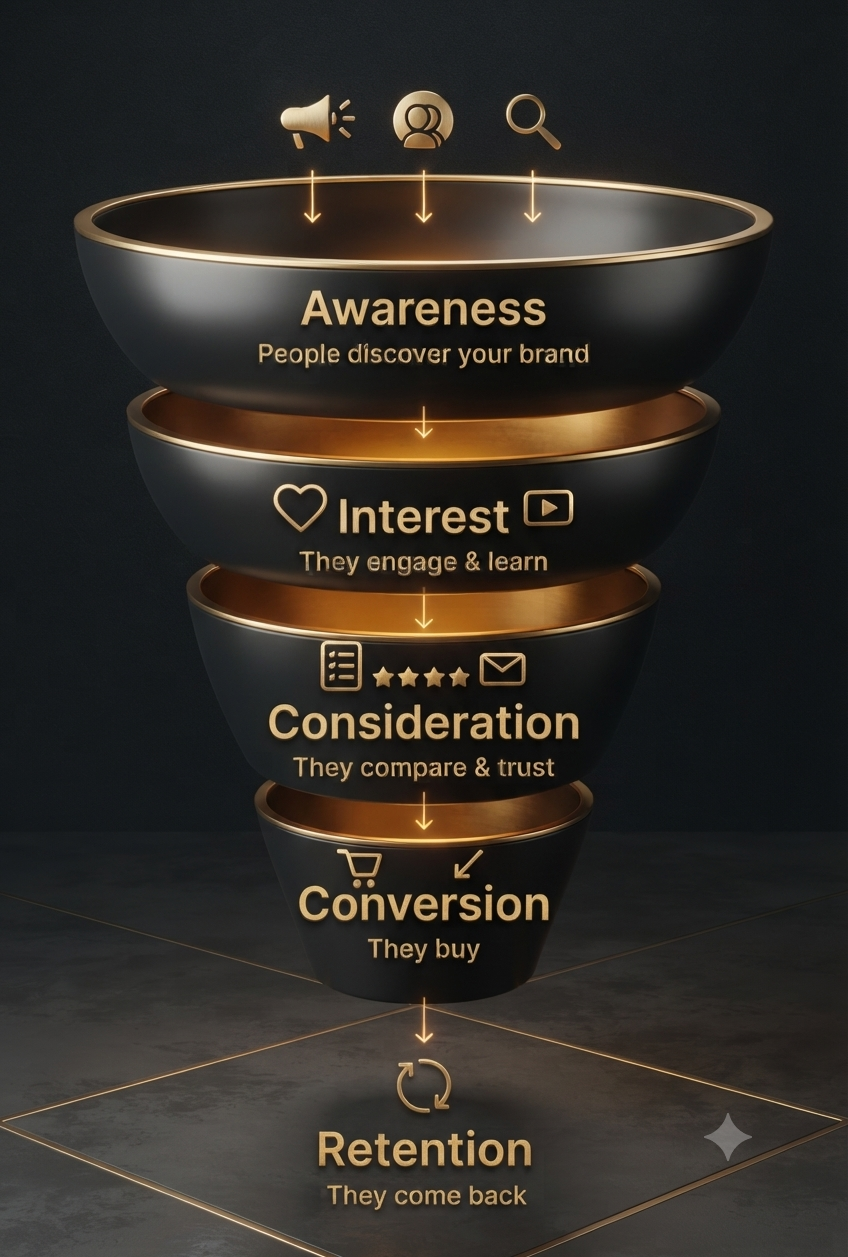
Traffic → Lead Magnet → Subscriber → Welcome Sequence → Nurturing → Offer → Email Click → Landing Page → Checkout → Purchase → Retention
Each stage has one job. Traffic attracts attention. The lead magnet converts attention into permission. The welcome sequence builds trust and sets expectations. Nurturing moves someone from curious to convinced. The offer gives them something worth paying for. The click is a micro-commitment. The landing page confirms the promise. Checkout removes the last obstacle. Purchase is the outcome. Retention turns one sale into recurring revenue.
Break any single link and the whole chain underperforms — which is why “write better emails” is rarely the complete answer.
| Funnel Stage | What Should Happen | Common Problem | What to Improve |
|---|---|---|---|
| Traffic | Attract the right audience | Broad, untargeted traffic | Channel-to-audience fit, ad targeting |
| Lead Magnet | Convert attention into permission | Attracts freebie seekers | High-intent offer, qualification question |
| Welcome Sequence | Build trust, set expectations | Single generic welcome email | 5–7 email sequence with proof |
| Nurturing | Move curious → convinced | No education, only promotion | Value-first content, objection handling |
| Offer | Present something worth buying | Weak value, no risk reversal | Offer-market fit, guarantees, urgency |
| Email Click | Generate a micro-commitment | Vague CTA, multiple competing links | One specific CTA per email |
| Landing Page | Confirm the email’s promise | Message mismatch, distractions | Message match, single goal, trust signals |
| Checkout | Remove the last obstacle | Hidden costs, forced account creation | Guest checkout, wallets, transparent pricing |
| Purchase | Complete the transaction | Technical errors, payment failures | Payment options, page speed, QA |
| Retention | Turn one sale into repeat revenue | No onboarding or follow-up | Post-purchase sequence, loyalty, win-back |
10 Reasons Your Email Subscribers Aren't Buying
These are the ten leaks I see most often when auditing email funnels. For each one, I’ve broken down the problem, why it happens, what it looks like in your data, how to fix it, and a realistic example.
1. Your Subscribers Never Had Strong Purchase Intent
The problem: You’re emailing an audience that never intended to buy. They wanted the free thing, not the paid thing.
Why it happens: Lead magnets attract the people they’re designed for. A “10 Social Media Myths” PDF attracts hobbyists and students. A “Free Shipping + Fit Guide” attracts shoppers. Same channel, completely different intent.
What it looks like: Strong lead magnet download rates, healthy open rates, but offer emails barely click. Unsubscribe spikes the first time you promote something.
How to fix it: Redesign the lead magnet around a buying-adjacent problem, add a one-question qualification survey at opt-in, use a quiz funnel to route people by intent, and tag every subscriber with their original lead source so you can segment from day one.
Example: A skincare brand offering “10 Skincare Myths Debunked” attracts browsers. Switching to “Find your skin type in 60 seconds” attracts people actively shopping for products — and the same email sequence converts noticeably better.
2. Your Emails Are Too Generic
The problem: One newsletter goes to everyone. The message is relevant to no one in particular.
Why it happens: Batch-and-blast habits, small teams, and a belief that personalization requires expensive tooling. It doesn’t — it requires data you already have.
What it looks like: Flat engagement. The same click-through rate regardless of what you send. Subscribers who engage with one topic and ignore everything else.
How to fix it: Use behavioral triggers instead of calendar-based sends. Add dynamic content blocks based on browsing or purchase history. Personalize the first line, the product recommendation, and the CTA — not just the subject line with a first name.
Example: A B2B software company split its newsletter into two versions: one for people who’d viewed the pricing page, one for everyone else. The pricing-page group received a case study; the rest received an educational guide. Click-to-conversion rate on the pricing-page version was materially higher — because the message matched where they actually were.
3. Your Segmentation Is Too Weak
The problem: Everyone gets the same offer, regardless of where they are in the buying journey.
Why it happens: Segmentation requires clean data, consistent tagging, and someone to maintain it. Most teams never build the habit.
What it looks like: Offer fatigue. Unsubscribe spikes after promotions. Long-term customers receiving “welcome, here’s 10% off your first order.”
How to fix it: Segment on at least five dimensions: lead source, engagement level, purchase history, on-site behavior, and funnel stage. Then add customer lifecycle — new subscriber, engaged prospect, customer, repeat buyer, lapsed.
Example: An e-commerce brand sending a 15% discount to its entire list discovered that 40% of recipients were repeat buyers who would have paid full price. Segmenting repeat buyers out of discount campaigns protected margin without reducing revenue.
4. You Are Selling Too Early
The problem: The first email after opt-in is a sales pitch. Trust hasn’t been earned yet.
Why it happens: Pressure to monetize the list quickly, or a misunderstanding of how buying decisions actually happen.
What it looks like: High unsubscribe rates in the first 72 hours. Low conversion on early promotional emails. Subscribers who open but never click.
How to fix it: Respect the sequence: Awareness → Trust → Consideration → Conversion. Email 1 delivers the promised value. Emails 2–4 build credibility and handle objections. Only then does the offer arrive — and it lands better because it’s earned.
Example: A B2B SaaS company that asked for a demo in email 1 saw almost no bookings. When they moved the demo request to email 4 — after two educational emails and one case study — demo bookings increased substantially from the same list.
5. You Are Not Selling Clearly Enough
The problem: You describe what your product is instead of what it does for the buyer.
Why it happens: Internal perspective. Teams talk about features because features are what they built.
What it looks like: Emails full of technical language, certifications, and specifications. Subscribers who understand the product but feel no urgency to buy it.
How to fix it: Move every claim through the chain Feature → Benefit → Outcome. Then lead with the outcome.
Example: “256-bit encryption” (feature) → “Your data is protected” (benefit) → “You can pass compliance reviews without a week of back-and-forth” (outcome). Only the third version gives a buyer a reason to act today.
6. Your Offer Is Not Strong Enough
The problem: The email isn’t the problem. The offer is.
Why it happens: Pricing set by internal cost rather than perceived value. No differentiation from competitors. No risk reversal.
What it looks like: Clicks happen, purchases don’t. People reach the pricing section and leave. “Too expensive” replies.
How to fix it: Strengthen the offer before rewriting the email. Improve offer-market fit, reframe value against the cost of the problem, add guarantees, stack bonuses that address objections, and use urgency only when it’s genuine.
Example: A course business with strong email engagement and poor sales added a 14-day money-back guarantee and a live Q&A bonus. Revenue from the same email sequence increased — without a single change to the copy or send schedule.
7. Your Emails Get Clicks but the Landing Page Loses the Sale
The problem: The email makes a promise; the landing page tells a different story.
Why it happens: Email and landing pages are often owned by different people, built at different times, and optimized separately.
What it looks like: Healthy click-through rate, high bounce rate on the landing page, low add-to-cart or low form completion.
How to fix it: Enforce message match across Email → CTA → Landing Page → Checkout. One goal per page. Mirror the email headline. Keep pricing visible. Remove navigation. Add trust signals. Test on mobile first, because that’s where most email clicks land.
Example: An email promoting “Save 20 hours a month” linked to a homepage featuring six different products. Replacing it with a dedicated landing page that repeated the headline and showed one CTA increased conversion from the same email.
8. You Are Sending Emails at the Wrong Stage of the Customer Journey
The problem: A new subscriber and a repeat buyer receive the same message.
Why it happens: No lifecycle map. Most teams build campaigns, not journeys.
What it looks like: Cart abandoners getting generic newsletters. Loyal customers getting first-purchase discounts. Inactive subscribers getting the same cadence as active ones.
How to fix it: Build separate tracks for each lifecycle stage: new subscribers, engaged prospects, product-aware prospects, cart abandoners, first-time customers, repeat buyers, and inactive subscribers. Each track needs its own message, offer, and cadence.
Example: A subscription brand moved cart abandoners from the general newsletter into a three-email recovery sequence. The recovery flow recovered a meaningful share of abandoned carts that the newsletter never touched.
9. There Is Too Much Friction Between Click and Purchase
The problem: The buying process itself is harder than it needs to be.
Why it happens: Legacy checkout systems, too many stakeholders, and a focus on collecting data rather than completing sales.
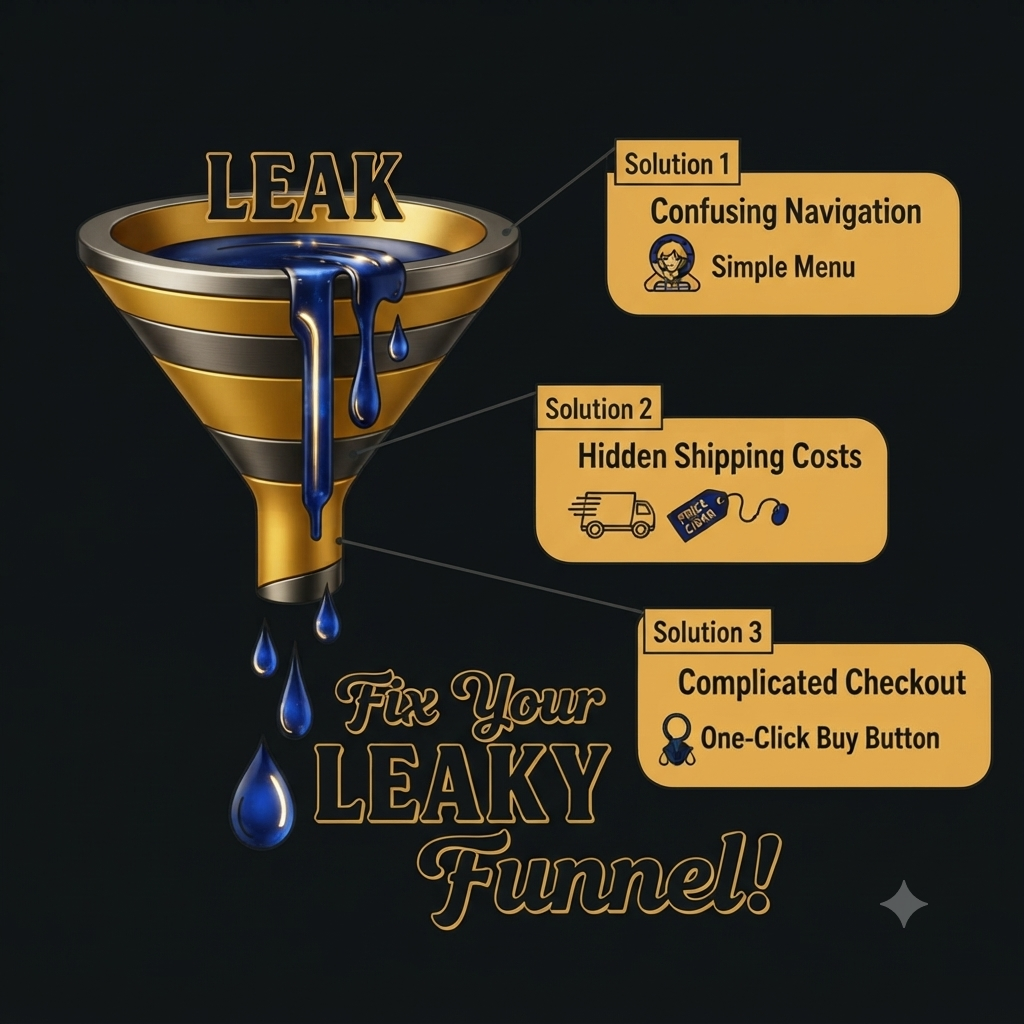
What it looks like: Drop-off at account creation. Abandonment when shipping costs appear. Mobile users bouncing at the payment step.
How to fix it: Enable guest checkout. Cut form fields to the minimum. Show total cost early. Add digital wallets. Improve page speed. Offer multiple payment options. Make the next step unmistakably clear at every stage.
Example: A service business requiring a full intake form before a call reduced form fields from 11 to 4 and moved the rest to the call itself. Bookings from the same email campaign increased noticeably.
10. You Are Measuring the Wrong Metrics
The problem: Open rates look healthy while revenue stays flat.
Why it happens: Opens are visible and easy to celebrate. Revenue attribution requires connecting email to actual business outcomes.
What it looks like: Reports that stop at opens and clicks. No one knows revenue per email or revenue per subscriber.
How to fix it: Track metrics that map to revenue: click-through rate, click-to-conversion rate, conversion rate, revenue per email, revenue per subscriber, average order value, repeat purchase rate, and engagement by segment. Use open rate only as a deliverability signal, not a success metric.
Example: A brand celebrated a 42% open rate for months while revenue per subscriber stayed flat. Once they started tracking click-to-conversion rate, the real leak — a mismatched landing page — became obvious.
The metrics that actually matter:
- Click-through rate — is the message compelling?
- Click-to-conversion rate — does the destination deliver?
- Revenue per email — which campaigns earn?
- Revenue per subscriber — is the list profitable?
- Average order value — is the offer structured well?
- Repeat purchase rate — is retention working?
- Unsubscribe rate by segment — who is fatigued?
- Engagement by segment — who is still listening?
How to Find the Leak in Your Email Funnel
You don’t need to fix everything. You need to find the single stage that’s losing the most money. Match your symptom to the table below and start there.
| Symptom | Likely Leak | Where to Start |
|---|---|---|
| Low opens | Subject lines, sender reputation, deliverability, list quality | List hygiene, authentication (SPF/DKIM/DMARC), subject line testing |
| High opens + low clicks | Messaging, offer, CTA, relevance | Segment by interest, sharpen the offer, use one clear CTA |
| High clicks + low conversions | Landing page, offer, trust, pricing, checkout | Message match, trust signals, transparent pricing, friction audit |
| Good first purchase + poor repeat purchases | Retention, onboarding, customer experience | Post-purchase sequence, loyalty offers, win-back flow |
| High unsubscribe on promotions | Offer fatigue, weak segmentation, wrong cadence | Segment by engagement, reduce send frequency, rebalance value vs. promotion |
How to Fix an Email Funnel That Isn't Converting
Work through these twelve steps in order. Each one builds on the last, and skipping ahead usually means redoing work later.
Step 1: Audit the audience
Pull your full list and check the source of every subscriber. Which lead magnet, page, or campaign brought them in? If you can’t answer that, that’s your first problem.
Step 2: Identify subscriber intent
Group subscribers by why they joined. Freebie seekers, researchers, and ready-to-buy prospects should never receive the same sequence.
Step 3: Segment the list
Build segments on lead source, engagement, purchase history, on-site behavior, and lifecycle stage. Even three well-built segments outperform one giant list.
Step 4: Map the customer journey
Write out every stage from first touch to repeat purchase. Identify what the subscriber needs to know, feel, and believe at each stage.
Step 5: Improve the welcome sequence
Replace the single welcome email with a 5–7 email sequence. Deliver the promise, teach something useful, prove credibility, then offer.
Step 6: Build a nurturing sequence
Nurturing isn’t a newsletter. It’s a structured path that moves someone from curious to convinced through education, proof, and objection handling.
Step 7: Improve the offer
Before rewriting emails, ask whether the offer is genuinely competitive. Add guarantees, bonuses, and clarity around value.
Step 8: Improve email copy
Lead with the outcome. Write subject lines that earn the open honestly. Use one specific CTA per email. Keep the tone human.
Step 9: Align landing pages
Match the email headline, the offer, and the CTA. Remove navigation. Show pricing. Add proof. Optimize for mobile first.
Step 10: Reduce purchase friction
Guest checkout, fewer fields, transparent costs, digital wallets, fast pages, clear next steps. Every removed obstacle is recovered revenue.
Step 11: Test systematically
Test one variable at a time: subject line, offer framing, CTA, landing page headline, send time. Log results so you build institutional knowledge.
Step 12: Measure revenue, not vanity metrics
Report on revenue per email and revenue per subscriber. If a campaign didn’t move revenue, it didn’t work — regardless of how the opens looked.
How Many Emails Should Be in a Welcome Sequence?
For most businesses, five to seven emails is the practical range. Fewer than five rarely builds enough trust to justify a purchase. More than seven starts to feel like a campaign rather than a welcome. The exact sequence should depend on your price point and buying cycle — a $30 product needs less nurturing than a $3,000 service.
| Purpose | Main Message | CTA | |
|---|---|---|---|
| Email 1 | Welcome | Deliver the promised value | Take the next step |
| Email 2 | Problem | Name the pain point clearly | Learn more |
| Email 3 | Education | Teach the solution approach | Explore the method |
| Email 4 | Trust | Show proof and results | See the outcome |
| Email 5 | Offer | Present your solution | Buy or book |
| Email 6 | Objection | Address hesitations directly | Take action |
| Email 7 | Urgency | Give a final honest reason to act | Convert |
Space the sequence based on how quickly your audience makes decisions. High-consideration purchases need more breathing room between emails; impulse purchases can be compressed.
How to Write Emails That Actually Convert
Conversion email copy follows a structure, not a formula. The structure is:
- Strong subject line that earns the open honestly
- Relevant opening line — no throat-clearing
- Problem agitation without manipulation
- Clear value proposition
- Benefits before features
- Proof — results, testimonials, data
- Objection handling
- One specific CTA
- Appropriate urgency
- Conversational tone throughout
Before and after: a real transformation
Before (generic, feature-led):
Subject: Our New Project Management Tool Is Here
Hi [First Name],
We’re excited to announce the launch of our new project management platform. It includes Kanban boards, Gantt charts, time tracking, file sharing, and integrations with over 50 apps. Our platform uses cloud-based architecture and supports teams of any size.
Click here to learn more.
After (outcome-led, customer-focused):
Subject: The reason your team keeps missing deadlines
Hi [First Name],
Most teams don’t miss deadlines because they’re lazy. They miss them because the work lives in five different places — a spreadsheet, three chat threads, and someone’s inbox.
We built [Product] so that doesn’t happen. Everything your team is working on sits in one view, so you can see what’s blocked before it becomes a missed deadline.
Teams using it typically cut their weekly status meetings in half.
→ See how it works in 2 minutes
The second version names a real problem, connects the product to an outcome, and gives one clear next step. That’s the difference between describing a product and selling one.
How AI Can Improve Email Funnel Conversion in 2026
AI has moved past novelty in email marketing. In 2026, the useful applications are specific and measurable:
- Customer segmentation — clustering subscribers by behavior rather than manual rules
- Predictive targeting — identifying which subscribers are most likely to purchase next
- Content personalization — assembling email blocks based on individual behavior
- Send-time optimization — delivering at the moment each subscriber is most likely to engage
- Subject-line testing — running continuous multivariate tests instead of one-off A/B tests
- Behavioral triggers — activating sequences based on real-time actions
- Churn prediction — flagging subscribers likely to disengage before they do
- Lead scoring — ranking subscribers by purchase readiness
- Journey analysis — finding where subscribers drop off at scale
- Automated experimentation — testing copy, offers, and layouts continuously
But here’s the boundary that matters: AI should optimize the system. It should not replace customer understanding, strategy, empathy, or brand voice. An AI model can tell you which subject line wins. It cannot tell you why your customers are afraid to buy, what they’ve tried before, or what would make them trust you. That’s still a human job — and it’s the job that determines whether your funnel converts.
Use AI to remove manual work, surface patterns, and accelerate testing. Use humans to decide what to build, who to serve, and how to say it.
Email Funnel Audit Checklist
Run through this checklist once a quarter. Any unchecked box is a potential revenue leak.
Audience
- ☐ Are subscribers relevant to the offer?
- ☐ Do you know the lead source of every subscriber?
- ☐ Have you identified and suppressed chronic non-openers?
Segmentation
- ☐ Are subscribers grouped by intent and behavior?
- ☐ Are buyers separated from non-buyers in every campaign?
- ☐ Is there a lifecycle track for customers vs. prospects?
Messaging
- ☐ Is the message relevant to the segment receiving it?
- ☐ Does every email lead with an outcome, not a feature?
- ☐ Is there one clear CTA per email?
Offer
- ☐ Is the value clear within five seconds?
- ☐ Is there risk reversal — guarantee, trial, or refund policy?
- ☐ Is urgency genuine rather than manufactured?
- ☐ Is the CTA specific (“See how it works” beats “Click here”)?
- ☐ Does the email render correctly on mobile?
Landing page
- ☐ Does the page match the email’s promise?
- ☐ Is there a single goal with no competing navigation?
- ☐ Are trust signals visible above the fold?
Checkout
- ☐ Is purchasing easy on mobile?
- ☐ Are all costs shown before the final step?
- ☐ Is guest checkout available?
Measurement
- ☐ Are conversions and revenue being tracked per email?
- ☐ Do you know your revenue per subscriber?
- ☐ Are you reviewing engagement by segment monthly?
Common Email Funnel Mistakes to Avoid
- Treating email as a broadcast channel. Sending the same message to everyone and expecting different results.
- Optimizing for opens. Open rates are a deliverability signal, not a revenue metric.
- Buying or renting email lists. This destroys sender reputation and rarely produces revenue.
- Never cleaning the list. Inactive subscribers drag down deliverability for everyone else.
- Writing emails in isolation from the landing page. The email and page must be built as one experience.
- Using discounts as the only conversion lever. It trains subscribers to wait for a sale and erodes margin.
- Ignoring post-purchase email. Retention revenue is often the cheapest revenue available.
- Testing too many variables at once. You learn nothing when five things change simultaneously.
- Copying competitor campaigns without understanding your audience. Their list isn’t your list.
- Never asking subscribers why they didn’t buy. A single reply can reveal more than a month of analytics.
Segment your audience, provide relevant content, build trust, present the right offer at the right stage, and create a frictionless path from email to purchase.
An email marketing funnel is the journey subscribers take from discovering your brand and joining your list to engaging with your emails, considering your offer, and eventually becoming customers.
A high open rate shows that your subject line is attracting attention, but it does not guarantee purchase intent. The problem may be the email content, offer, landing page, pricing, trust, or overall customer journey.
Improve audience segmentation, personalize your messaging, strengthen your offer, use clearer CTAs, address objections, optimize landing pages, and test different email elements.
- One major mistake is trying to sell too quickly without first understanding the subscriber’s needs, building trust, and providing enough information to support the buying decision.
Track metrics such as click-through rate, conversion rate, revenue per recipient, unsubscribe rate, engagement, landing-page performance, and ultimately customer acquisition and revenue.