
How to Build a Content Strategy That Works Across Google, AI Search, and Social Media
One content ecosystem. Three discovery channels. Zero wasted effort. Here’s the playbook for 2026.
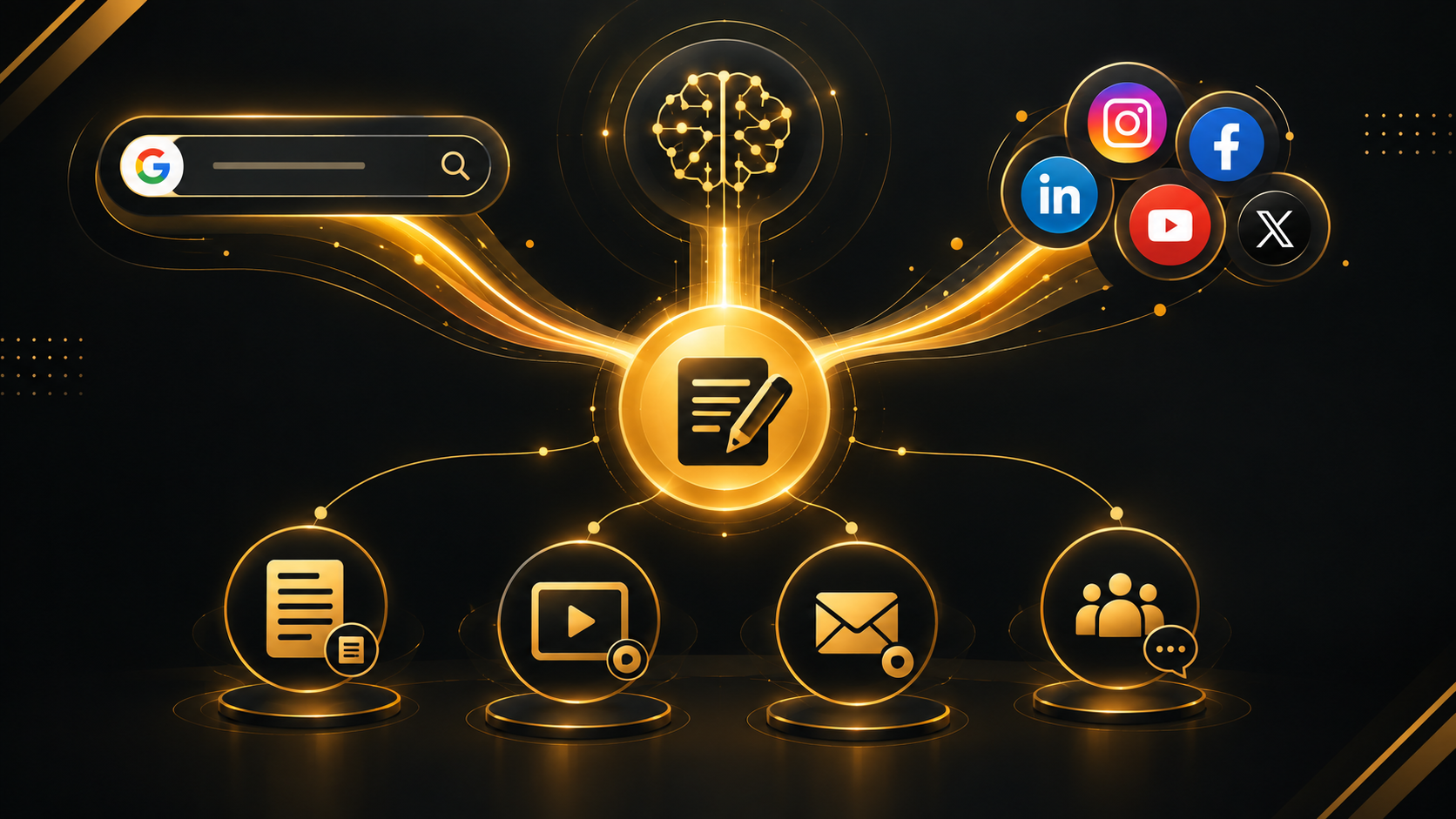
Picture this: You publish a well-researched blog post. You wait for Google to send traffic. A week passes. Nothing. Meanwhile, a competitor’s messy TikTok about the same topic gets 40,000 views, and ChatGPT recommends their brand when someone asks about your category.
That’s not bad luck. That’s a strategy that only works for one channel in a world where people discover information across many.
In 2026, discovery is fragmented. Someone might first see your brand on LinkedIn, then ask ChatGPT for recommendations, then Google your name to verify you’re real. If you’re only optimized for one of those moments, you’re invisible for the rest.
This guide is about fixing that. Not by creating three separate strategies, but by building one content system that gets discovered, understood, and shared everywhere your audience looks.
What Is a Modern Content Strategy?
A content strategy is the plan that decides what content you make, who it’s for, where it lives, and what it’s supposed to achieve. It’s the difference between publishing because you feel like you should and publishing because you know exactly what result you’re chasing.
People often mix up content creation, content marketing, content strategy, and content distribution. They’re related, but they’re not the same thing:
- Content creation — making the thing (writing the post, recording the video).
- Content marketing — using content to attract and convert an audience.
- Content strategy — deciding what to create, for whom, and why, before you start.
- Content distribution — getting that content in front of the right people on the right platforms.
Most businesses skip strategy and jump straight to creation. That’s why they burn out. Without a strategy, every piece of content is a guess.
Why One Content Strategy Must Work Across Multiple Channels
Your audience doesn’t live on one platform. Someone might find you through Google, verify you through ChatGPT, and follow you on Instagram. That journey is normal now.
The businesses that win aren’t running three separate content operations. They’re building one core body of work and adapting it for each discovery surface.
Stop treating each platform like its own separate content universe. A strong pillar article can feed a LinkedIn post, a short video script, an email newsletter, and an AI-search-friendly FAQ section — all from the same research and expertise.
How Google Search Is Changing Content Strategy
Google still matters. It just doesn’t work the way it did five years ago. Three shifts are reshaping what gets visibility:
- Experience is now part of the quality equation. Google's Quality Rater Guidelines added a second 'E' — Experience — to the old E-A-T framework. First-hand knowledge and original perspective carry weight that generic summaries don't.
- Topical authority beats isolated posts. The algorithm evaluates content clusters, not just individual pages. Depth around a subject is the signal.
- AI Overviews are in the results. Google's AI-generated summaries appeared on roughly 25–50% of queries by late 2025, up from around 6.5% in January 2025. When they show, users click less.
The practical takeaway: stop writing for a single keyword. Write to become the most useful, specific, and trustworthy source on a topic. That’s what both traditional rankings and AI systems reward.
How AI Search Is Changing Content Discovery
AI search tools — ChatGPT, Perplexity, Gemini, Google’s AI Mode — don’t show a list of links. They read, synthesize, and answer. If your content isn’t structured for that process, you don’t get mentioned.
These systems look for content that is:
- Clear and direct in its answers
- Well structured with descriptive headings
- Factually accurate and sourced where needed
- Context-rich with specific examples
- Consistent in how it names entities (brands, people, places)
- Supported by evidence and first-hand experience
One thing the data makes clear: YouTube mentions show the strongest correlation with AI visibility across platforms — stronger than traditional authority metrics like domain rating. When brands appear in video titles, transcripts, and descriptions, AI systems pick them up.
That doesn’t mean every brand needs a YouTube channel tomorrow. It means video content and transcript-rich pages are becoming part of the discoverability layer, not just a nice-to-have.
What Is AEO and Why Does It Matter?
Answer Engine Optimization (AEO) is the practice of structuring your content so AI tools can find it, understand it, and use it as a direct answer.
Think of it as SEO’s cousin. SEO tries to get you ranked in a list. AEO tries to get you quoted in the answer.
The core moves are simple:
- Answer the question in the first two sentences. Don't make the AI dig for it.
- Use question-based headings. Mirror how people actually ask things.
- Add FAQ sections where they're genuinely useful. Not as an SEO trick — as a service to the reader.
- Define key concepts clearly. Ambiguity kills citability.
- Keep punctuation and formatting clean. Lists and tables work better than walls of text for machine parsing.
AEO doesn’t replace SEO. It extends it. The same content can rank in traditional results and get cited in AI answers if it’s structured for both.
What Is GEO (Generative Engine Optimization)?
GEO is the broader practice of making your content more useful for generative AI systems — the models behind ChatGPT, Gemini, Claude, and AI Overviews.
Where AEO focuses on answer structure, GEO focuses on the qualities that make a source worth citing:
- Information clarity — no jargon soup, no vague claims.
- Authority signals — credentials, experience, and evidence where relevant.
- Context — the surrounding information that helps a machine understand what you're actually saying.
- Original insight — something the model can't get from 50 other pages.
- Factual accuracy — because generative systems pull from sources that don't contradict themselves.
- Entity clarity — naming your brand, products, and key people consistently.
- Citability — writing in a way that's easy to quote and reference.
No one can promise you a guaranteed spot in AI answers. These systems change constantly. But content that’s clear, accurate, specific, and well-organized consistently performs better in generative environments than content that’s vague or thin.
How Social Media Fits Into the Modern Search Journey
Social media isn’t just a distribution channel anymore. It’s a search engine for a growing chunk of the population.
The numbers tell the story. Social media search use grew from 1% in 2021 to 21% in 2025. Among Gen Z, 41% turn to social platforms first when they’re looking for something — ahead of traditional search engines at 32%.

This means social content needs to be discoverable, not just likable. That’s a different design brief. A funny Reel that nobody searches for doesn’t help your discoverability. A clear, keyword-aware short video with a strong hook and a searchable caption does.
The Core Framework for Building a Cross-Platform Content Strategy
Here’s a practical sequence. It’s not glamorous, but it works.
Step 1: Define Your Business Goal
Are you trying to generate leads, build brand awareness, drive e-commerce sales, or establish authority? The answer changes everything that follows. A lead-gen content strategy looks different from a brand-awareness one.
Step 2: Understand Your Audience
Where do they spend time? What language do they use? What problems keep them up at night? Don’t guess. Talk to sales teams, read support tickets, look at what people ask in communities.
Step 3: Identify Audience Problems and Questions
Every content piece should answer a question someone actually has. Mine search suggestions, Reddit threads, Quora, and customer conversations for real queries, not keyword-tool abstractions.
Step 4: Map Search Intent
Is the person looking for information, comparing options, or ready to buy? Match your content format to the intent. A comparison post is useless for someone who just wants to understand a concept.
Step 5: Build Topic Clusters
Pick one core topic and map every related subtopic, question, and angle around it. This creates the depth that both Google and AI systems reward.
Step 6: Create a Strong Core Content Asset
This is your pillar piece. A comprehensive guide, a deep-dive tutorial, an original research report. It should be the best resource on that specific topic that exists — or at least the most useful for your specific audience.
Step 7: Optimize for Search and AI Discovery
Clear headings. Direct answers. Proper schema markup. Descriptive image alt text. Internal links to related content. Everything that helps both a human reader and a machine understand what this page is about.
Step 8: Repurpose for Social Media
Pull the best insights, quotes, and visuals from the core asset and adapt them for each platform. Don’t copy-paste. Rewrite the hook for LinkedIn, design a carousel for Instagram, script a 45-second video for TikTok.
Step 9: Distribute and Amplify
Publishing is not distribution. Share the piece in relevant communities, email it to your list, pitch it to industry newsletters, mention it in podcast interviews. Give it a push beyond your own channels.
Step 10: Measure, Learn, and Improve
Track what actually moves the needle — not just pageviews. Look at branded search growth, AI mentions, lead quality, and which topics generate the most engagement and conversion.
One Idea → Many Content Assets
Here’s what that looks like in practice. Start with one core topic — say, “How to Build a Content Strategy in 2026” — and watch it multiply.
- Research — interviews, data, competitor gaps, audience questions.
- Pillar Content — the comprehensive 3,000-word guide.
- SEO Optimization — keyword mapping, meta tags, internal links, schema.
- AEO Optimization — direct answer blocks, FAQ section, question headings.
- GEO Optimization — entity clarity, citability, original data, source references.
- Social Media Repurposing — LinkedIn post, Instagram carousel, X thread.
- Video — YouTube tutorial, 45-second Reel, TikTok explainer.
- Email — newsletter breakdown, drip sequence segment.
- Community — discussion prompt in Slack/Discord/forum.
- Lead Generation — downloadable checklist, template, or mini-audit.
- Performance Analysis — what worked, what didn't, what to double down on.
Content Ecosystem Example: One Topic, 14 Assets
Core Topic: “How to Build a Content Strategy in 2026”
From that one research effort, you can produce:
| Asset | Format | Primary Channel |
|---|---|---|
| 1. Comprehensive guide | Website article (3,000 words) | Website / Google |
| 2. Supporting articles | Deep-dives on subtopics | Website / Google |
| 3. FAQ content | Question-answer blocks | Website / AI Search |
| 4. LinkedIn post | Professional insight + data point | |
| 5. Instagram carousel | 7-slide visual summary | |
| 6. Short-form video | 45-second key takeaway | Instagram / TikTok |
| 7. YouTube video | 10-minute tutorial | YouTube |
| 8. X/Twitter post | Thread with key stats | X / Twitter |
| 9. Email newsletter | Key insight + actionable tip | |
| 10. Lead magnet | Downloadable strategy template | Website |
| 11. Community prompt | Discussion question | Slack / Discord / Forum |
| 12. Case study | Client example applying the framework | Website / LinkedIn |
| 13. AI-answer section | Concise, citable definition block | Website / AI Search |
| 14. Sales enablement doc | One-pager for prospects | Sales team |
None of these are copy-paste jobs. The LinkedIn post leads with a contrarian take. The Instagram carousel breaks the framework into visual steps. The video shows the process in real time. But they all come from the same research and the same strategic core.
Content Formats and Their Best Uses
| Content Format | Primary Purpose | Best Channel | Example |
|---|---|---|---|
| Pillar Article | Authority / Search | Website | Complete guide to content strategy |
| FAQ | Direct Answers | Website / AI Search | Common content strategy questions |
| Case Study | Trust | Website / LinkedIn | How a client grew organic traffic 140% |
| Carousel | Education | Instagram / LinkedIn | 7-step content framework |
| Short Video | Discovery | Instagram / YouTube Shorts | 60-second strategy tip |
| Long Video | Education | YouTube | Full tutorial walkthrough |
| Newsletter | Retention | Weekly strategy insights | |
| Checklist | Lead Generation | Website | Downloadable content audit checklist |
| Podcast Episode | Authority | Spotify / Apple | Interview with content leaders |
| Infographic | Shareability | Pinterest / LinkedIn | The content ecosystem visual |
| Webinar | Consideration | Zoom / LinkedIn Live | Live strategy workshop |
| Template | Lead Generation | Website | Content calendar template |
Understanding Search Intent (and Adapting Content for It)
Search intent is the why behind a query. Get it wrong, and even well-written content fails.
- Informational — “what is a content strategy” → Guide, explainer, definition post.
- Navigational — “content strategy framework template” → Direct link to a resource.
- Commercial investigation — “best content strategy tools 2026” → Comparison, review, alternatives post.
- Transactional — “hire content strategist” → Service page, pricing page, contact form.
The same core topic — content strategy — can be adapted across all four intents. A beginner gets a definition post. Someone deeper in the journey gets a tool comparison. Someone ready to act gets your service page.
The Content Funnel: From Discovery to Retention
Not every piece of content should ask for the sale. The right ask depends on where someone is.
- Awareness — Social posts, short videos, educational content. Goal: get noticed.
- Consideration — Guides, comparisons, case studies, webinars. Goal: build trust and prove competence.
- Decision — Service pages, testimonials, demos, pricing transparency. Goal: remove friction.
- Conversion — Forms, calls, purchases, consultations. Goal: make action easy.
- Retention — Email, community, ongoing educational resources. Goal: turn customers into advocates.
The mistake most brands make: treating every piece of content like a bottom-funnel sales pitch. That’s exhausting for the audience and it kills trust. Awareness content that purely educates can do more for your long-term pipeline than another “contact us” post.
How to Make Content More Useful for AI Search (Checklist)
- Answer the core question clearly in the first two sentences
- Use descriptive headings that mirror natural language questions
- Define important concepts before diving into detail
- Include original insights, data, or examples that can't be found elsewhere
- Demonstrate first-hand experience where applicable
- Support important claims with references or evidence
- Keep information current and update outdated sections
- Make entity relationships clear (brand, product, person, place)
- Avoid vague statements that could mean anything
- Organize information logically with lists, tables, and short paragraphs
- Use FAQs where they genuinely help the reader
- Maintain consistent terminology throughout
Measuring Content Performance Beyond Traffic
Traffic is a vanity metric if it doesn’t lead to anything. Here’s a fuller picture.
SEO Metrics
Organic clicks and impressions, rankings for target keywords, click-through rate, non-branded search visibility, organic conversions and assisted conversions.
AI Visibility Signals
AI visibility can’t be reduced to a single metric. There’s no universal “AI ranking score.” But you can track useful indicators: brand mentions across AI platforms, referral traffic from AI tools where measurable, growth in branded search volume, and assisted conversions from AI-referred sessions.
Social Metrics
Reach and impressions, engagement rate, video retention, profile visits, and link clicks.
Business Metrics
Leads and qualified leads, conversion rate by content type, customer acquisition cost, and revenue attributed to content touchpoints.
12 Common Content Strategy Mistakes (and How to Fix Them)
| Mistake | The Fix |
|---|---|
| Creating content without a business goal | Write down the objective before you write a single word. |
| Writing only for keywords | Write for the question behind the keyword. |
| Publishing generic AI-generated content | Use AI for research and structure, not for original insight. |
| Ignoring search intent | Check what already ranks. Match the format, not just the topic. |
| Running separate strategies for every platform | Build one core asset and adapt it per channel. |
| Copying the same content everywhere | Rewrite the hook and framing for each platform’s audience. |
| Ignoring social distribution | Treat social as a discovery layer, not a promotion channel. |
| Focusing only on traffic | Track leads, brand mentions, and AI visibility too. |
| Not updating old content | Schedule quarterly content audits and refreshes. |
| Publishing without measuring | Set up tracking before you publish, not after. |
| Ignoring first-hand expertise | Add original examples, data, or experience to every piece. |
| Chasing every trend | Stay in your topical lane. Depth beats novelty. |
AI-Generated Content vs. Human Expertise
AI is genuinely useful for content work. It can organize research, brainstorm angles, draft outlines, suggest headline variations, summarize long documents, and help with repurposing. Ignoring those capabilities is leaving time on the table.
But AI can’t do the things that make content actually valuable:
- Original opinions shaped by experience
- First-hand knowledge of what actually works
- Strategic judgment about what’s worth publishing
- Accuracy checks that require domain understanding
- A consistent brand voice that doesn’t sound like a chatbot
- Real case studies and client outcomes
The standard isn’t “human vs. AI.” It’s “useful vs. not useful.” Use AI to accelerate the parts of the process that are mechanical. Reserve your human judgment for the parts that require actual thinking.
Practical Content Strategy Checklist
- Define your business goal for content
- Research your audience's real questions
- Map search intent for your core topics
- Build topic clusters around your pillar
- Create one strong pillar content asset
- Optimize for traditional search (headings, meta, internal links)
- Structure direct answers for AEO
- Add original expertise and evidence for GEO
- Repurpose for at least three social platforms
- Distribute beyond your own channels
- Set up measurement before publishing
- Review and update winning content quarterly
People now discover information through traditional search, AI-generated answers, social platforms, and recommendations. A unified strategy helps businesses remain visible across multiple discovery channels.
Traditional SEO focuses heavily on ranking in search results, while AI-search optimization also emphasizes clear answers, context, trustworthy information, structured content, and information that AI systems can easily understand and reference.
Yes. Well-researched, original, clearly structured content can serve both traditional search engines and AI-powered answer systems when it directly addresses user intent and demonstrates expertise.
A cross-platform content strategy is a plan for creating and distributing content that works across Google Search, AI search engines, social media platforms, websites, and other digital channels.
No. Repurpose content selectively. Focus on articles containing strong insights, original research, useful frameworks, statistics, case studies, or actionable advice that can become valuable standalone social content.
Search intent is foundational. Understanding whether users want to learn, compare, solve a problem, find a product, or make a decision helps you create content that can be adapted effectively across search and social channels.