October 5, 2026

Uncategorized

“What Happens When Every Brand Uses AI to Write Their Emails?”

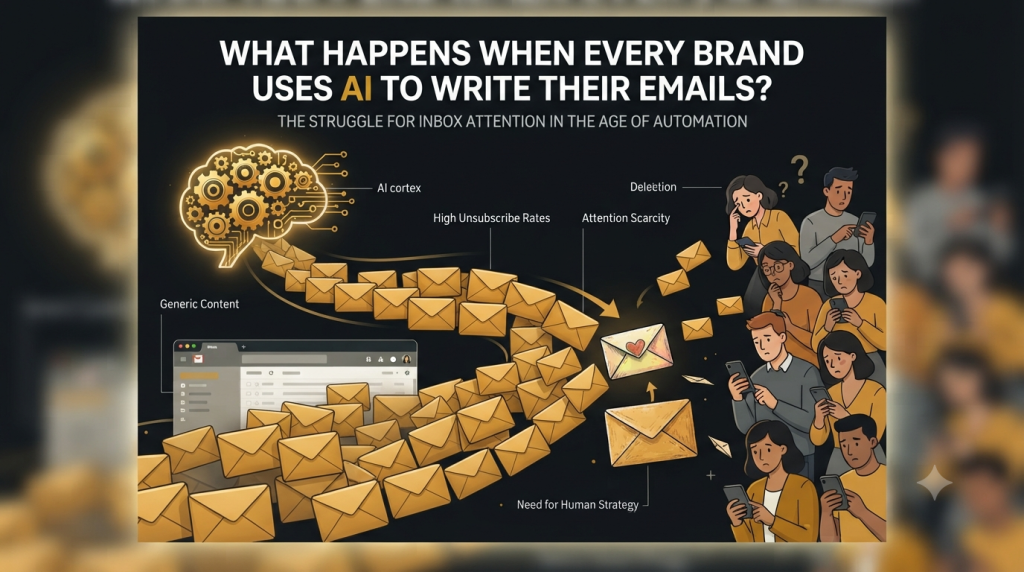
What Happens When Every Brand Uses AI to Write Their Emails? The email marketing advantage is no longer AI. It is what you do with it. Imagine opening your inbox on a Tuesday morning. Five promotional emails sit unread. One from a clothing brand. One from a SaaS company. One from a coffee subscription. One from an airline. One from a fitness app. They are all perfectly written. Personalized. Grammatically flawless. Optimized for conversion. Each one greets you by name. Each one references something you actually looked at. Each one has a subject line engineered to make you click. And yet something feels wrong. They all sound strangely similar. The rhythm is the same. The hooks are the same. The emotional temperature is the same. It is as if five different brands hired the same copywriter, who happens to be a large language model. This is the question that matters in 2026: What happens when AI-generated email becomes so common that it stops being a competitive advantage? The short answer: AI has made email production easier, faster, and cheaper. But it has also made differentiation harder. When every brand can generate a polished, personalized email in seconds, polish and personalization stop being differentiators. The brands that win will be the ones that use AI intelligently, creatively, and authentically, without losing the human judgment that makes a message worth reading. This article explores what widespread AI email adoption actually means for marketers, where AI genuinely helps, where it quietly hurts, and how to build an email strategy that is AI-assisted but unmistakably human-led. AI Has Made Email Writing Easier—But That Changes the Competitive Landscape A decade ago, producing a single email campaign required a writer, a designer, an approval chain, and days of coordination. Enterprise teams typically invested eight to fourteen working days to build one campaign, with complex multilingual versions taking up to three weeks. Today, that timeline has collapsed. AI-powered platforms help teams produce emails in minutes rather than weeks. A recent industry benchmark showed that enterprises using AI-powered production platforms achieve 70% faster timelines than traditional methods, with some teams cutting build time by over 90%. This is genuinely useful. Marketers can generate draft subject lines in seconds. They can produce five variations of the same offer for different segments before lunch. They can translate a campaign into six languages without hiring six translators. But here is the uncomfortable implication: speed and efficiency are not durable competitive advantages when everyone has access to the same tools. When a capability becomes commoditized, the advantage shifts. It moves from access to application. From can you do it? to can you do it in a way that actually matters to your customer? The data supports this. While 87% of businesses using AI apply it to email marketing workflows, only 6% qualify as AI high performers. Adoption is nearly universal. Mastery is rare. What Happens When Every Brand Uses AI to Write Emails? The consequences of widespread AI email adoption are already visible. Some are positive. Some are concerning. Most are a mix of both. Email Quality May Improve AI raises the floor. A brand that previously sent poorly written, error-ridden emails can now produce clean, structured, grammatically correct messages. That is a net positive for the inbox. AI is also excellent at brainstorming. It can generate twenty subject line variations in seconds. It can suggest angles a human might not have considered. It can analyze which phrasing tends to perform better in similar campaigns. For resource-constrained teams—small businesses, solo founders, lean startups—AI has been a genuine equalizer. A solo marketer can now produce a volume and quality of email content that previously required a team. But Emails May Start Sounding the Same This is where the story gets more complicated. AI models are trained on vast corpora of human writing. They are optimized to produce text that is clear, coherent, and conventional. In email marketing, this means they default to familiar patterns: the friendly opener, the benefit-driven body, the urgency-driven CTA, the polite sign-off. Research comparing AI-generated and human-written emails found that AI-generated emails tend to be more formal, more verbose, and more complex, while human-written emails are often more concise and personalized. In other words, AI writes like a polite professional who has read a lot of marketing textbooks. That is fine for a first draft. It is less fine when every brand in the inbox sounds like the same polite professional. The result is a phenomenon marketers are already noticing: inbox sameness. Different brands, different products, different audiences—but the same rhythm, the same hooks, the same emotional register. Personalization May Become Less Differentiating For years, personalization was the holy grail of email marketing. Insert the customer’s name. Reference their past purchase. Recommend a product based on browsing history. The assumption was that this level of tailoring would create a sense of one-to-one communication. But when every brand can do this—and do it at scale—personalization becomes table stakes. It stops being a differentiator. There is a deeper problem, too. AI personalization is often surface-level. It can insert a name and a product reference. It struggles with genuine relevance. It cannot infer what a customer is actually struggling with, what they are hesitant about, or what question they have not yet articulated. A recent analysis of AI personalization failures in cold email found that AI frequently hallucinated details, referenced outdated job titles, and confused people with similar names. In one test batch, only one out of ten AI-personalized emails contained accurate information. Even when the data is accurate, inserting a name is not the same as understanding a person. Customers May Become Better at Detecting Generic AI Content Consumers are not passive recipients. They develop pattern recognition. And the patterns of AI-generated email are becoming recognizable. According to a HubSpot and SurveyMonkey study of 15,000 consumers worldwide, 70% say they have noticed AI being used in marketing emails. Only 23% say they like or love AI when applied to marketing
Uncategorized

“Why Your Email Subscribers Aren’t Buying—and How to Fix Your Funnel”

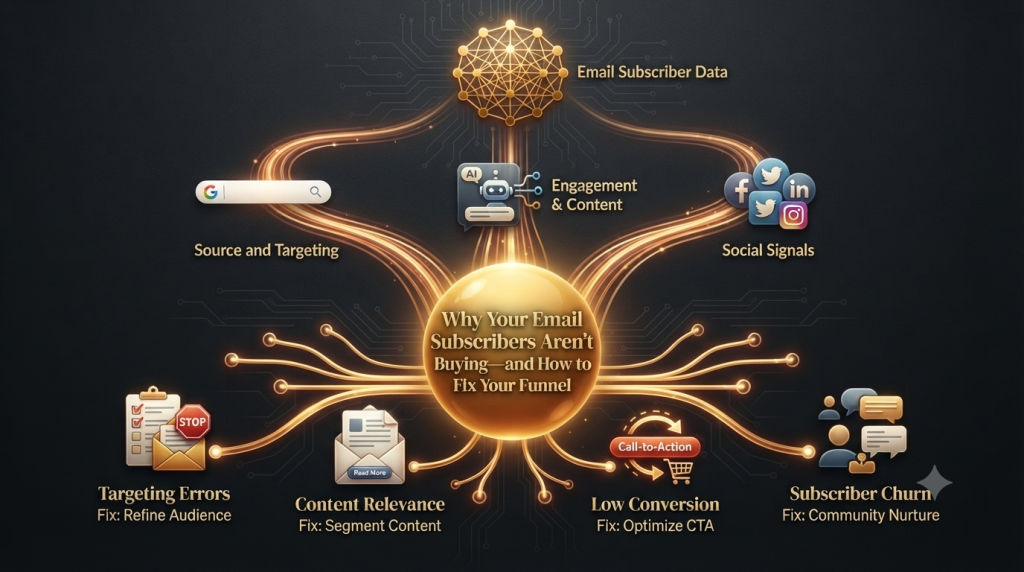
Why Your Email Subscribers Aren’t Buying—and How to Fix Your Funnel Email Marketing · Funnel Optimization · 2026 A subscriber is an audience asset. A customer is a business outcome. The funnel in between decides which one you get. You did the hard part. You built the list. Maybe 5,000 subscribers. Maybe 50,000. You send campaigns, watch the opens come in, see the clicks register — and then almost nothing. A handful of sales. A conversion rate that makes you quietly wonder whether email marketing is worth the effort at all. Here’s the uncomfortable truth most agencies won’t say out loud: an email list is an audience asset, not a guaranteed sales channel. Those are two completely different things. A subscriber gave you permission to talk to them. They did not promise to buy. Between “I subscribed” and “I purchased” sits a funnel — and if that funnel is broken, growing your list only multiplies the problem. Most businesses with underperforming email revenue don’t have a subscriber problem. They have a journey problem. The wrong people, the wrong message, the wrong moment, the wrong offer, or too much friction at the wrong stage. This article breaks down exactly why email subscribers aren’t buying, where email funnels leak, and how to fix each stage — from segmentation and nurturing to landing pages, checkout, and measurement. By the end, you’ll have a diagnostic framework, a 12-step fix plan, an audit checklist, and the metrics that actually matter. Why Aren’t My Email Subscribers Buying? Email subscribers often don’t buy because the funnel between attention and purchase is misaligned. The most common causes are weak purchase intent in the lead source, generic messaging, poor segmentation, selling too early, an offer that doesn’t match the audience, a landing page that breaks the email’s promise, checkout friction, and measurement focused on opens instead of revenue. Fixing this means auditing each stage of the email conversion funnel — not just writing better emails. Having Subscribers Is Not the Same as Having Buyers List size is the most flattering metric in email marketing and one of the least useful. A subscriber is simply someone who raised their hand for something. That something might be a discount, a PDF, a webinar, a quiz result, or a genuine interest in buying. The funnel treats all of them identically until you decide otherwise. It helps to separate four distinct groups: Subscriber — opted in, no demonstrated intent beyond the opt-in itself. Lead — shared enough information or behavior to indicate a possible fit. Marketing-qualified lead (MQL) — engaged repeatedly, matches your ideal customer profile. Customer — has paid, and ideally will pay again. A list of 40,000 where 3,000 are MQLs will almost always out-earn a list of 100,000 where nobody remembers signing up. Engagement and purchase intent matter far more than raw list size. If your email reporting celebrates subscriber growth while revenue stays flat, you’re optimizing the wrong number. The Email Funnel: Where Subscribers Become Customers Every email-driven sale travels through the same sequence. When revenue is weak, one of these stages is underperforming. Traffic → Lead Magnet → Subscriber → Welcome Sequence → Nurturing → Offer → Email Click → Landing Page → Checkout → Purchase → Retention Each stage has one job. Traffic attracts attention. The lead magnet converts attention into permission. The welcome sequence builds trust and sets expectations. Nurturing moves someone from curious to convinced. The offer gives them something worth paying for. The click is a micro-commitment. The landing page confirms the promise. Checkout removes the last obstacle. Purchase is the outcome. Retention turns one sale into recurring revenue. Break any single link and the whole chain underperforms — which is why “write better emails” is rarely the complete answer. Funnel Stage What Should Happen Common Problem What to Improve Traffic Attract the right audience Broad, untargeted traffic Channel-to-audience fit, ad targeting Lead Magnet Convert attention into permission Attracts freebie seekers High-intent offer, qualification question Welcome Sequence Build trust, set expectations Single generic welcome email 5–7 email sequence with proof Nurturing Move curious → convinced No education, only promotion Value-first content, objection handling Offer Present something worth buying Weak value, no risk reversal Offer-market fit, guarantees, urgency Email Click Generate a micro-commitment Vague CTA, multiple competing links One specific CTA per email Landing Page Confirm the email’s promise Message mismatch, distractions Message match, single goal, trust signals Checkout Remove the last obstacle Hidden costs, forced account creation Guest checkout, wallets, transparent pricing Purchase Complete the transaction Technical errors, payment failures Payment options, page speed, QA Retention Turn one sale into repeat revenue No onboarding or follow-up Post-purchase sequence, loyalty, win-back 10 Reasons Your Email Subscribers Aren’t Buying These are the ten leaks I see most often when auditing email funnels. For each one, I’ve broken down the problem, why it happens, what it looks like in your data, how to fix it, and a realistic example. 1. Your Subscribers Never Had Strong Purchase Intent The problem: You’re emailing an audience that never intended to buy. They wanted the free thing, not the paid thing. Why it happens: Lead magnets attract the people they’re designed for. A “10 Social Media Myths” PDF attracts hobbyists and students. A “Free Shipping + Fit Guide” attracts shoppers. Same channel, completely different intent. What it looks like: Strong lead magnet download rates, healthy open rates, but offer emails barely click. Unsubscribe spikes the first time you promote something. How to fix it: Redesign the lead magnet around a buying-adjacent problem, add a one-question qualification survey at opt-in, use a quiz funnel to route people by intent, and tag every subscriber with their original lead source so you can segment from day one. Example: A skincare brand offering “10 Skincare Myths Debunked” attracts browsers. Switching to “Find your skin type in 60 seconds” attracts people actively shopping for products — and the same email sequence converts noticeably better. 2. Your Emails Are Too Generic The problem: One newsletter goes

Uncategorized

“AI-Powered Email Marketing: What Should Marketers Automate—and What Should Stay Human?”

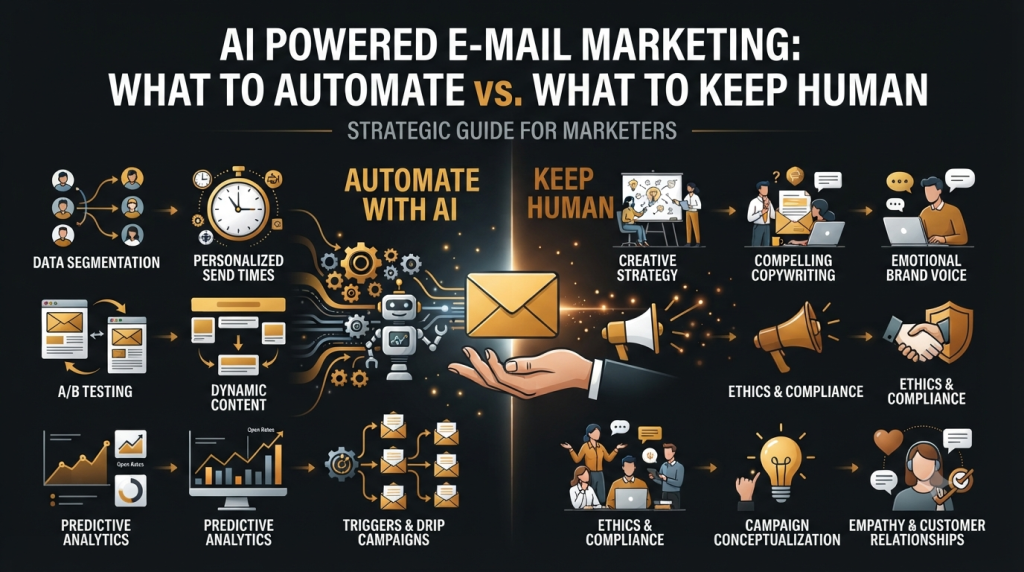
AI-Powered Email Marketing: What Should Marketers Automate — and What Should Stay Human? Every marketer knows the feeling. You open your email platform, stare at a blank campaign, and realize you need to segment 15,000 subscribers, write three subject line variants, schedule sends across four time zones, and somehow personalize it all — before lunch. The pressure to send more, personalize deeper, and optimize faster keeps growing. AI-powered email marketing promises relief. And in 2026, that promise is largely real: 87% of businesses using AI now apply it to email marketing workflows, and advanced adopters deploy campaigns 28% faster than early-stage teams. But here’s the tension. Forty percent of U.S. consumers say they would trust a retailer’s emails less if they knew AI had written them. Automating everything doesn’t just risk generic messaging — it risks eroding the very trust that makes email the highest-ROI channel most businesses have. The real question isn’t whether to use AI. It’s knowing exactly which tasks to hand over, which to keep human, and how to build a workflow where both sides make each other better. AI is reshaping how marketers build, send, and measure email campaigns. What Is AI-Powered Email Marketing? AI-powered email marketing means using artificial intelligence — from rule-based automation to machine learning and generative models — to plan, create, send, and analyze email campaigns. It’s not one thing. It’s a spectrum. Traditional email automation follows fixed rules: if a subscriber abandons a cart, wait two hours, then send a reminder. Predictive AI goes further by studying historical data to estimate who is likely to engage, churn, or purchase. Generative AI drafts subject lines, body copy, and even images from a prompt. AI-assisted optimization analyzes performance patterns and recommends adjustments — send times, audience segments, content variations. Consider a simple example. A clothing brand wants to recover abandoned carts. Traditional automation sends the same reminder email to everyone after 24 hours. An AI-assisted workflow, by contrast, analyzes each shopper’s browsing history, purchase frequency, and engagement patterns to decide whether to send a reminder, a product recommendation, or a small incentive — and at what time that specific person is most likely to open it. Klaviyo’s personalized send time feature works this way: AI delivers each message when the individual is most likely to open, click, and buy. The business benefit is measurable relevance. But AI outputs still depend on data quality, appropriate permissions, and human oversight. No platform’s AI can compensate for inaccurate CRM data, missing consent records, or a team that never reviews what goes out. Why AI Is Changing Email Marketing in 2026 The shift isn’t theoretical. Adoption is already mainstream. According to Litmus’s State of Email 2026 report, 28% of marketers have AI deeply integrated into their email workflows and another 34% use it regularly — only 5% aren’t using it at all. Meanwhile, 40% of marketers named expanded AI use among their top three email priorities for 2026. More relevant segmentation. AI now identifies customer groups using behavioral, transactional, and engagement data — not just demographics. You can spot high-intent prospects, at-risk subscribers, and loyal advocates without manually building dozens of filters. Behavioral personalization. Instead of inserting a first name and calling it personalization, AI can recommend products, content, and offers based on real behavior. Klaviyo’s next best product recommendations dynamically show unique products based on each customer’s recent purchase history. Automated customer journeys. AI-assisted workflows adapt on the fly. HubSpot’s Nurture Agent uses CRM data and live web research to rewrite subject lines, preview text, body copy, and CTAs for individual recipients at send time. Faster experimentation. Teams that once needed two weeks to produce a single email now ship campaigns in minutes using AI-powered platforms. Enterprises using AI-powered email tools achieve 70% faster timelines than traditional methods. Integration with CRM and e-commerce data. The real advantage comes when AI connects to your CRM, e-commerce platform, and behavioral tracking. ActiveCampaign’s Active Intelligence 3.0 now monitors your website for content changes and automatically drafts campaigns with that new content. The privacy imperative. With India’s DPDP Act, GDPR, and Google/Yahoo bulk sender requirements tightening, consent and data handling are no longer optional. AI can help you manage this — but only if humans set the rules. What Should Marketers Automate Using AI? A. Audience Segmentation AI can analyze behavioral, transactional, and engagement data to identify customer groups automatically — new subscribers, repeat buyers, inactive subscribers, high-intent prospects. What a human should review: Check for inaccurate assumptions, unfair profiling, and inappropriate use of sensitive data. Common mistake: Assuming AI segments are always accurate without validating against actual business outcomes. B. Routine Email Personalization AI can handle product recommendations, relevant content suggestions, lifecycle messages, and contextual offers at scale. What a human should review: The line between useful and intrusive personalization. A recommendation based on browsing history feels helpful; one that references a sensitive purchase feels invasive. Common mistake: Overpersonalizing using data customers didn’t expect you to use. C. Welcome Emails and Onboarding Sequences AI can automate welcome messages, introductory sequences, product education, and onboarding reminders. What a human should review: The initial brand messaging and strategic framing. The first email sets the relationship tone. Common mistake: Letting AI write the entire welcome sequence without human review — resulting in generic openings that fail to establish brand personality. D. Abandoned Cart and Behavioral Emails AI can trigger cart reminders, browse-related follow-ups, and post-purchase communications at optimal times. What a human should review: Consent, frequency limits, and relevance. Common mistake: Sending too many reminders without testing whether they actually recover carts — or annoy customers. E. Lead Nurturing and Lifecycle Workflows AI can support lead scoring, follow-up timing, educational sequences, and lifecycle communications. What a human should review: Predictive scores are estimates, not guarantees. A high score doesn’t mean someone will buy. Common mistake: Treating AI lead scores as definitive and deprioritizing prospects the model undervalues. F. Subject Line and Email Copy Variations Generative AI can produce initial drafts, alternative

Uncategorized

“Beyond Open Rates: The Email Marketing Metrics That Actually Matter in 2026”

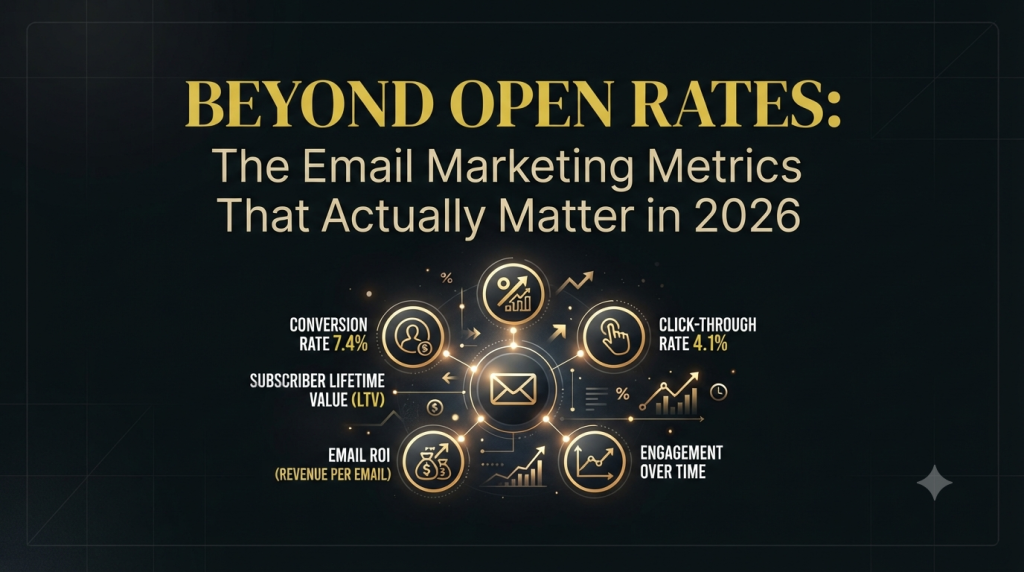
Beyond Open Rates: The Email Marketing Metrics That Actually Matter in 2026 An email being opened does not necessarily mean that it influenced a customer, generated a lead, produced a sale, or created business value. Modern email measurement should move from “Did someone open the email?” to “What happened because we sent the email?” Are Open Rates Still Relevant in 2026? Open rate measures the percentage of delivered emails that were opened. Historically, marketers relied on it because it was the first meaningful signal available in most email platforms, and it offered a quick read on subject lines and sender recognition. It can still be useful as a directional diagnostic metric—especially when you compare your own campaigns over time. But Apple Mail Privacy Protection has structurally inflated open rates since 2021. Apple Mail pre-fetches tracking pixels the moment an email lands, before a human has seen the subject line. Apple Mail accounts for roughly 47% of all email opens as of January 2026, based on 1.1 billion tracked opens. A campaign reporting a 50% open rate post-MPP might genuinely have a 25–30% human open rate. The distinction that matters: Open rate is a useful diagnostic metric for subject-line testing and send-time optimization. It is not a business outcome metric. It does not tell you whether anyone engaged with your content, clicked through, or converted. The Problem With Measuring Email Success by Opens Alone A high open rate does not automatically mean high engagement, more clicks, more leads, more sales, higher revenue, or better customer retention. It means a tracking pixel loaded. That is it. Consider two hypothetical campaigns: Campaign A: 50% open rate, 2% click rate, 0.3% conversion rate Campaign B: 35% open rate, 8% click rate, 4% conversion rate Campaign B may be significantly more valuable despite having a lower open rate. The people who did open were far more likely to engage, click, and convert. If those conversions are purchases, Campaign B could generate several times the revenue of Campaign A from the same list size. This is why the question needs to shift from “How many people opened?” to “What did they do next?” The Email Marketing Metrics That Actually Matter in 2026 1. Click-Through Rate (CTR) Formula: CTR = (Total Clicks ÷ Delivered Emails) × 100 CTR tells you what percentage of people who received the email actually clicked a link inside it. Unlike open rate, a click requires a deliberate human action. Someone had to read enough of the email to decide a link was worth their time. That decision carries far more weight than a tracking pixel loading automatically. In 2026, Klaviyo’s benchmark data shows a good email click rate is 1.69% for campaigns and 5.58% for flows. The gap between campaigns and flows is significant—it reflects the difference between sending to a broad list and sending to people based on a specific action or trigger they just took. Limitations: CTR can be inflated by bot clicks in some environments, and it does not tell you whether the click led to a meaningful action. Pair it with conversion data. 2. Click-to-Open Rate (CTOR) Formula: CTOR = (Unique Clicks ÷ Unique Opens) × 100 CTOR measures how effective your email content is at getting people who opened to click. It isolates the quality of your body copy, call-to-action, and offer from the subject line’s performance. MailerLite data suggests a good email click-to-open rate is 6.81%, meaning just under 7 in every 100 people who open go on to click a link inside. The GDMA Email Benchmark 2026 puts CTOR at 7.7%. Important caveat: Because CTOR uses opens in the denominator, it inherits the reliability problems of open tracking. If Apple MPP is inflating your open count, your CTOR will look artificially low. Use it as a relative comparison between your own campaigns, not as an absolute benchmark. 3. Conversion Rate Formula: Conversion Rate = (Conversions ÷ Delivered Emails or Clicks) × 100 A conversion is whatever action you defined as valuable: a purchase, a form submission, a demo booking, a registration, a download. The denominator matters—conversions per delivered email tells a different story than conversions per click. In 2026, email marketing conversion rates typically range from 1–5% across most industries, with rates above 3% considered good performance. Automated flows convert at 2.11% versus 0.16% for campaigns—a 13x advantage. Conversion rate is often more meaningful than open rate because it connects email activity to a tangible outcome. But it still does not tell you the value of that outcome. A 4% conversion rate on a $10 product is a very different business result than a 4% conversion rate on a $2,000 service. 4. Revenue Per Email Revenue per email divides the total revenue attributed to a campaign by the number of emails delivered. It gives you a direct monetary read on campaign efficiency. Example: A promotional campaign delivers 10,000 emails and generates $2,500 in revenue. Revenue per email = $0.25. If a product launch campaign delivers the same 10,000 emails and generates $8,000, revenue per email = $0.80. The second campaign is more than three times as efficient per send. Klaviyo’s 2026 benchmarks show top 10% email flows achieve revenue per recipient as high as $7.79, while average campaigns generate far less. This metric is especially useful for comparing campaigns of different sizes and identifying which offers, audiences, and send times produce the most value per contact. 5. Email Marketing ROI Formula: ROI = ((Revenue − Marketing Cost) ÷ Marketing Cost) × 100 Revenue is not the same as profit. Profit is not the same as ROI. ROI accounts for the cost of generating that revenue—platform fees, design costs, copywriting, list acquisition, and the labor involved in running the program. Sinch Mailgun’s 2026 Email Impact Report found that fewer than half of senders actively measure the ROI of their email programs. Among those who do measure promotional email ROI, 60% report returns greater than $10 for every $1 spent, and 13% report returns above $40:1.

Scroll to Top